
Most people think McDonald’s makes its money from selling burgers. The reality is more precise and considerably more interesting. McDonald’s is, at its structural core, a real estate company that happens to operate a global food franchise within its property portfolio.
Here is how it actually works.
McDonald’s Finds the Land, Builds the Restaurant. Basically Keeps Both.
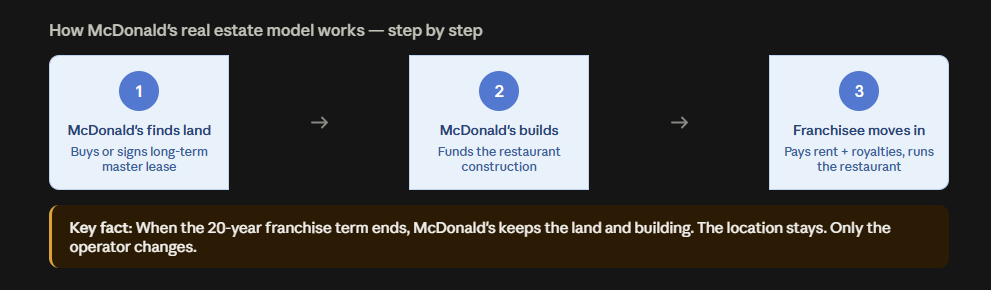
When a new McDonald’s restaurant is being planned, McDonald’s Corporation does the work that most people assume the franchisee does. It identifies the location. It acquires the land, either by purchasing it outright or by signing a long-term master lease with the existing property owner. It then builds or funds the construction of the restaurant on that site.
Once the restaurant is ready to operate, McDonald’s does not run it. It finds a franchisee, an independent business owner, and enters into a franchise agreement with them. The franchisee pays McDonald’s rent to occupy the building and operate the restaurant. The franchisee does not own the land. The franchisee does not own the building. They are, in the most straightforward terms, a tenant of McDonald’s Corporation who has additionally purchased the right to use the McDonald’s brand, menu, operating system, supply chain, and marketing infrastructure.
This arrangement is confirmed in McDonald’s own 10-Q filing with the US Securities and Exchange Commission, which states: “Under a conventional franchise arrangement, the Company generally owns or secures a long-term lease on the land and building and leases or subleases the property to the franchisee.”
What the Franchisee Pays
The franchisee’s payment to McDonald’s has two components, both of which flow directly to McDonald’s Corporation.
The first is rent. The franchisee pays McDonald’s a rent amount, typically calculated as a percentage of the restaurant’s gross sales with a guaranteed minimum floor. This payment continues for the life of the franchise agreement, which is typically 20 years. McDonald’s collects that rent whether the restaurant is having a good month or a difficult one, as long as the minimum threshold is met.
The second is royalties. On top of rent, the franchisee pays McDonald’s a royalty of approximately 4 to 5% of gross restaurant sales. Unlike the rent floor, royalties scale directly with performance. The more a franchisee sells, the more McDonald’s earns. This gives McDonald’s a commercial interest in the franchisee’s success, which is why the company invests in marketing campaigns, product development, supply chain infrastructure, and operational training that benefit franchisees across the entire system.
In Q1 2025, rent from franchised restaurants generated $2.31 billion for McDonald’s. Royalties generated a further $1.33 billion. Combined, those two income streams produced $3.66 billion out of McDonald’s total quarterly revenue of $5.96 billion, or approximately 61% of total revenue, from restaurants that McDonald’s does not staff, does not stock, and does not manage day-to-day.
What Happens When the Franchise Agreement Ends
The structural consequence of this arrangement becomes most apparent when a franchise term expires or when McDonald’s decides to reassign a location. Because McDonald’s owns or controls the long-term lease on the property, the physical site stays with McDonald’s regardless of what happens to the franchisee relationship. The franchisee who has been operating that restaurant for 20 years leaves. The building remains. McDonald’s finds a new franchisee and starts the arrangement again.
This is what makes McDonald’s real estate position different from that of a standard commercial landlord. The locations McDonald’s accumulated over decades of global expansion were selected not for generic commercial value but for their specific suitability as high-traffic, high-visibility restaurant sites. A McDonald’s at a major highway interchange, at the entrance to a large shopping centre, or at a prominent urban corner occupies commercial real estate that was acquired at historical prices and whose strategic value has compounded significantly over time. A competitor cannot simply replicate that position by building nearby. The location itself is part of what McDonald’s owns.
The Three Revenue Streams and Their Margins
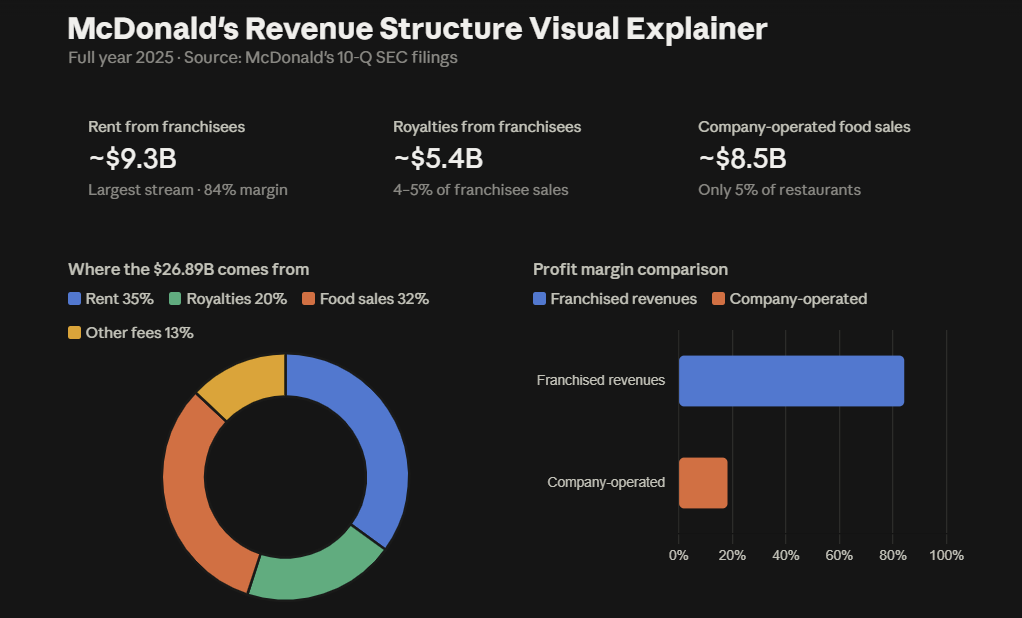
McDonald’s revenues fall into three categories confirmed in its SEC filings. Rent from franchised restaurants is the largest and highest-margin income stream. Royalties from franchised restaurants are the second. Company-operated restaurant sales, meaning actual food and beverage revenue from the small number of restaurants McDonald’s runs itself, are the third.
From its franchised revenues of $16.5 billion in 2025, McDonald’s generated approximately $13.9 billion in operating income, a margin of approximately 84%, according to analysis using McDonald’s Form 10-K data. From its company-operated restaurants, margins are significantly lower because every cost of running those restaurants, staff wages, food ingredients, utilities, maintenance, sits on McDonald’s own balance sheet rather than the franchisee’s.
This margin gap explains why McDonald’s has spent decades systematically reducing the proportion of restaurants it operates directly. In 2005, McDonald’s owned and operated approximately 32% of its restaurants. By 2025, that figure had fallen to approximately 5%. Each restaurant transferred from company ownership to franchise ownership converts a lower-margin food revenue stream into a higher-margin rent and royalty stream.
What McDonald’s Systemwide Sales Actually Are
McDonald’s reports a figure called systemwide sales, which exceeded $120 billion in 2024. That number represents the total amount of money customers spent at every McDonald’s restaurant on Earth, whether franchised or company-operated. It is not McDonald’s revenue. McDonald’s reported revenue for 2025 was $26.89 billion, which represents only the rent, royalties, fees, and direct food sales that flow to McDonald’s Corporation. The remainder of that $120 billion belongs to the franchisees who operate the restaurants and bear the costs of running them.
The gap between $120 billion in customer spending and $26.89 billion in corporate revenue is the most concise illustration of what McDonald’s business model actually is. The franchisees are running the restaurants. McDonald’s is collecting the rent.
The Structure in One Sentence
McDonald’s finds the land, builds the restaurant, rents the building to a franchisee who operates it under the McDonald’s brand and pays royalties on every sale, and retains the property when the franchise term ends.
The burger is why people walk through the door. The lease is why McDonald’s Corporation is worth approximately $220 billion.