A magazine ad that requires you to urinate on it to reveal a discount is not a concept that would survive a conventional creative review. IKEA Sweden and Åkestam Holst ran it anyway, in January 2018, in one of Sweden’s most widely read women’s magazines, and the response was overwhelming enough that Felix Östman from IKEA Sweden’s press department confirmed it publicly: “The reaction has been overwhelming, and inspired us to continue surprising and entertaining with the ‘where life happens’ campaign.”
The Mechanism
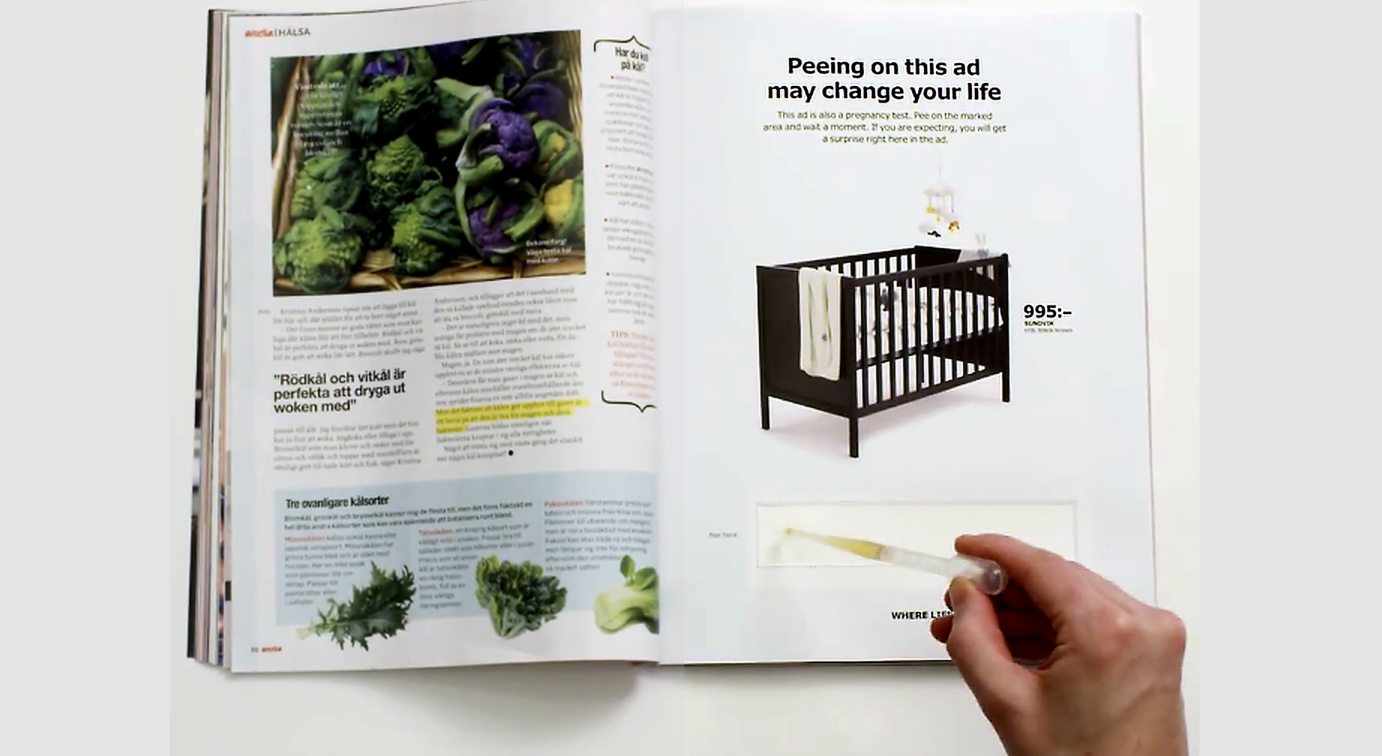
The ad ran in Amelia, one of Sweden’s most influential magazines for women, in a limited-edition print run. The full-page spread showed an image of IKEA’s Sundvik crib, priced at 995 Swedish krona, approximately $122. Below the crib image was a marked rectangular area accompanied by the instruction: “Pee on the marked area and wait a moment. If you are expecting, you will get a surprise right here in the ad.”
The surprise was a price. If the reader was pregnant, the page’s hidden ink revealed the crib’s discounted family price of 495 krona, approximately $61, a reduction of exactly 50%. The technology behind the reveal was developed by Mercene Labs, a Swedish startup specialising in surface-active materials for microfluidics and medical diagnostics, working in collaboration with Åkestam Holst.
The chemistry is the same that powers every home pregnancy test: antibodies embedded in the paper bind to the hCG hormone, human chorionic gonadotropin, present in the urine of pregnant women. The binding triggers a colour change. In a standard pregnancy test, that colour change produces a line or a plus sign. In the IKEA ad, it revealed a price. Åkestam Holst confirmed that the technical advancements made during the development of the campaign had potential applications in improving medical diagnostics more broadly.
The Campaign It Belongs To
The Pee Ad is an execution within IKEA’s broader “Where Life Happens” platform, a campaign strategy built around the real, unfiltered moments of domestic life rather than the aspirational version of home living most furniture advertising presents. Previous executions under the same platform had addressed divorce, single-parent households, and other realities of contemporary family life that most home brands prefer not to acknowledge.
The pregnancy test ad applies the same philosophy to a different life moment: the discovery of an unexpected or planned pregnancy, and the immediate, practical reality that follows. A crib is not an aspirational purchase. It is a necessity with a specific time pressure attached to it. IKEA’s decision to gate its discount behind a functional medical test rather than a loyalty card or a voucher code is the campaign’s structural precision. The offer was designed to reach exactly one audience: people who had just found out, in real time, that they needed the product being advertised.
The Targeting Logic
The campaign is built on a targeting argument that no digital programmatic platform could replicate. The discount unlocks when and only when the reader meets the single most directly relevant qualification for needing a crib: biological confirmation of pregnancy. The reader does not need to self-identify, apply, register, or claim. The chemistry does the verification.
That logic sits inside a broader conversation about how retailers identify and reach pregnant consumers. A 2012 New York Times Magazine article had sparked significant privacy debate by describing Target’s data-driven programme for predicting customer pregnancy based on purchasing behaviour. IKEA’s 2018 approach inverted the entire framework: rather than using data to deduce whether a consumer was pregnant, it simply asked the consumer to verify it themselves, in the most direct available format, with an immediate and proportional reward attached.
The Reaction
The ad generated global press coverage from publications including Adweek, Fortune, Global News, Today’s Parent, and Euronews, significantly extending its reach beyond the Swedish Amelia readership where the print run appeared. Social media discussion raised questions about the practicalities of redemption: whether customers were expected to bring a urine-soaked page into an IKEA store, and whether cashiers had been briefed on what to do when they arrived.
IKEA confirmed the ad was exclusive to Sweden and appeared in a limited edition of the magazine, not all copies. The mechanics of physical redemption were deliberately left ambiguous in the campaign’s public communications, which may itself have been a considered decision. The ambiguity generated additional discussion and extended the campaign’s news cycle beyond what a more procedurally precise execution would have achieved.
For a campaign that ran in a limited print edition of a single national magazine, the global media reach it generated made it one of the most cost-efficient advertising investments IKEA produced that year.
Campaign Name: IKEA Pee Ad / “Where Life Happens”
Agency Name: Åkestam Holst, Sweden / Technology partner: Mercene Labs
Brand Name: IKEA Sweden
Location: Sweden (Amelia magazine, limited edition; January 2018)