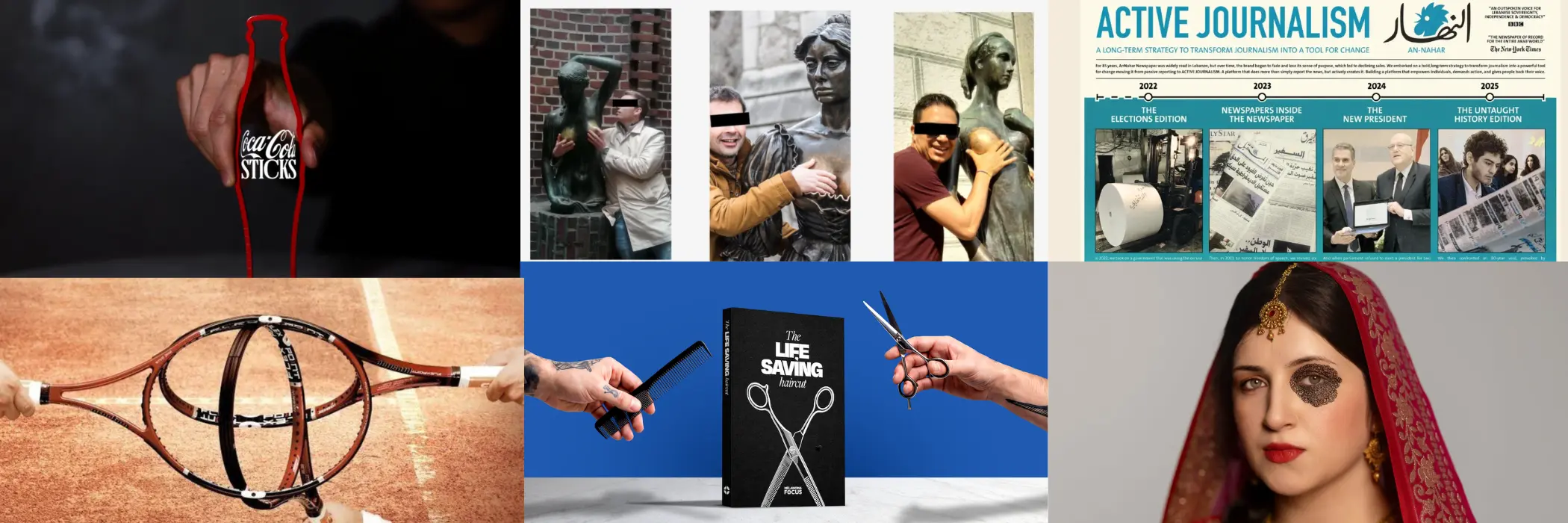
Melanoma Focus trained UK barbers to spot skin cancer on the scalp and neck, areas one in four melanoma cases in men occur, and almost no person can examine themselves. A free handbook developed pro bono gives barbers enough knowledge to start the conversation. The outcome is not a diagnosis. It is a GP appointment.
KFC Ukraine converted its worst-performing Kyiv location, days from permanent closure, into the world’s first fully vegetarian KFC. No announcement. No paid media. People queued. Influencers covered it for free. Menu items were resold online. The location became the best-performing restaurant in the entire KFC Ukraine network.
Toyota announced its Bulgarian Tennis Federation sponsorship with a single print ad: three tennis rackets arranged to form the Toyota logo. No copy. No tagline. Just one instant of recognition. The ad was made in 2008, resurfaced on Reddit in 2025, went viral again, and is still being shared seventeen years later.
UN Women Pakistan trained henna artists to deliver helpline information to brides during application. Three films showed bridal henna forming a black eye, strangulation marks, and a cut lip. The campaign generated a 24% rise in helpline awareness, a 19% spike in calls, and contributed to a domestic violence protection bill passing into law.
Women’s Aid embedded facial detection cameras into a billboard displaying a bruised woman’s face. When passers-by stopped and looked, her injuries began to heal in real time. The longer and the more people who stopped, the faster she recovered. Coverage ran across 20 countries and reached 326.9 million people from one screen in London.
OpenTable hung a towering restaurant receipt inside Melbourne Central, listing every act of unpaid maternal care from “carried you” to “loved you infinitely.” The total at the bottom read $0.00. The line followed: “You’ll never settle the bill. But you can pick up the next one this Mother’s Day.”
TERRE DES FEMMES placed a single placard next to three bronze statues in Munich, Berlin, and Bremen whose breasts had been worn visibly lighter by decades of repeated public groping. The sign read: “Sexual harassment leaves its mark.” Three days. Three placards. Gold at New York Festivals. Bronze at Cannes Lions.
Coca-Cola engineered a functional chopstick in the precise proportions and taper of the contour bottle and distributed it through restaurants, street food stalls, and delivery packaging across Southeast Asia. No advertisement required. The brand’s most recognisable shape ended up in diners’ hands before they opened the menu.
AnNahar donated its entire print run of ink and paper to fund Lebanese election ballots when the government cited shortages as a reason to cancel voting. It then built an AI President trained on 90 years of its own journalism when parliament failed to elect one for two years. The body of work won the D&AD White Pencil 2026.
The Times of India built a road sign outside Brioude mocking Burger King’s 258km distance from the nearest location. The Hindu responded with “Stay Ahead of the Times.” Seven years later, a reader published a matrimonial ad in Mumbai Mirror praising The Hindu and ending with the line: “They read their ads before they post them.” The war ended there.