Every child in South Korea is entitled to free vaccinations up to age 12. The care costs nothing. The system around it is built for Korean speakers, and most migrant families are not. The result is a gap that has nothing to do with money and everything to do with access: 96.4% of Korean children complete their essential vaccinations. Only 55.2% of migrant-background children do. CHOROGUSAN, a Korean NGO that has worked with children for 78 years, and Seoul agency Dminusone identified the one channel that reaches migrant parents regardless of language or origin: the grocery store receipt.
The Brief
South Korea’s migrant population has crossed five percent of the total population. An estimated 200,000 children from migrant families live in the country. Their parents navigate daily life in a language many do not read fluently. Healthcare communication in Korea, like most government systems, assumes Korean literacy. The gap between the right to free vaccinations and the ability to access them was not a funding problem. It was a communication problem sitting in plain sight, and it had not been solved because nobody had looked for it in the right place.
Research for the campaign identified where migrant parents actually go. Communities tend to settle by country of origin, which keeps daily radius small, but one place cuts across every community: the local grocery store stocked with halal food, Vietnamese spices, and other imported essentials from home. These shops had already become informal community hubs, trusted spaces where families could communicate in their own language. Dminusone treated that as a media insight.
The Mechanism
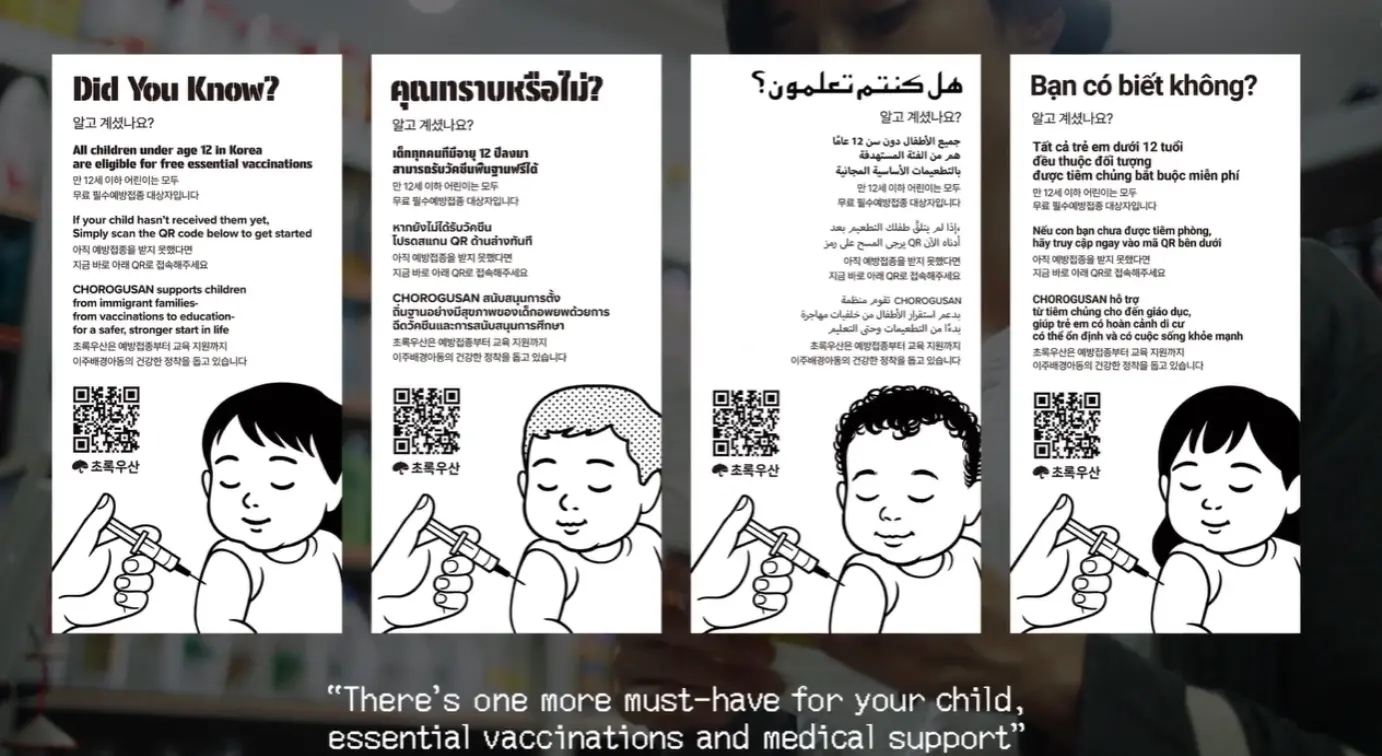
The team wrote a new receipt algorithm and installed it on existing point-of-sale terminals in grocery stores across migrant communities in Icheon, Gimpo, and Incheon. The system was designed to be triggered only by specific purchases. When a shopper bought childcare items, diapers, formula, or baby lotion, the receipt changed. A message printed at the bottom in the parent’s native language: there is one more essential item your baby needs. A QR code on the same slip linked directly to vaccination support, medical interpretation, and counselling services.
The targeting logic is precise. A parent buying diapers is a parent with a young child. That is the population most at risk of missing the early vaccination window. The receipt arrives at the moment of maximum relevance, in the hands of the exact person who needs it, in a language they can actually read, without requiring them to seek anything out.
What It Delivered
The campaign placed 70,000 receipts directly with migrant families across the participating stores. Eighty percent of migrant-background children who had previously missed medical care went on to receive checkups and vaccinations following the campaign. More than 1,000 institutions joined the effort, including 40 regional offices, 68 partner organisations, local supermarket chains, and a metropolitan city government. The campaign generated over 101.6 million impressions in Korea. Coverage spread to migrant families’ home countries through media outlets in Vietnam and Ukraine. The work reached Korea’s National Assembly, where it prompted a policy forum on healthcare access for migrant-background children.
At Spikes Asia 2026, The Life-Saving Receipt won a Bronze in the Media Channels category. The award is a secondary outcome. The primary one is documented in the vaccination records of 200,000 children who already had the right to care and now have the access to match it.
Why the Approach Is Replicable
The campaign required no new hardware. Every participating store already owned a receipt printer. The only structural addition was a modified algorithm and the partnership with store operators. The cost of the intervention is negligible compared to the cost of a child’s preventable illness. The mechanism scales to any country where migrant communities shop in culturally specific grocery stores, which is most countries. The receipt is already being printed. Dminusone changed what it said.
Campaign Name: The Life-Saving Receipt
Agency Name: Dminusone, Seoul, South Korea / Production: Episode Film
Brand Name: CHOROGUSAN (Korean children’s welfare organisation)
Location: Icheon, Gimpo, Incheon, South Korea