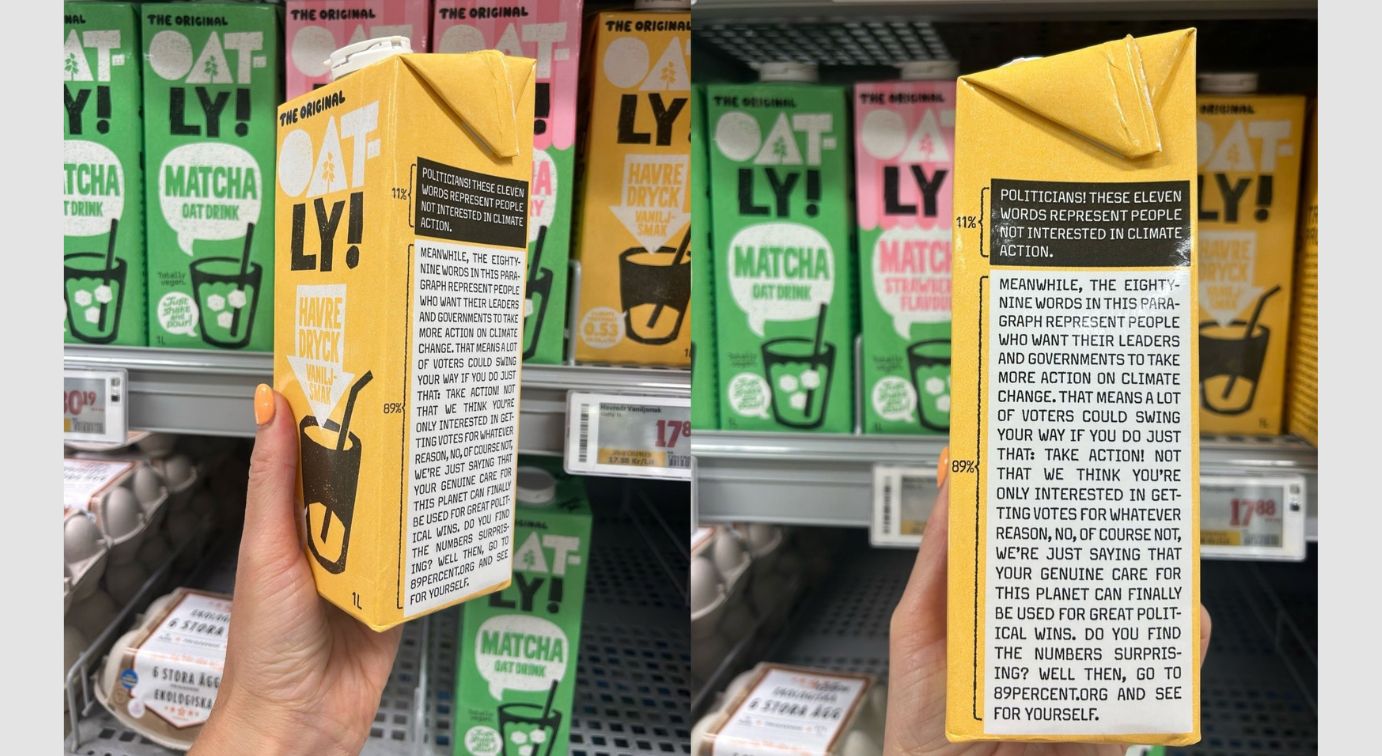
The side panel of an Oatly carton is not a conventional political medium. It holds around 100 words of space, typically used for nutritional information and brand messaging. In September 2026, Oatly used that space to address politicians directly, with a piece of visual mathematics that makes its argument before the reader has finished the first sentence.
The Carton
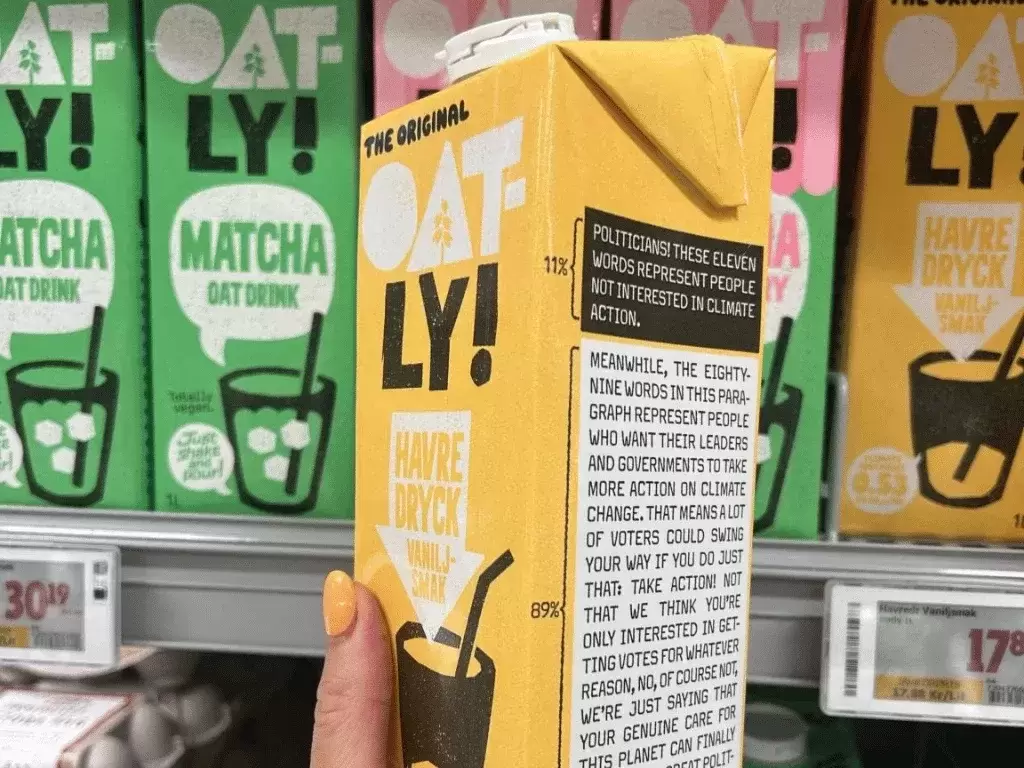
The message is split into two blocks of text, separated by nothing except the word count of each.
The first block reads: “Politicians! These eleven words represent people not interested in climate action.”
The second block runs to exactly 89 words. It reads: “Meanwhile, the eighty-nine words in this paragraph represent people who want their leaders and governments to take more action on climate change. That means a lot of voters could swing your way if you do just that: take action. Use your voice, use your vote, solutions exist, governments can enable and accelerate these solutions. Every election, every vote, every voice matters. The majority wants this and politicians who deliver for climate will win more than they lose.”
The visual argument is immediate and requires no statistical footnote to comprehend. The short block is small. The long block is large. The ratio between them is the campaign.
The Research Behind the Numbers
The campaign is tied to Covering Climate Now’s 89% Project, a global journalism collaboration launched in April 2025 involving The Guardian, Agence France-Presse, and dozens of other newsrooms. The project is built around a single finding from recent survey data: between 80 and 89% of citizens globally, depending on the country, want their governments to take stronger action on climate change. In the United States, that figure is 75%.
The 89 Percent Project’s founding premise is that these people do not know they are the majority. Climate action is routinely framed in public discourse as a contested, polarising issue. The coverage that follows from that framing gives the impression of an evenly divided public. The reality, the research confirms, is a large supermajority that has been consistently misrepresented as a fringe by the volume and nature of the media coverage surrounding the debate.
Caroline Reid, Senior Sustainability Director at Oatly, set out the reasoning in a LinkedIn post accompanying the campaign launch: “The facts are, around the globe, approximately 80 to 89% of citizens, depending on country, want their governments to take more climate action. It is not polarised nor partisan. With a summer fuelled by wildfires and drought, continued climate migration, soaring food prices, food insecurity and linear, fossil fuel driven supply chains being disrupted, we need governments to look up, listen to science and act.”
Why the Packaging Format Works
Oatly’s decision to use its own product packaging as the campaign medium rather than conventional advertising channels is the most structurally considered element of the activation.
Oatly reported selling 593 million litres of oat drink and related products across more than 40 countries in 2025. Every one of those cartons has a side panel. Every side panel that carries the 89% Project message reaches a consumer in a context where they are already engaged with the product, handling the carton, reading the information on it, standing in their kitchen or sitting at their breakfast table.
That context is different from a billboard, a social post, or a news article. It is intimate, habitual, and repeated across every purchase. A consumer who buys Oatly weekly encounters the message weekly, without any additional media spend required after the decision to print it.
The campaign launched in Sweden before expanding internationally, making it the first time Oatly has used its global packaging footprint as a dedicated political advocacy medium at this scale.
The Precedent and the Pattern
Oatly’s use of its packaging for climate advocacy is consistent with a broader brand strategy that has treated every surface the company controls as a potential communications channel for climate arguments. In 2025, the company became the first food and drink brand to qualify as a Climate Solutions Company under the Exponential Roadmap Initiative framework. It has added climate footprint figures to its product labelling, and it has used its own advertising space to run arguments that most food and drink brands would not go near.
The 89 Percent Project carton continues that approach but with a specific escalation: it does not communicate to consumers about Oatly’s own climate credentials. It communicates to politicians about what their voters actually want. The carton is not brand advertising. It is a message delivered through brand infrastructure to a political audience that the brand’s consumers are members of.
Activists affiliated with the 89% Project had previously projected the message “89% OF PEOPLE WANT CLIMATE ACTION” onto England’s white cliffs of Dover. A related Japanese campaign, running from April 2026 for two years, committed every television station and network in Japan to air public service commercials stating the same statistic. The Oatly carton is the consumer goods industry’s contribution to the same effort, printed across every carton in 40-plus countries.
Reid’s framing of the initiative’s purpose is precise: the goal is to “unlock the power of the 89% of people” who want governments to tackle the climate crisis. The unlocking mechanism is making those people aware that they are 89%.
Campaign Name: The 89% Project / Oatly Carton Campaign
Agency Name: Not mentioned / Partner: Covering Climate Now
Brand Name: Oatly
Location: Global (launched Sweden; international rollout across 40-plus countries; September 2026)