Movie captions have not meaningfully changed since the 1970s. White text. Static position. A functional transcript of dialogue, nothing more. For the approximately 466 million people worldwide living with disabling hearing loss, every film experience has been filtered through a system that conveys words but strips out the emotion, tone, humour, sarcasm, fear, and rhythm that those words are spoken with. FCB Chicago and the Chicago Hearing Society spent six years changing that.
The Problem With White Text
A caption that reads “I love you” looks identical whether the character is whispering it tenderly, shouting it across a crowded room, or saying it through tears. A caption that reads “Stop it” carries no information about whether it is playful or terrifying. The entire emotional architecture of film, carried by an actor’s voice, is absent from the text that appears at the bottom of the screen.
Bruno Mazzotti, Executive Creative Director at FCB Chicago, described growing up with two Deaf parents and watching captioned programming as his household’s default: “As someone who could hear, I could tell just how much was missing. Sarcasm, anger, joy, fear, all of it lost in plain white text. That experience stayed with me my whole life. This project was a chance to finally close that gap, not just for my parents, but for millions of people like them.”
The System
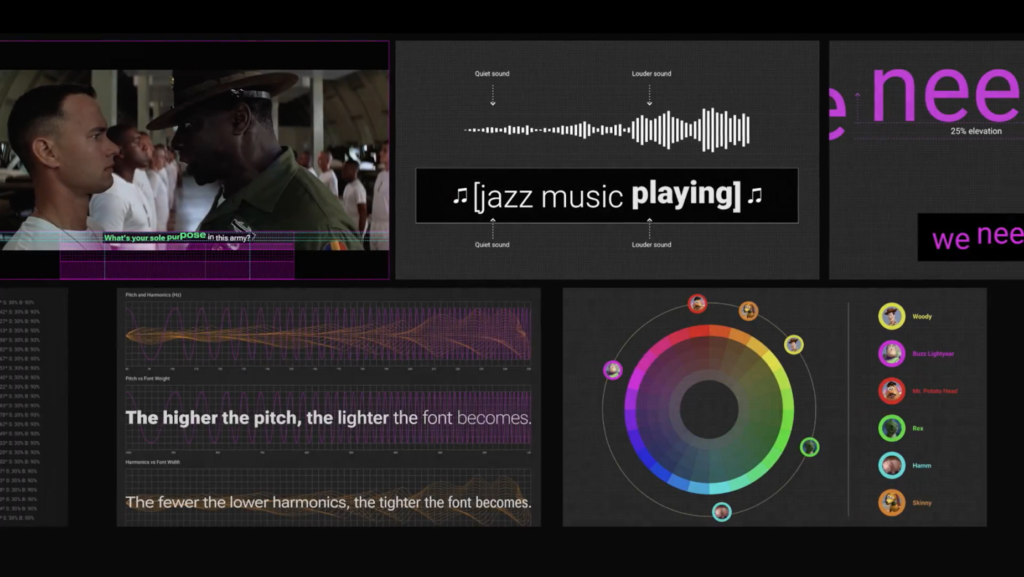
Caption with Intention is a new caption design system built over the course of nearly a year through close collaboration between FCB Chicago, the Chicago Hearing Society, and Rakish Entertainment, the production company founded by acclaimed director Marc Forster. Rather than replacing the white text with a different font or colour, the system reimagines captions as a fully responsive design language.
Word-by-word synchronisation means the caption tracks dialogue in real time rather than presenting whole sentences ahead of the words being spoken. Expressive typography changes to reflect tone, volume, and timbre: a whisper appears in smaller, lighter text; a shout arrives in bold, larger characters; a trembling voice is rendered in italic or unsteady letterforms. Colour-coded character attribution assigns each speaker a distinct visual identity so that dialogue between multiple characters is immediately and intuitively readable without the viewer losing track of who is speaking. Animation ties the caption’s appearance to the emotional pacing of the scene rather than presenting text in static blocks.
The system was developed through dozens of prototype variations tested against iconic film scenes, refined through in-person workshops and remote feedback sessions with a diverse group of Deaf and Hard of Hearing people across the full year of development. Karla Giese, Coordinator of Training and Education at the Chicago Hearing Society, described what that process produced: “Centering Deaf perspectives was essential to ensuring the authenticity of this new caption design system. We brought together a diverse group of Deaf and Hard of Hearing people whose lived experiences and expertise guided the team in shaping a system designed to serve our community and beyond.”
So A Ryu, the Hard of Hearing designer who led the visual design system, described the philosophy behind the work: “Accessibility isn’t just about delivering information. It’s about delivering the full creative expression. This project brought that belief to life to deliver a total cinematic experience.”
The Oscar
Marc Forster, as an Academy member, played a pivotal role in introducing the Caption with Intention system and the team behind it to Academy leadership. On April 29, 2025, the Academy of Motion Picture Arts and Sciences presented FCB Chicago, the Chicago Hearing Society, and their collaborators with an Award of Merit, an Oscar statuette, at its Scientific and Technical Awards ceremony. The award specifically recognised those “who have developed and supported captioning technology, whether open or closed, for film.”
More significantly, the Academy adopted Caption with Intention as the official captioning standard for all films submitted for Oscar consideration going forward, meaning the system’s influence is now embedded into the foundational requirements of the industry’s most prestigious annual competition. Every film seeking Academy Award consideration must now meet the standard that FCB Chicago and the Chicago Hearing Society built together.
The Cannes Recognition
At Cannes Lions 2025, Caption with Intention won two Grand Prix, the Design Lions Grand Prix and the Digital Craft Lions Grand Prix, making it one of the most broadly recognised accessibility projects in advertising history. From 1,087 entries judged in Design, 33 Lions were awarded. The Grand Prix went to Caption with Intention.
Design Lions Jury President Jessica Walsh, founder and creative director of &Walsh, delivered the citation with precision: “This Grand Prix winner excelled as it masterfully married strong design with a greater idea and purpose. For over 50 years, captions for film and TV have been largely unchanged, designed to be solely functional. Caption with Intention is a design system that brings emotion, depth and context into the caption experience.”
The system also swept the 2025 Clio Entertainment Awards, earning Grand Awards in Theatrical Innovation, Public Relations, and Design, and continued to accumulate recognition, including national ADDY honours in 2026.
The Open Source Decision
Caption with Intention is freely available. The system has been released as open source, meaning any studio, production company, or streaming platform anywhere in the world can adopt it without a licensing fee. The decision to release it publicly rather than commercially is the same logic that drove Cemento Sol’s open-source Sightwalks tile design and Mastercard’s open Touch Card standard: if the goal is to change an industry-wide practice rather than generate revenue from the solution, the only path is to make the solution as easy to adopt as possible.
Andrés Ordóñez, Global CCO at FCB, described the project’s underlying conviction: “Caption with Intention was born from a belief that even the smallest details, like captions, hold the power to connect, include, and move people. This project is proof that creativity, when led by empathy, can spark lasting change. Because true inclusion isn’t just about being heard. It’s about being understood.”
Campaign Name: Caption with Intention
Agency Name: FCB Chicago / Creative partner: Rakish Entertainment (Director Marc Forster) / Organisation: Chicago Hearing Society / Academy of Motion Picture Arts and Sciences
Brand Name: Chicago Hearing Society / Academy of Motion Picture Arts and Sciences
Location: United States (global adoption via open-source release)