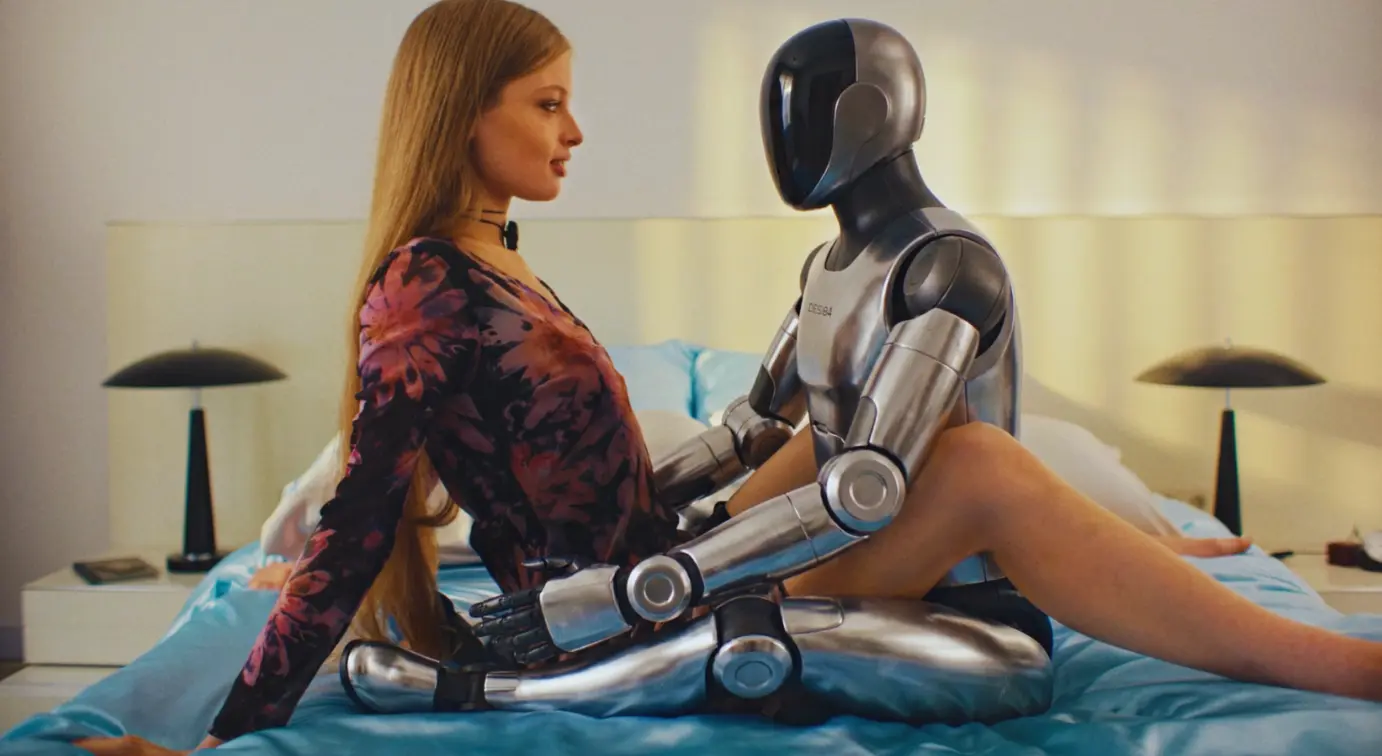
The casting decision for Desigual’s FW26 campaign is either the most calculated move in fashion advertising this season or the most elegantly simple one. Vivian Jenna Wilson, a 22-year-old LA-based model, social media personality, and the estranged daughter of Elon Musk, stands opposite a malfunctioning humanoid robot that bears more than a passing resemblance to the Tesla Optimus. She walks it on a leash. She uses it as a golf tee. She tries to teach it to say “Desigual.” Eventually the machine starts banging its head against a wall. “He was designed to obey,” Wilson says. “Not me.”
The Film
Born to Disobey was directed by PSG, a newly formed directorial trio at ProdCo, comprising Yukihiro “Sho” Shoda, Pau López, and Gerardo del Hierro, formerly known as TURBO. The campaign’s creative direction came from Desigual’s own team, led by Alexandra Sanhueza and Esther Escudero. The film marks PSG’s first project as a trio.
The film opens with Wilson lounging in a “Born to Disobey” T-shirt, reading Karel Čapek’s R.U.R., the 1920 play credited with introducing the word “robot” into popular language. The prop is not accidental. What follows is a series of scenes placing Wilson in deliberately absurd situations with DESI84, the campaign’s robot, whose name references the year Desigual was founded in Barcelona. Each scene tests a different limit of the machine’s programming. Each time, Wilson is the problem the machine cannot solve.
PSG described the appeal of the brief with a characteristic piece of wit: “In a world where everyone worries about AI taking human jobs, we did the exact opposite: we actually stole a job from a robot by hiring a human actor to play it.” The directors said they were “instantly hooked” when the campaign was first outlined to them, with phrases like “Vivian Wilson” and “mistreating a robot” capturing their attention before the treatment was written.
The Layers the Casting Creates
Desigual and Wilson do not explicitly describe DESI84 as a Tesla Optimus parody. They do not need to. The robot’s visual language, the context of Wilson’s public estrangement from her father, her documented criticism of AI’s impact on creative workers, and Musk’s centrality to both Tesla and xAI create a set of associations that the audience brings to the screen without prompting. The film works as a fashion campaign. It also works as a comment on automation, creative displacement, and the specific dynamic between a father who builds humanoid robots and a daughter who publicly refuses to belong to his world.
Wilson has been vocal about AI’s impact on artists, photographers, and other creative workers, arguing that automated systems risk displacing the people whose labour the industry depends on. Desigual’s campaign gives her that argument a visual form: a robot that cannot do what she does, cannot learn what she teaches it, and ultimately fails in every interaction the film stages for it.
Reel 360, which named Born to Disobey its Ad of the Week, described the casting’s structural advantage precisely: “That is good casting. Not because Wilson is merely famous, but because who she is changes how the concept reads.”
The Brand Logic
Desigual was founded in Barcelona in 1984, built on a philosophy it describes as “no es lo mismo,” or “it’s not the same.” The brand has historically positioned itself around nonconformity, eccentricity, and the refusal of sameness. Born to Disobey updates that philosophy for 2026, placing it in direct tension with the moment the fashion and creative industries are navigating: a world shaped by automation, AI-generated content, and the pressure on individuals to conform to systems that are increasingly designed to predict and absorb them.
The campaign’s press release described its intention with the kind of clarity that fashion campaigns rarely achieve: “The greatest rebellion is no longer about fighting against the system but about refusing to be part of it. When everything invites you to obey, the answer is attitude, irony and the freedom to be yourself.”
Wilson sports the “Born to Disobey” T-shirt throughout the film, which also functions as the campaign’s primary retail product. The message moves from the film’s argument into something a customer wears. The FW26 collection itself extends the campaign’s visual identity through reconstructed denim, contrasting proportions, botanical prints, and an emphasis on red.
The Broader Context
Born to Disobey arrives in the same month as an Anthropic researcher’s widely reported statement that AI could kill all humans within a decade, and at a moment when fashion’s relationship with technology has become one of its most contested creative territories. Earlier in 2026, a digital camouflage shirt was designed specifically to vanish from surveillance cameras. Drones replaced models on Dolce and Gabbana’s catwalk in 2018. The creative pushback against automation that Desigual’s campaign embodies is not an isolated brand statement. It is a cultural direction that multiple industries are navigating simultaneously.
What Desigual and PSG produced is a fashion campaign that says something specific about that direction, using the tools of the category, the film, the model, the clothing, to make an argument the audience does not need to be told it is receiving. The robot bangs its head against the wall. Wilson walks out wearing Desigual. The point lands before the credits.
Campaign Name: Born to Disobey
Agency Name: Desigual in-house / Creative Directors: Alexandra Sanhueza and Esther Escudero / Production: ProdCo / Directors: PSG (Yukihiro “Sho” Shoda, Pau López, Gerardo del Hierro) / Production Company: ProdCo x Contrario
Brand Name: Desigual
Location: Spain (global digital and social media distribution; September 2026)