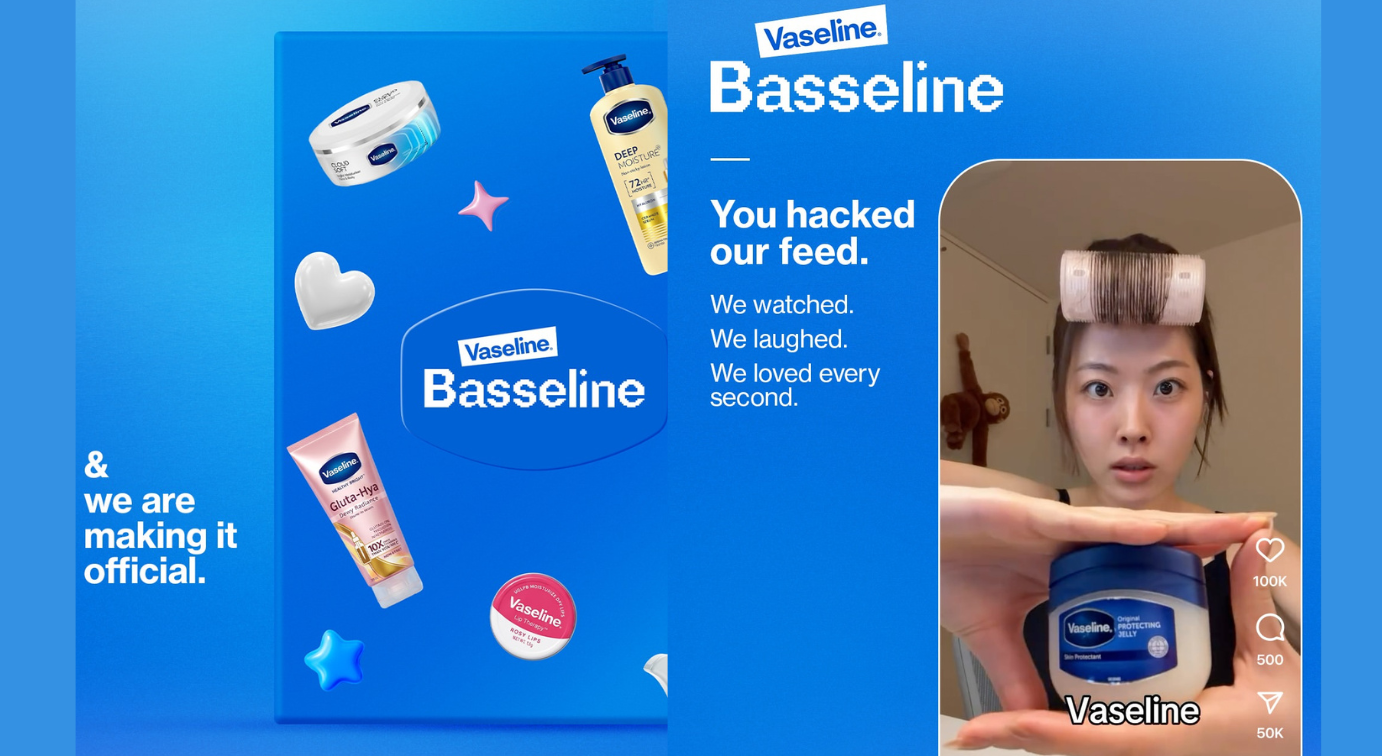
On an ordinary Tuesday in the last week of August 2026, Seoul-based beauty content creator Min Day Lee uploaded a short Instagram video showing off her skincare collection. The video was cheerful, enthusiastic, and entirely ordinary, right up until the point where viewers noticed she was calling one of the world’s most recognisable skincare brands by a slightly different name for its entire duration.
“Dry lip Baseline, dry hands Baseline, ashy elbow Baseline, rough heels Baseline.”
Vaseline had been Vaseline for 156 years. For approximately 38 million people watching in the last week of August 2026, it was now Baseline.
Why “Baseline”
The pronunciation is not a random mistake. Korean does not have a native “V” sound. English words containing the letter V are adapted when absorbed into Korean speech, with the V sound replaced by something closer to a B. Vitamin becomes bitamin. Vaseline becomes Baseline, or in some regional variations, Baserin. It is a documented and consistent feature of Korean phonology rather than an individual error, which is why millions of Korean viewers immediately understood and recognised what Lee was doing when they saw the video.
Lee, who posts under the Instagram handle @mindaylee_, was not performing a joke. She was speaking naturally. The video’s comedy, from the perspective of the 38 million people who watched it, came from the gap between how well she clearly knew and loved the product and how differently the name landed on non-Korean ears. The affection was genuine. The pronunciation was simply Korean.
The Brand’s Response
Vaseline and its parent company Unilever chose not to correct the video. They chose the opposite.
Within days of the video going viral, Vaseline changed its social media display name to “Baseline” across its global accounts. It replaced its profile picture with a “Baseline” logo. It shared Lee’s original video with its own followers. It released a mock official statement announcing the rebrand: “same tub, same jelly.” It described Lee as a “Hijack Icon,” writing directly on one of its posts: “You hacked our feed. We watched. We laughed. We loved every second.”
Then it appointed her CEO of Baseline. Her stated qualification: no interview required.
Vaseline’s Indian account encouraged users to create their own “Baseline” content and tag the brand, extending the campaign beyond a reactive social media moment into an active UGC invitation. Regional accounts across the globe, including Vaseline UK and Vaseline Bangladesh, temporarily changed their profile icons and shared mock-ups of redesigned “Baseline” packaging. The joke became an open invitation. The audience that had created the cultural moment was handed the tools to keep it running.
Why the Response Worked
Vaseline’s decision to embrace the meme rather than distance itself from it is worth understanding as a commercial decision rather than simply a likable one.
The video generated 38 million views organically before Vaseline responded at all. Those views were produced by a single creator sharing a genuine moment from her own life. Vaseline did not commission the content. It did not brief an agency. It did not identify a cultural insight and build an execution around it. The audience created the cultural moment entirely without the brand’s involvement.
What Vaseline’s response did was extend the cycle. By changing its display name and appointing Lee as CEO, it gave everyone who had already seen the video a new thing to react to, which produced another round of posts, another wave of attention, and another set of eyes on the brand, regardless of which letter its name started with. Each step in the brand’s response, the name change, the CEO announcement, the packaging mock-ups, the UGC challenge, was calibrated to produce a new piece of content from the audience that had already proved it was willing to create content for free.
The fashion and beauty marketing publication Fashion Times described the strategic calculation precisely: “The move is particularly effective because it allows the brand to participate in the conversation without trying to manufacture the original joke itself.”
The Brand It Happened To
Vaseline was first distributed by Robert Chesebrough in the United States in 1870, making it one of the oldest continuously sold consumer products in the world. It is now present in more than 70 countries. In Unilever’s 2026 reporting, the company highlighted Vaseline as a 150-year-old brand that had been combining science and culture in its communications under the leadership of Ogilvy Singapore’s Vaseline Verified platform, which had itself won two Grand Prix at Cannes Lions 2025 by building a verification programme for creator-generated skincare hacks.
The Baseline moment is not a departure from that direction. It is the same strategy at a different speed. Vaseline Verified took months to develop. The Baseline response took days. Both begin from the same position: find what creators are already doing with the product, validate it, and give it more room to run.
For a 156-year-old product sold in a jar that has not fundamentally changed since the 1870s, the ability to move at creator speed in August 2026 is not a trivial achievement. It requires an internal team willing to make a decision quickly, a social media presence with the tone and permissions to execute it, and a brand whose identity is secure enough to absorb a joke without feeling diminished by it.
Vaseline’s name is still Vaseline. Its new CEO has no responsibilities. But 38 million people watched a video about it this week who might not have thought about the brand at all. That is what creator-led marketing looks like when a brand gets it right.
Campaign Name: Baseline / Vaseline Originals
Agency Name: Not mentioned (Unilever in-house social response)
Brand Name: Vaseline / Unilever
Location: Global (social media; creator origin in South Korea; August 2026)