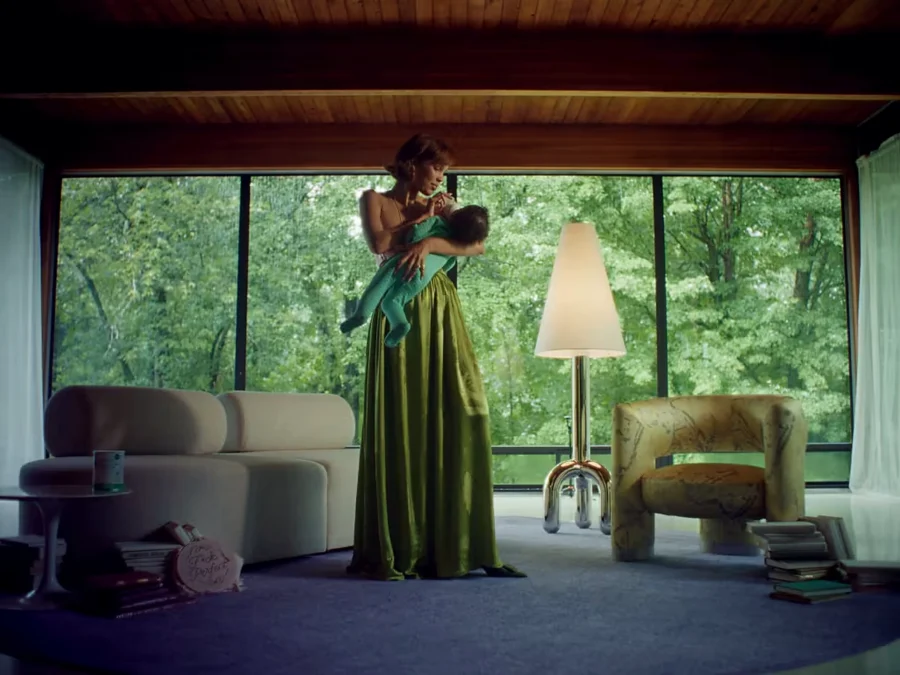
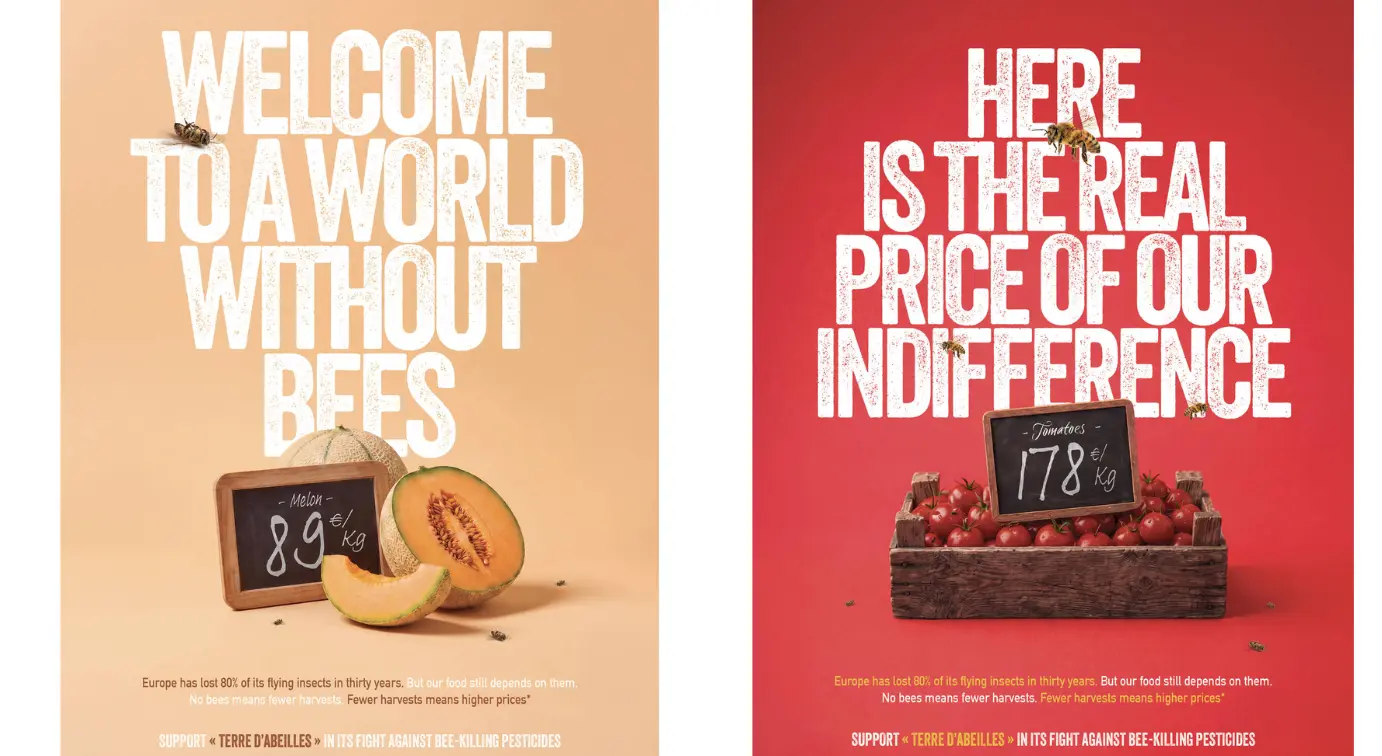
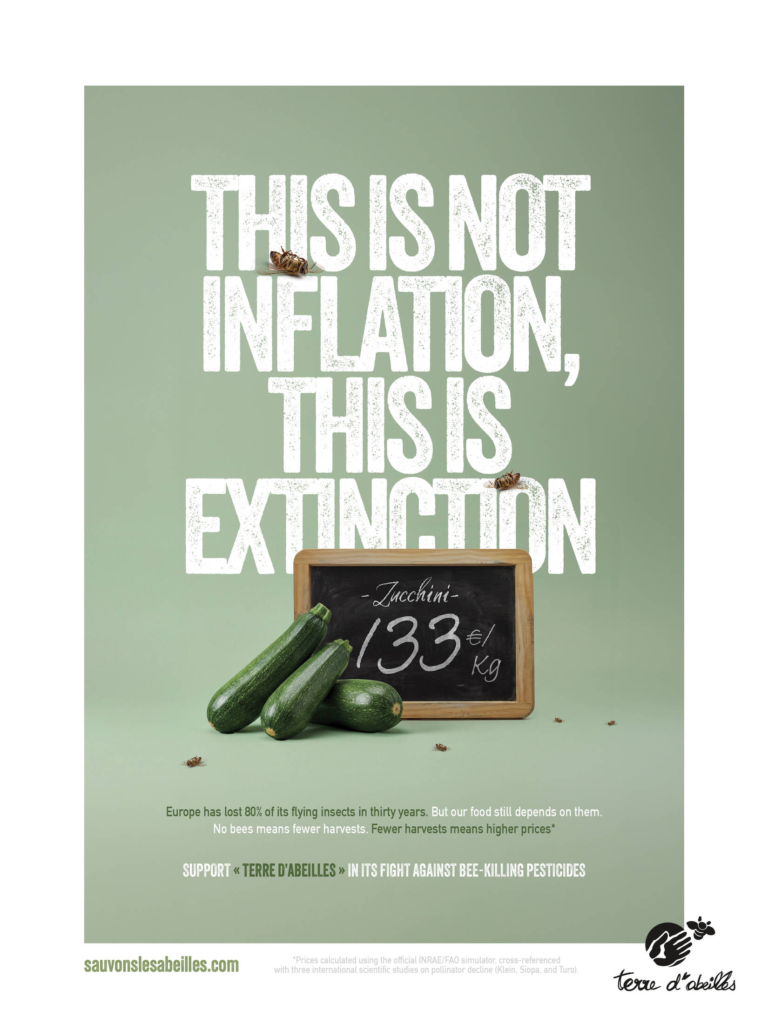
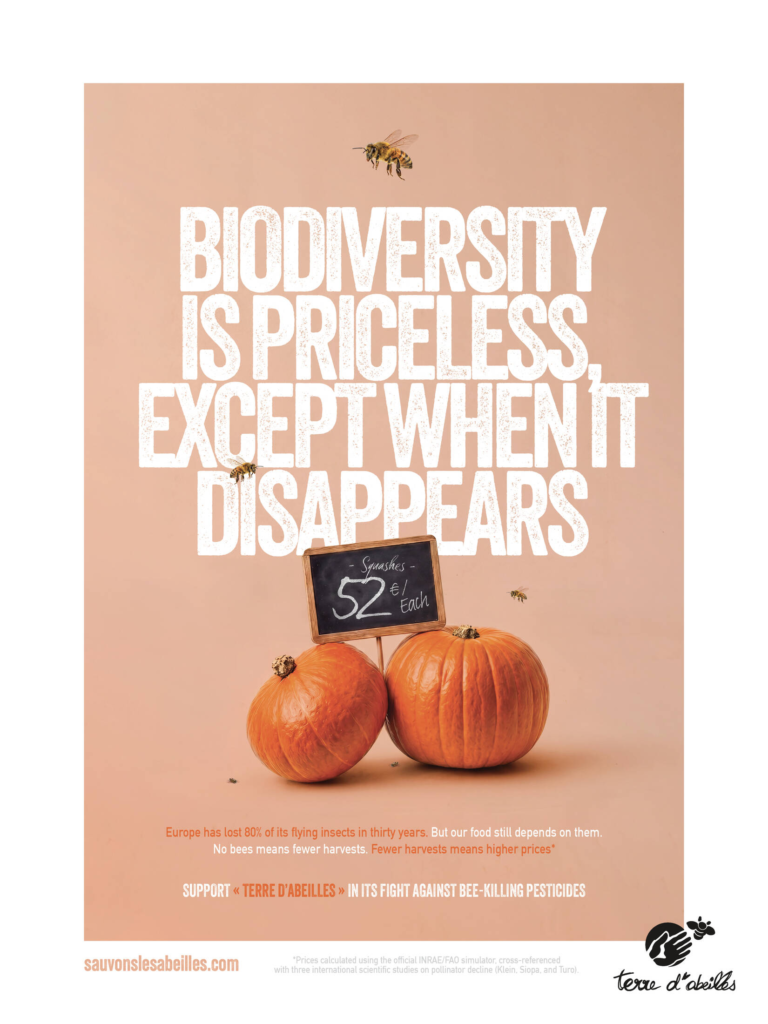
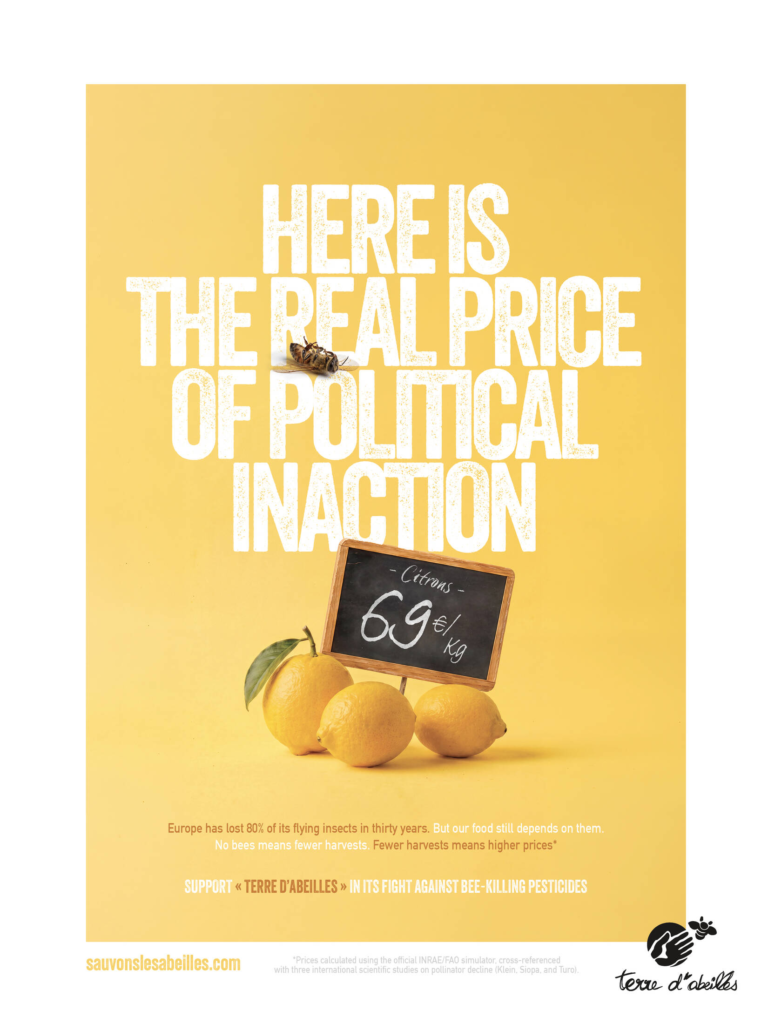
On a single day in Chauvigny, a market town in the heart of France, shoppers arrived to find something had gone wrong with the prices. Tomatoes: €180 per kilo. Cucumbers: €30 each. A punnet of strawberries: €120. Courgettes: €233 per kilo. A melon: €89. Every price on every stall had been multiplied by fifteen. The stallholders had not made an error. Terre d’Abeilles and TBWA Paris had made a point.
The Calculation Behind the Prices
The numbers are not invented for dramatic effect. They are derived from cross-referenced data produced by the INRAE simulator, France’s national agricultural research institute, validated against three independent international scientific studies by Klein, Siopa, and Turo. The methodology asks a specific and answerable question: if insect pollinators were removed from the food system entirely, what would the resulting scarcity do to the price of the food we currently buy?
The answer, applied to everyday produce at a French market, is that food becomes an unaffordable luxury for most of the population. The fifteen-times multiplier is not a worst-case projection. It is the calculated consequence of a system that has been losing its pollinators at a rate that makes the question urgent rather than hypothetical.
Each year in France, nearly one-third of honeybee colonies are wiped out or severely weakened. The most recent IUCN Red List update, published in October 2025, confirmed that 10% of European wild bee species are now threatened with extinction, a 123% increase in that category in just a decade.
Why Chauvigny and Why a Market
The market format was chosen because it is the setting where the abstraction of environmental data becomes a personal financial reality. Discussing pollinator collapse in academic or policy terms has produced decades of documentation and minimal behavioural change. Presenting the same information as a price list to someone standing at a market stall with a basket and a budget produces a different kind of comprehension.
Chauvigny was selected as a location representative of everyday French life rather than a metropolitan or institutional environment. The campaign was not addressed to policymakers or environmental professionals. It was addressed to the shopper who already feels squeezed by rising fuel costs and grocery bills and does not yet understand that the disappearance of bees is connected to the same household financial pressure they are already managing.
Terre d’Abeilles, the campaign’s client, exists specifically to advocate for the protection of honeybees and wild pollinators in the context of France’s ongoing debate about the authorisation of pesticide use. As that debate intensifies at a regulatory level, the organisation identified a gap in public understanding that environmental advocacy had not yet closed: most people know abstractly that bees matter, but do not feel that their absence has anything to do with the cost of living.
The Chauvigny market intervention addressed that gap in the most direct available format: by showing the price tag on the problem rather than describing the problem.
The Campaign Film
The activation was documented in a film directed by Mehdi Manser through production company Else, distributed across digital and social channels. The film captures real shoppers encountering the inflated prices in real time, their reactions ranging from disbelief to anger to something quieter when the reason for the prices is explained. The campaign was submitted to Ads of the World in June 2026 as a Film and Integrated submission, representing Terre d’Abeilles’ most widely distributed creative work to date.
Faustin Claverie, Executive Creative Director at TBWA Paris, built the campaign around a reframe that the organisation had not previously attempted: positioning the bee crisis not as an environmental emergency alone, but as the greatest threat to household purchasing power that most French families have not yet connected to what is happening in their gardens and fields.
The Number That Carries Everything
72.2% of crops grown for human consumption depend, to varying degrees, on insect pollinators. Less pollination means lower yields. Lower yields mean scarcer production. Scarcer production means increased pressure on agricultural markets. Increased pressure means higher prices. The chain from a declining bee population to a €180 tomato is not a metaphor. It is arithmetic.
The Chauvigny market made that arithmetic visible to the people standing in front of it, in the format they encounter every week, at the moment when the number on a price tag is the most real and least abstract thing in the world.
Campaign Name: The Price of a World Without Bees
Agency Name: TBWA\Paris / Production: Else / Director: Mehdi Manser
Brand Name: Terre d’Abeilles
Location: Chauvigny, France (national digital and social distribution)