McDonald’s became the official regional sponsor of Formula 1 in Latin America without a clear answer to the most important question a new sports sponsor faces: how do you activate a sponsorship in a way that no other brand has done before? Every consumer goods company that has ever sponsored a racing team has used the same toolkit: logo on the car, face on the driver, product in the hospitality suite. McDonald’s looked at 24 Formula 1 circuits instead, and found that its own logo had been hiding in the corners of every one of them.
The Insight
A Formula 1 circuit is not a straight line. It is a series of curves, chicanes, and complex corner combinations, each one unique to its location, each one traced in tarmac through a specific geometry. TBWA Colombia analysed all 24 circuits on the 2025-2026 calendar and found something that nobody at McDonald’s had previously noticed. Within the curves of every circuit, somewhere on every track, there was a combination of turns that traced the approximate shape of the Golden Arches.
McDonald’s had never been part of Formula 1. But its iconic logo had always been present, hidden in the geometry of every track. That observation was the brief. The Golden Zone was the response.
How the Mechanic Worked
TBWA Colombia mapped the specific section of each circuit where the track most closely followed the shape of the Golden Arches. That section became the Golden Zone for that race. During the Grand Prix, McDonald’s monitored the race leader’s position in real time. The moment the leader entered the Golden Zone on any given lap, McDonald’s triggered an exclusive, time-limited offer that appeared immediately in the McDonald’s app for fans watching the race.
The offers lasted only for the seconds it took the race leader to cross the Golden Zone. Fans watching the race, knowing the Golden Zone’s location on the circuit, could anticipate when the next offer would drop. Every lap brought another opportunity. The race became a game played alongside the sporting event, with McDonald’s app engagement mapped directly onto the tension and timing of Formula 1 competition.
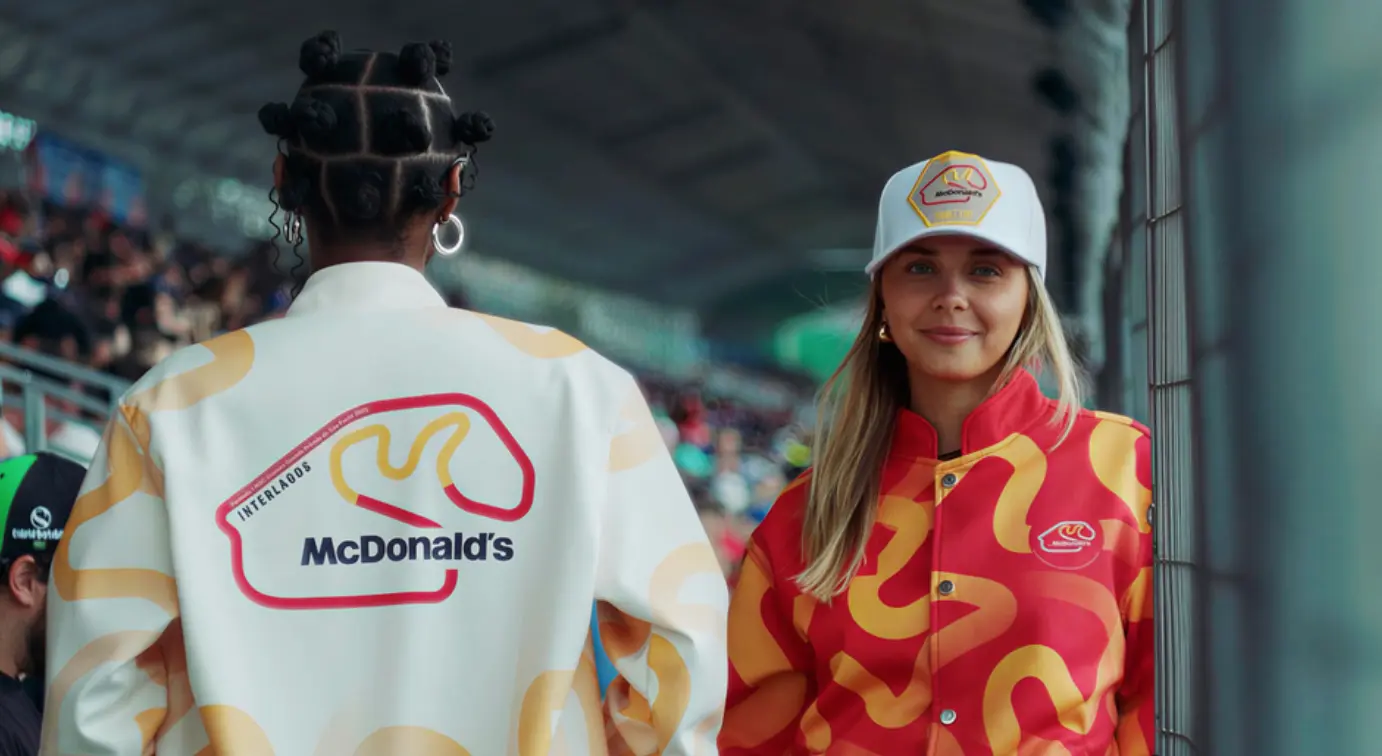
The offers varied by market. Each circuit had its own distinct Golden Zone shape, which became the visual identity for that race’s campaign materials, its merchandise, its app graphics, and its social content. Twenty-four circuits produced twenty-four distinct Golden Zone shapes, twenty-four visual systems, and twenty-four sets of exclusive merchandise that fans could unlock or win by engaging with the campaign during the race.
The Commercial Results
The Golden Zone drove a 7% incremental increase in daily sales during race days, concentrated into the two-hour window of the Grand Prix itself. McDonald’s app downloads reached 2.7 million in November 2025, growing 42% compared to the same period in the prior year. Active users during race periods increased significantly across the markets where the campaign ran.
The campaign launched at the Interlagos circuit in São Paulo for the Brazilian Grand Prix, McDonald’s first-ever in-app sponsorship integration at a Formula 1 event. It subsequently ran across seven races between 2025 and 2026, with full rollout planned for the complete 2026 season.
Santiago Blanco, Chief Marketing and Digital Officer at Arcos Dorados, which operates McDonald’s across Latin America, described the campaign’s founding logic: “It’s all about fan engagement. Formula 1 fans today know that true excitement during a race comes from following the action turn after turn. That insight unlocked a marketing idea that connects our two worlds: the thrill of the sport and the family experiences that McDonald’s turns into delicious moments.”
John Raúl Forero, President of TBWA Colombia, described the creative platform’s broader commercial potential: “This campaign demonstrates the power of iconic storytelling in advertising, supported by a solid visual system and the opportunity to activate across multiple McDonald’s markets throughout the F1 season, connecting fans directly with a seamless digital experience and meaningful ecommerce moments.”
What the Campaign Changed About Sponsorship
Formula 1 sponsorship has historically been about visibility at the event and on the broadcast. A logo on a car travels through every camera angle across a two-hour race. A logo on a helmet appears in every podium photograph. Both deliver impressions to a passive audience.
The Golden Zone changed the relationship between sponsorship and audience behaviour. Every person who opened the McDonald’s app during a Grand Prix was not passively receiving a brand impression. They were actively participating in a time-sensitive commercial transaction tied to the race’s live action. The sponsor was not in the background of the television feed. It was in the phone in the viewer’s hand, responding in real time to what was happening on track.
TBWA Colombia described the design intention precisely: “This mechanic was designed to shift behaviour from passive viewing to active participation, driving repeated app engagement and purchase. By tying every activation to real-time experiences, it delivered immediate commercial impact.”
The Golden Arches had been on every Formula 1 circuit for decades, hidden in the geometry of the corners. It took a Colombian creative agency and a regional sponsorship deal to notice them, name them, and turn them into one of the most commercially effective sports sponsorship activations in the competition’s history.
Campaign Name: The Golden Zone
Agency Name: TBWA Colombia / DDB Colombia (Interlagos launch) / President TBWA Colombia: John Raúl Forero
Brand Name: McDonald’s Latin America / Arcos Dorados
Location: Latin America (seven Formula 1 Grand Prix races; launched Interlagos, São Paulo, Brazil; 2025 to 2026)