In the world’s most closed society, a USB flash drive is not a piece of obsolete technology. It is a window to the outside world. That is the operating premise of Flash Drives for Freedom, an initiative launched in 2016 by the Human Rights Foundation and Forum 280, a Silicon Valley nonprofit, that has spent nearly a decade collecting donated USB drives from American households, loading them with foreign films, books, and news, and smuggling them across one of the world’s most militarised borders.
The Problem the Initiative Addresses
North Korea operates a complete information blackout for its 25 million citizens. There is no internet access for ordinary North Koreans. State-run media is the only permitted source of news. Independent journalism does not exist. Cultural output from outside the country is illegal to possess. The consequence of this blackout is documented by the accounts of defectors: millions of people living without any accurate understanding of the world beyond their borders, their perception of reality shaped entirely by the propaganda of a government that has spent seven decades maintaining that blackout with lethal enforcement.
Alex Gladstein, Chief Strategy Officer at the Human Rights Foundation, described the initiative’s founding logic: “To us, it’s important that North Koreans tell the world about the horrors of what’s happening to their people, but it’s much more important, as far as a solution, for us to tell North Koreans about what’s going on in the outside world. Ultimately, we believe it’s going to be an education and information solution, it’s not going to be a military or diplomacy solution. This is basically down to a knowledge awakening.”
How the Distribution Works
The Flash Drives for Freedom model operates on a straightforward supply chain. Americans donate old USB drives and SD cards, the kind that accumulate in desk drawers after technology upgrades. The Human Rights Foundation collects the donations, erases any existing content, and loads each drive with a curated library of outside-world material.
The content is tiered by risk. At the base level are South Korean dramas and Hollywood films, shows like Friends and Desperate Housewives that have already developed black market audiences inside North Korea. Above that are Korean-language Wikipedia pages, interviews with North Korean defectors, and news from outside the country. At the highest and most dangerous level of the content pyramid are documentaries about the fall of the Berlin Wall and materials that directly address the Kim regime, content that equips people not just to understand the outside world but to question their own.
From the collection and loading stage, drives are passed to North Korean defector-led organisations, which work with contacts on both sides of the border to smuggle the drives into the country. Most of the initiative’s budget goes not to technology or logistics but to the bribes required to move the drives through border checkpoints. Between 3,000 and 5,000 media-loaded drives were being smuggled into North Korea annually at the height of the programme.
Few North Koreans have access to desktop computers. Most view the drives through video players and smartphones capable of reading USB files, technology that had penetrated the black market even in the country’s most isolated regions. Gladstein described the drives as progressing through a “rabbit hole” of information exposure: starting with entertainment, building toward news, and eventually reaching content that prompts genuine questioning of the regime’s narrative.
The Creative Execution
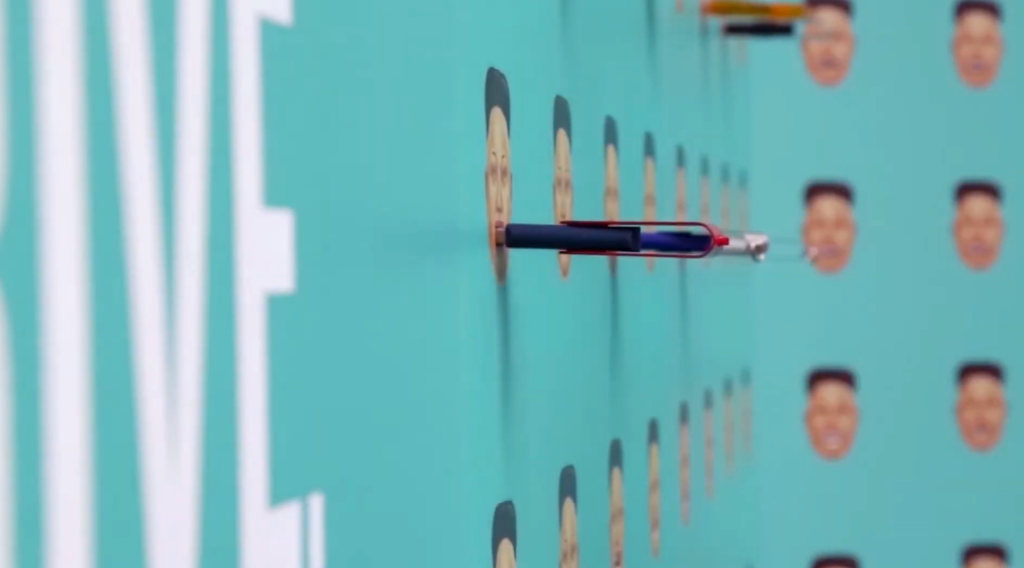
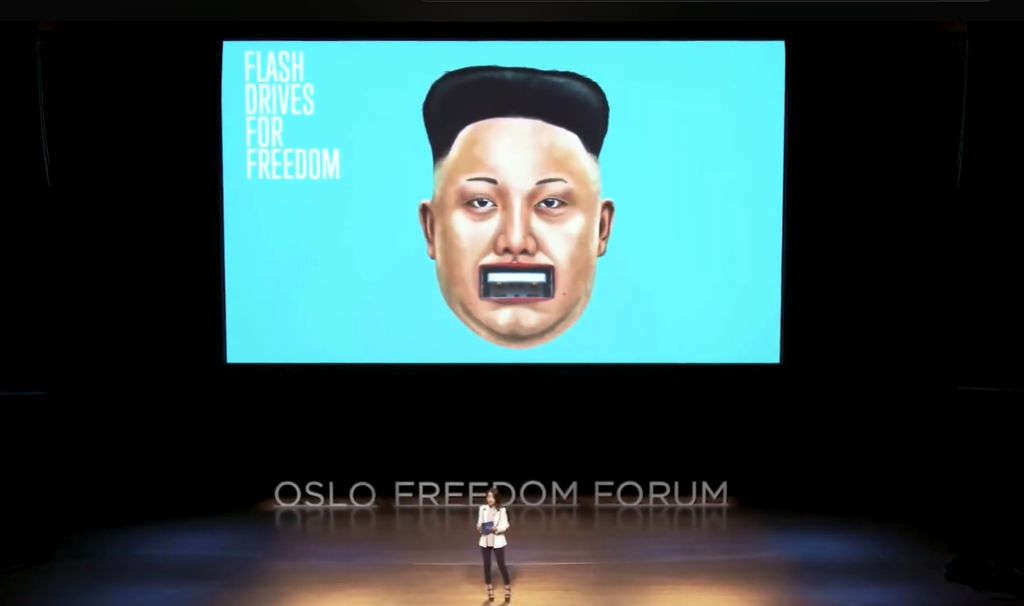
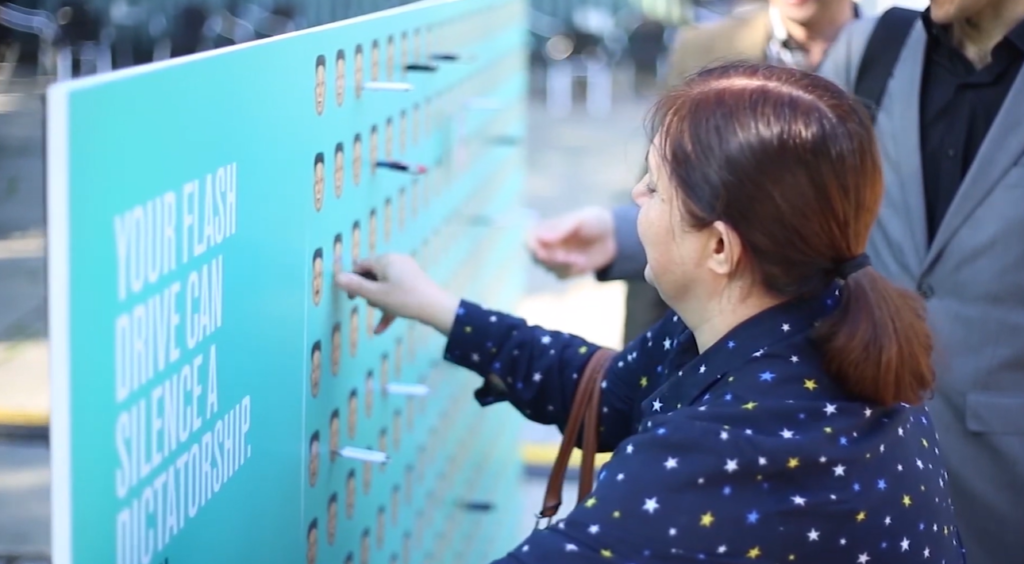
The Flash Drives for Freedom initiative commissioned agency Buena to develop a physical installation that could collect drive donations at public events while communicating the campaign’s purpose in a single, unarguable image.
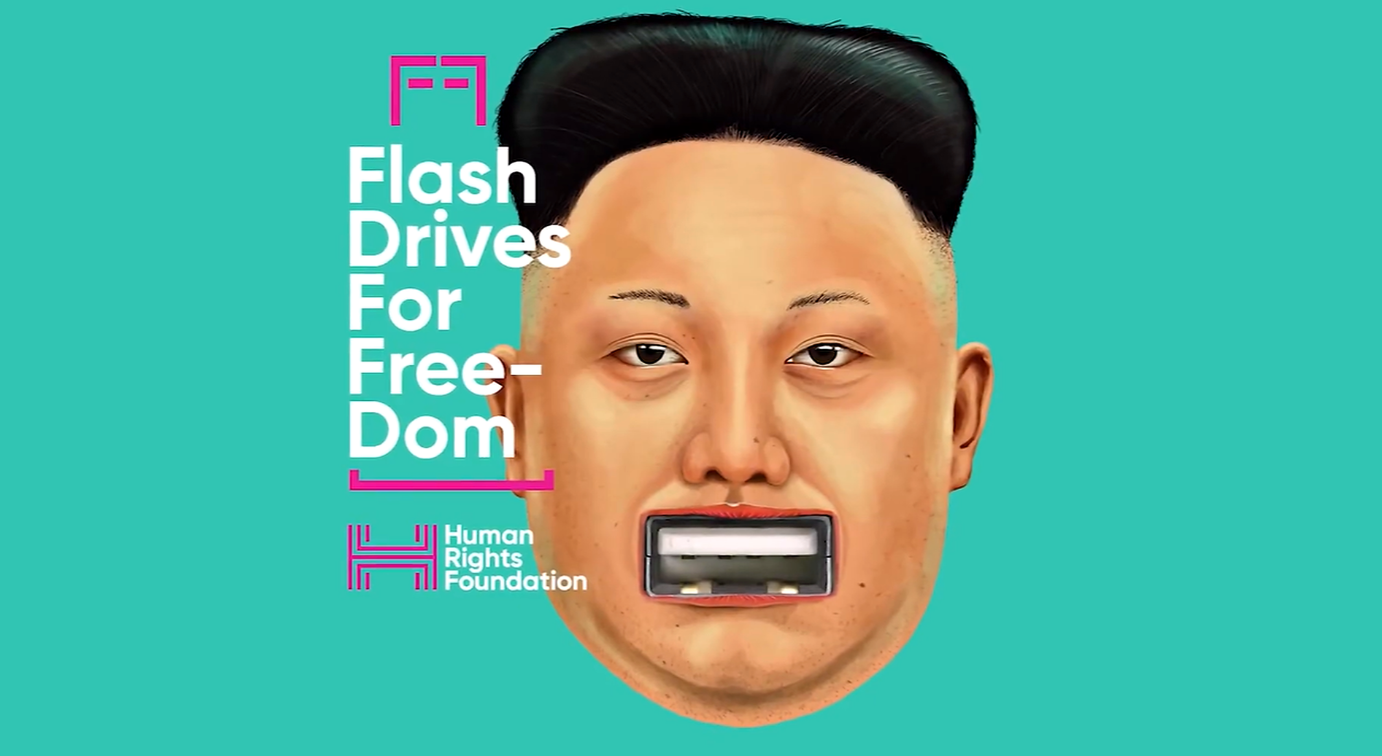
The installation consisted of hundreds of illustrated Kim Jong-un faces, mounted across a large display surface, each one with its mouth open and fitted with a USB port. Every time a donor inserted a flash drive into one of the ports, they were physically silencing a dictator’s propaganda with the act of donation. The drive that was about to bypass censorship entered the symbol of censorship itself. The metaphor required no explanation.
The installation won a Silver Pencil at The One Show and a Webby Award, confirming that the advertising industry recognised what the creative team had achieved: a donation mechanic that was also a political act, made tangible in a single visual gesture that worked at a glance and rewarded thought on a second look.
Why Flash Drives Work Where Other Methods Have Not
The Flash Drives for Freedom model represents a specific theory of change that Gladstein has articulated in multiple interviews. Diplomatic pressure on North Korea has produced limited results across decades of international effort. Military options carry catastrophic risk. Economic sanctions create hardship for ordinary citizens without dislodging the regime. The information model works differently because it operates at the level of individual understanding rather than institutional pressure.
A North Korean citizen who has watched South Korean dramas on a smuggled USB drive has seen, without anyone telling them, that the South Korean people they were taught to view as living in poverty and oppression are in fact living ordinary, prosperous, and free lives. That evidence, processed by individuals rather than announced by institutions, produces the kind of cognitive shift that no diplomatic statement can achieve.
Gladstein described the end goal of that process precisely: “When people know enough about their situation, they’ll be equipped with enough information to make an informed decision and realise it’s worth risking death to leave North Korea.”
The Broader Context
The Flash Drives for Freedom initiative operates alongside other information infiltration efforts targeting North Korea’s information blackout. Hydrogen balloons are released at night from the South Korean border town of Paju, drifting north across the DMZ carrying leaflets, dollar bills, DVDs, and additional USB drives. Radio broadcasts from outside the country are directed at North Korean frequencies. The cumulative effect of these channels is the slow erosion of what Gladstein describes as North Korea’s “iron curtain of information.”
Flash Drives for Freedom adds one specific element that the other methods lack: the participation of ordinary people who happen to have an obsolete piece of technology in their desk drawer. The initiative converts the universal experience of owning a forgotten USB drive into a direct connection with one of the most information-isolated populations on earth.
Gladstein’s summary of what that connection represents is the most precise available description of what a 16-gigabyte piece of plastic can actually do in the world’s most closed society: “Each one has the potential to literally change someone’s life.”
Campaign Name: Flash Drives for Freedom
Agency Name: Buena (installation creative)
Brand Name: Human Rights Foundation / Forum 280
Location: United States (donation collection national); North Korea (distribution via defector-led organisations); installation exhibited at public events and conferences