When Russia invaded Ukraine in February 2022, nearly ten million refugees crossed into Poland in the months that followed. Poland absorbed more Ukrainian refugees than any other nation. The immediate humanitarian response was extraordinary. What came next was harder to solve: where, precisely, should ten million people live?
Most arrived in Warsaw, Kraków, Wrocław, and Gdańsk, the cities they knew by name or had connections to. The result was predictable. Rental prices surged. Competition for jobs intensified. An unprecedented rise in inflation made major urban centres increasingly unliveable for the people arriving with the least. It became evident that the refugee movement needed to be redirected toward smaller Polish cities, but nobody could tell a Ukrainian family why Rzeszów or Bydgoszcz was the right fit for them specifically. Until Mastercard and McCann Warsaw built a tool to do exactly that.
The Data Mastercard Already Had
Mastercard processes millions of transactions every day across Poland. Anonymised and aggregated, that data produces a granular, continuously updated picture of the cost of living in cities of different sizes across the country, far more precise and current than any government census. Combined with data from the Polish Central Statistical Office, which tracks employment rates, housing availability, and economic opportunity at the municipal level, Mastercard had the raw material for something nobody had yet thought to build: a personalised relocation tool for people who had never chosen to move.
How Where to Settle Works
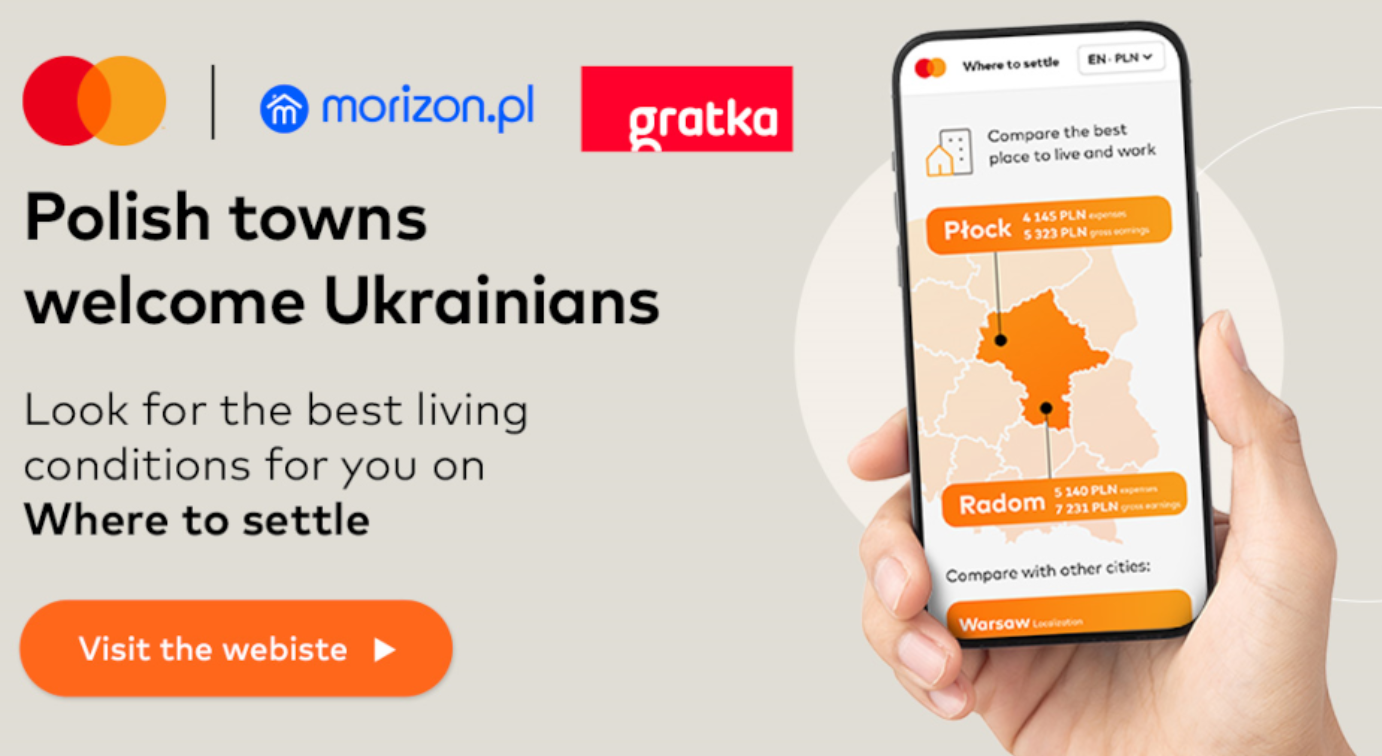
The platform was built in cooperation with Morizon-Gratka Group, part of Poland’s largest news organisation, which provided access to live job listings and apartment rental offers across the country. A Ukrainian refugee visits the site, fills in an anonymous form asking about their preferred employment sector, family size, and basic needs, and the platform produces a customised recommendation covering average cost of living, salary levels, housing availability, and economic opportunities in specific Polish cities that match their profile.
The process requires no sensitive personal data to be stored or shared. The anonymised Mastercard spending insights do the comparative work in the background. The output is a ranked set of cities where a specific family is most likely to thrive, presented in Ukrainian, with local residents from each recommended city featured in the accompanying digital campaign, welcoming refugees and showing them what their new hometown looked like.
The Polish government and the Association of Polish Cities, the oldest Polish organisation of local governments, formally supported and promoted the platform once it launched.
The Structural Problem It Addressed
In the first months following the outbreak of the war, 34% of Ukrainian refugees in Poland were unable to decide where to live. That indecision compounded their despair and prevented them from becoming financially independent. The absence of reliable, personalised information about life outside the major cities meant that most refugees defaulted to wherever they had an existing connection, regardless of whether that city could accommodate them economically.
Where to Settle addressed a structural gap in refugee support that NGOs, governments, and aid organisations had not yet filled. Most refugee assistance programmes focus on immediate needs: food, shelter, legal status, language support. The question of where specifically to build a sustainable life once the immediate crisis has passed is one that most support structures leave to the individual to navigate without data.
The Results
The platform attracted 242,170 unique visitors. 73,700 completed the full form. Based on average family size data collected through the platform, an estimated 300,696 individuals directly benefited from its recommendations, approximately 20% of Ukraine’s total refugee population in Poland at that time.
The campaign also measurably shifted Mastercard’s brand perception in both markets. Among Ukrainian respondents, “technological” perception rose 12 points, “modern” rose 14 points, and “social” rose 14 points. Among Polish respondents, “social” perception rose 11 points. Usage intent among non-Mastercard users rose to 57% among Poles and 80% among Ukrainians after contact with the platform.
Jerzy Hołub, Head of Marketing and Communication for Mastercard in Poland, Czech Republic, and Slovakia, framed the commercial and humanitarian argument simultaneously: Mastercard’s commitment to financial inclusion is not simply a brand purpose. It is a business strategy. The more people who have access to economic opportunity, the better for them, for society, and for Mastercard.
Why the Data Angle Matters
Mastercard’s business is built on processing transactions. The data produced by those transactions, anonymised and aggregated, is one of the most precise available pictures of how economies function at the granular level. Where to Settle is the clearest demonstration in the brand’s recent campaign history of what it means to leverage that data responsibly in the service of a specific social need rather than purely in the service of the brand’s commercial interests.
The campaign belongs to the same strategic tradition as Mastercard’s Touch Card for visually impaired cardholders and its True Name feature for transgender customers: finding the places where the brand’s own operational capabilities connect directly to an underserved population’s practical needs, and building a product rather than an advertisement in response.
Campaign Name: Where to Settle
Agency Name: McCann Warsaw / McCann Worldgroup / Production: Dynamo / Media: Carat
Brand Name: Mastercard Poland
Location: Poland (national digital platform; launched June 2023)