
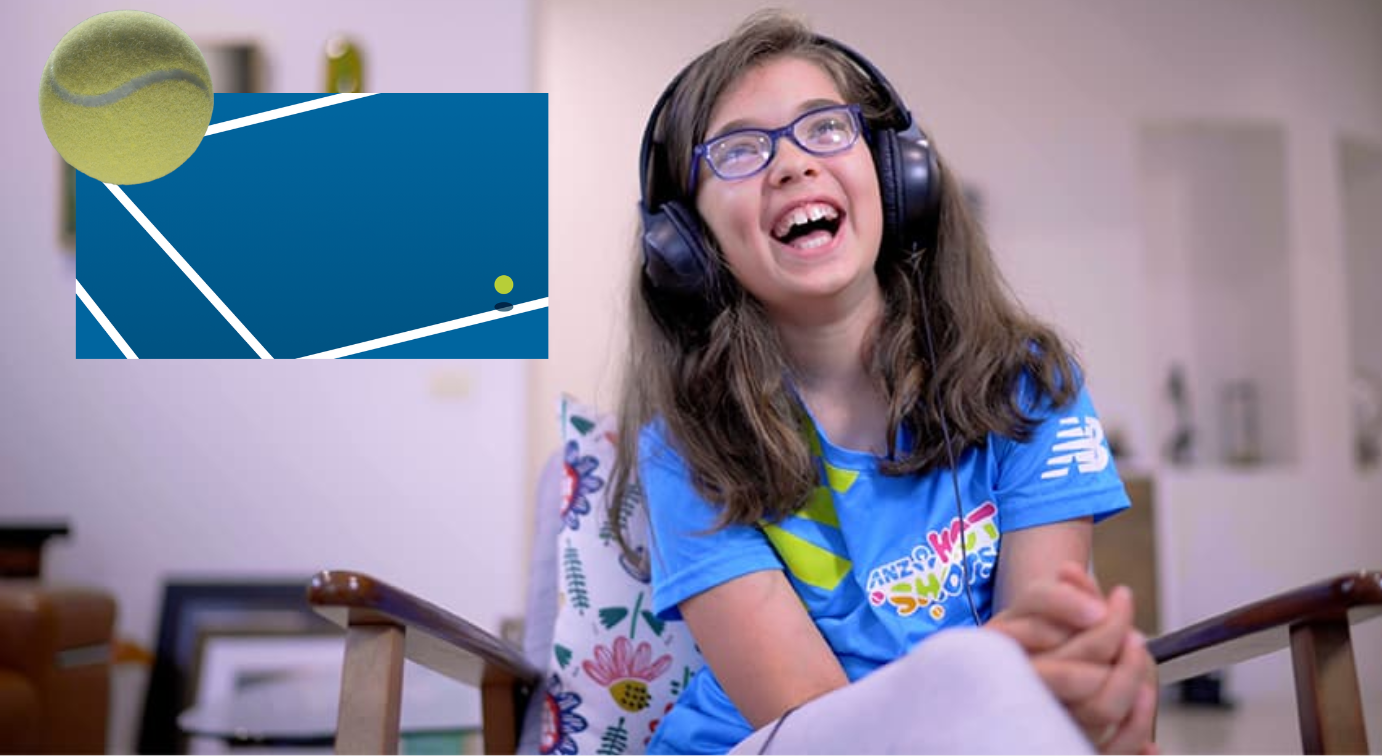
A tennis ball travels at speeds exceeding 200 kilometres per hour. It bounces within millimetres of the line. It changes direction, spin, and trajectory dozens of times per point. For a sighted spectator, following it requires sustained visual attention across a court. For the 285 million people globally who are blind or have low vision, the ball has never been followable in real time at all. Commentary arrives after the fact. The score arrives after the point. The experience of live tennis, the tension of a rally unfolding, the urgency of a ball landing on the line, has been structurally unavailable to blind and low-vision fans regardless of how closely they listened.
Tennis Australia, AKQA, and Monash University built a system to change that, and launched it at the finals of the 2021 Australian Open.
The Problem With What Already Existed
Television coverage of tennis is built almost entirely around what can be seen. Camera angles, slow-motion replays, line-call graphics, and split-screen comparisons all assume a viewer who can track the ball visually. Radio commentary provides a verbal description of play, but the commentary is inevitably delayed by the time required to process and articulate what a commentator has just seen. For a sport where a point can be decided in under three seconds, that delay is the difference between following the action and receiving a summary of it.
Maurice Gleeson, CEO at Blind Sports Victoria, described the experience with the precision of someone who had lived it: “I love tennis, but being blind, all I can hear is the ball going up and down and then I have to wait for the results.”
That waiting, the gap between the point ending and understanding what just happened, was the structural barrier Action Audio was built to close.
The Technology
Action Audio takes its core input from Tennis Australia’s real-time ball-position monitoring system, the same Hawkeye electronic line-calling technology that has been used across more than 80 tennis tournaments worldwide for years. Hawkeye’s computer vision tracks the ball’s position, speed, trajectory, and proximity to the line in real time with the accuracy required for line-call decisions. Its spatial data is rich, precise, and already being generated for every ball hit during a match.
AKQA and Monash University’s Faculty of Information Technology, led by Research Fellow Dr. Cagatay Goncu, took that spatial data and built a 3D sound design system on top of it. The ball’s position in the court maps directly to its position in a binaural audio soundscape: a ball hit to the left arrives as sound from the left, a ball deep in the court sounds distant, a ball landing near the line triggers a distinct proximity cue. Ball speed is reflected in the speed and intensity of the sound. Shot type is indicated by a different audio signature for each type of stroke. The result is a real-time audio representation of a tennis point that gives a blind or low-vision listener the spatial information they need to follow the action as it happens rather than after it has finished.
The system can run in sync with a televised broadcast or as a standalone stream available through AO Radio and Google Assistant. It requires only standard headphones to deliver the binaural experience.
The Two Years of Co-Design That Came Before It
The Action Audio system did not arrive as a technological solution imposed on its intended users. AKQA and Monash spent two years developing and testing it iteratively with the blind and low-vision community before the 2021 launch. The Blind Tennis Association and Blind Sports and Recreation Victoria both participated in the co-design process, providing the feedback that shaped how the audio system represented different elements of play and how those representations were refined until they matched the actual information needs of blind and low-vision tennis fans rather than what sighted designers assumed those needs would be.
Tim Devine, Executive Creative Director at AKQA AUNZ, described the system’s origin as a response to a gap rather than a technological ambition: “Since 2019, we’ve partnered with Tennis Australia and Monash to close that gap. This launch sets a new bar for inclusion and accessibility for every other global sports tournament that follows the 2021 Australian Open.”
Machar Reid, Head of Innovation at Tennis Australia, described what the system represented for broadcast accessibility: “Action Audio is essentially a new language being created to transcend sport. It enables us to augment the live radio broadcast and changes the way blind and low-vision sports fans can participate in live sport entertainment.”
The Launch and What Followed
Action Audio launched for the Women’s and Men’s Singles Finals of the 2021 Australian Open on February 20 and 21, 2021, making those finals the first live tennis matches ever accessible to blind and low-vision audiences in real time. The pilot covered three matches. In 2022, coverage expanded to nearly 60 matches across the event. Fast Company estimated more than 10,000 fans used the service during the 2022 Australian Open.
From there, the system scaled beyond tennis. AKQA’s own documentation confirms that Action Audio has since been applied to cricket, football, and basketball, including an expansion to live basketball as part of the NBA Launchpad programme. The electronic line-calling technology that provides the ball-tracking data is already operational across more than 80 tennis tournaments globally, creating a ready infrastructure for Action Audio to follow wherever Hawkeye is already deployed.
Sandra Knight, who has been legally blind since birth, described the experience of using the system for the first time: “I’m not a great watcher of sport because I can’t see where the balls are. It gives you those cues that you never really had before.”
The Recognition
Action Audio won D&AD Pencils in Radio and Audio and Media at the 2021 D&AD Awards. It won Fast Company’s World Changing Ideas Award in the Asia-Pacific category in 2022. The recognition reflected what the juries identified: a system that used existing technology in a genuinely new way to make something accessible that had been structurally inaccessible, built over two years with the community it was designed to serve rather than for them at a distance.
The ball has always been moving. Action Audio made it audible for the first time.
Campaign Name: Action Audio
Agency Name: AKQA / Research Partner: Monash University, Faculty of Information Technology
Brand Name: Tennis Australia
Location: Melbourne, Australia (Australian Open, February 2021; subsequently scaled globally)