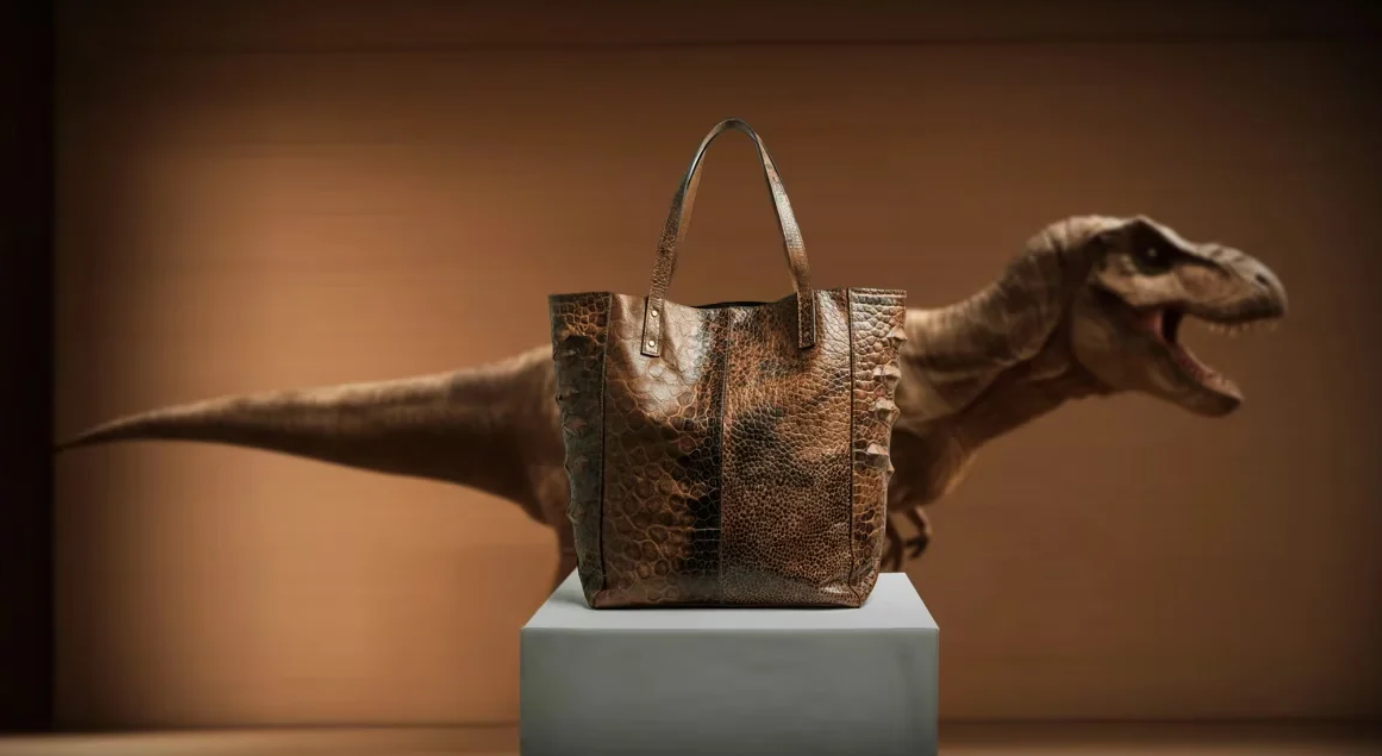
A handbag grown from engineered cells, built on a collagen sequence reconstructed from Tyrannosaurus rex fossils, went on display in Amsterdam next to a full-size cast of the dinosaur. Its makers call the material T. rex leather. The bag is the first product made from it, and it is headed for auction.
The Problem Lab-Grown Leather Faced
Luxury fashion sells heritage and rare materials. Most leather alternatives sell a cheaper copy of the real thing. Bas Korsten, Global Chief Creative Officer for Innovation at VML, has said lab grown leather has yet to convince the luxury world.
His team decided to stop imitating cowhide. The goal, Korsten said, was “not a substitute, but something entirely new.”
VML partnered with genomic engineering firm The Organoid Company and biotech firm Lab Grown Leather Ltd. The three announced the project in May 2025 and promised a finished luxury product by the end of that year. It arrived in April 2026.
Where the Blueprint Came From
Scientists started with fossilised T. rex collagen sequences. Computational biology and AI modelling filled in the missing genetic information to produce a complete collagen blueprint. The synthesised DNA was inserted into a carrier cell line, and billions of engineered cells were grown on Lab Grown Leather’s Advanced Tissue Engineering Platform.
The cells build their own structure without a scaffold. The companies say the result is structurally identical to conventional leather, and that it is durable, repairable, biodegradable and fully traceable. It avoids animal slaughter, deforestation and the chromium used in traditional tanning.
“We went back 66 million years in time,” Korsten said.
How the Material Shaped the Bag
Polish designer Michal Hadas, founder of the techwear label Enfin Levé, turned the material into a single handbag. Hadas built the design around where the material resisted and how it held tension, rather than forcing it into a standard luxury shape.
“It has a distinct character and responds unlike any leather we’ve worked with,” Hadas said.
A Museum Debut With an Unusual Neighbour
The bag was unveiled on April 2, 2026 at the Art Zoo Museum in Amsterdam, beside a life size T. rex cast the museum acquired from Naturalis Biodiversity Center. It stayed on display for 6 weeks, until May 11, before going to auction. The auction house and price have not been disclosed.
The material will now be offered to brands and designers. Luxury accessories come first, with fashion and automotive planned later.
What Scientists Had to Say
The dinosaur claim did not go unchallenged. When the project was announced, University of Maryland paleontologist Thomas Holtz Jr. pointed out that scientists have never recovered T. rex DNA, and said the idea “seems to be fantasy.” Thomas Carr of Carthage College noted that “collagens are pretty generic molecules,” which makes a sequence unique to T. rex hard to pin down. Tom Ellis, a synthetic genome engineer at Imperial College London, said the dinosaur angle gives the product something “unique” that can justify “a much higher price.”
When the bag launched, experts quoted by De Telegraaf added that fossil collagen survives only as tiny, degraded fragments from bone, which differs from the skin collagen that gives leather its feel. The companies responded that the material represents the limit of what biotechnology can currently extract from a 66 million year old specimen.
How Cannes Lions Responded
At Cannes Lions 2026, VML Paris won Gold and Silver in PR for the campaign, plus Bronze in Creative B2B and Bronze in Innovation.
Lab grown leather has struggled to look like luxury. VML gave it a backstory 66 million years long, a single handbag and a museum spot beside a dinosaur.
Campaign Name: T Rex Leather
Agency Name: VML Paris / VML Netherlands
Brand Name: Lab Grown Leather Ltd. and The Organoid Company (design partner Enfin Levé)
Location: Amsterdam, Netherlands (unveiled April 2026)