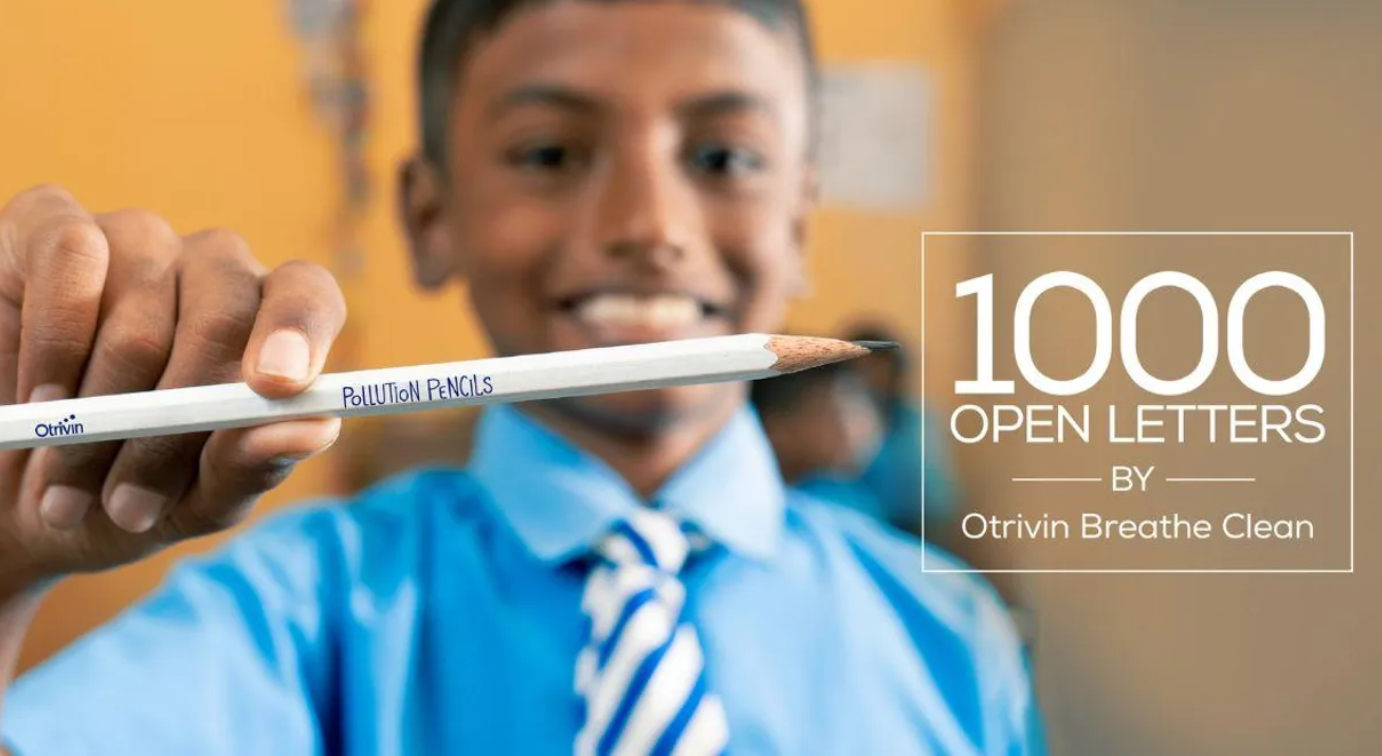
98% of children in India breathe toxic air. The toxic air is not only outdoors. It is in the classroom, where a child spends up to eight hours a day. In Bengaluru’s industrial areas of Peenya, Hegganahalli, and Mallasandra, that statistic is most acute. The air quality in these neighbourhoods exceeds WHO danger thresholds consistently, and the low-income schools that serve the children who live there had no mechanism to address it. Otrivin, Wunderman Thompson Singapore, and an Indian innovation startup built a system to not only clean the air but turn what it removed into an object those same children could use.
The Mechanism
Twenty-two specially designed air purifiers, built using soot-capture technology developed by Indian startup Panjurli Labs, were installed inside and outside three school buildings across the three target areas. The purifiers used a filtration system capable of removing up to 74% of airborne pollutants from the surrounding air, improving breathing conditions for over 1,500 students over the course of the pilot.
The innovation that made the campaign distinctive was not the air purifiers. It was what happened to what they removed. Panjurli Labs, led by CEO Ashik SV, had developed technology that could harvest the particulate matter, the soot and pollution residue, collected by the filters and combine it with graphite to produce a functional writing material. Over two months, the purifiers cleaned over two billion cubic feet of toxic air. The captured pollution was transformed into 10,000 certified non-toxic pencils.
Those pencils were given directly to the children in the three schools. The same air that had been harming their lungs and their cognitive development became the instrument they used to write and draw.
The Self-Sustaining Model
The Pollution Capture Pencils were not produced exclusively for distribution. A portion of the pencils went to market, available for purchase by consumers outside the schools. Otrivin’s long-term plan is to use the revenue generated from pencil sales as a fundraising mechanism to finance more air purifiers in more schools across India, creating a loop where the pollution removed from one school’s air finances cleaner air in another.
The scale of ambition behind this model is significant. The pilot reached 1,500 children in three Bengaluru schools. Otrivin announced plans to supply 100 additional air purifiers to schools in need in Q1 2023. The proceeds from Pollution Capture Pencils sales were earmarked to extend the programme to Delhi, the world’s most polluted capital, with a target of reaching 6,800 additional schoolchildren.
Farhad Nadeem, Global Marketing and Digital Director for Nasal Health at Haleon, described the programme’s dual purpose: it addresses an urgent public health problem with a tangible product intervention while simultaneously creating a commercial model that funds its own expansion. The campaign’s most powerful characteristic is that it does not require a donation or a charity model. It requires someone to buy a pencil.
The Results
The Pollution Capture Pencils programme generated 241 million media impressions across its initial rollout. Coverage ran in The Drum, Creative Review, Campaign Asia, Trend Watching, and advertising and environmental press globally. Panjurli Labs went on to install air purifiers inside Bengaluru’s Banashankari TTMC, a major bus terminus serving 50,000 to 60,000 commuters daily, using prize money won at the India Clean Air Challenge following the campaign’s recognition.
The WHO Director-General’s framing of the underlying problem sits above everything the campaign achieved: “Polluted air is poisoning millions of children and ruining their lives.” Otrivin found a way to make those children write with the poison.
Campaign Name: Pollution Capture Pencils / Actions to Breathe Cleaner
Agency Name: Wunderman Thompson Singapore / Wunderman Thompson India / WPP Team GSK Haleon / Technology Partner: Panjurli Labs / Pencil Manufacturer: Guna Pencils
Brand Name: Otrivin / Haleon
Location: Peenya, Hegganahalli, Mallasandra, Bengaluru, India