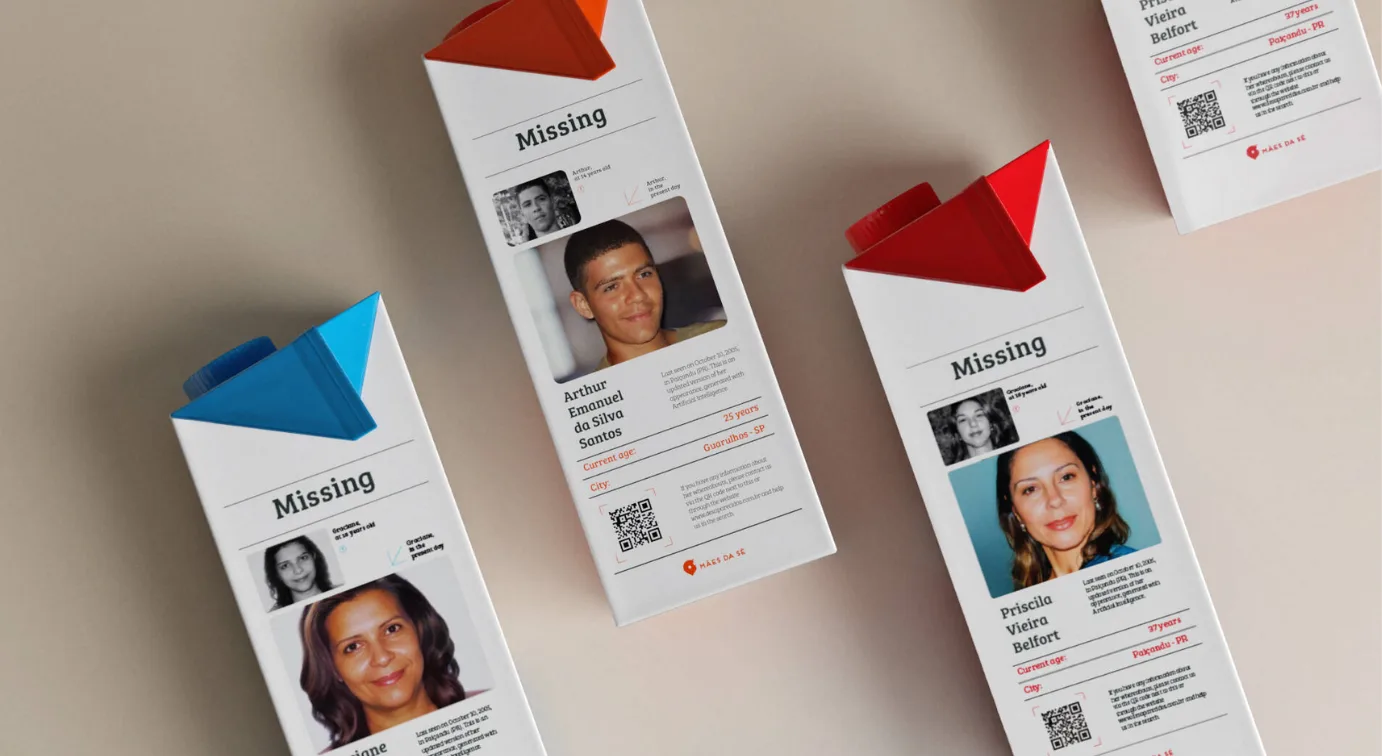
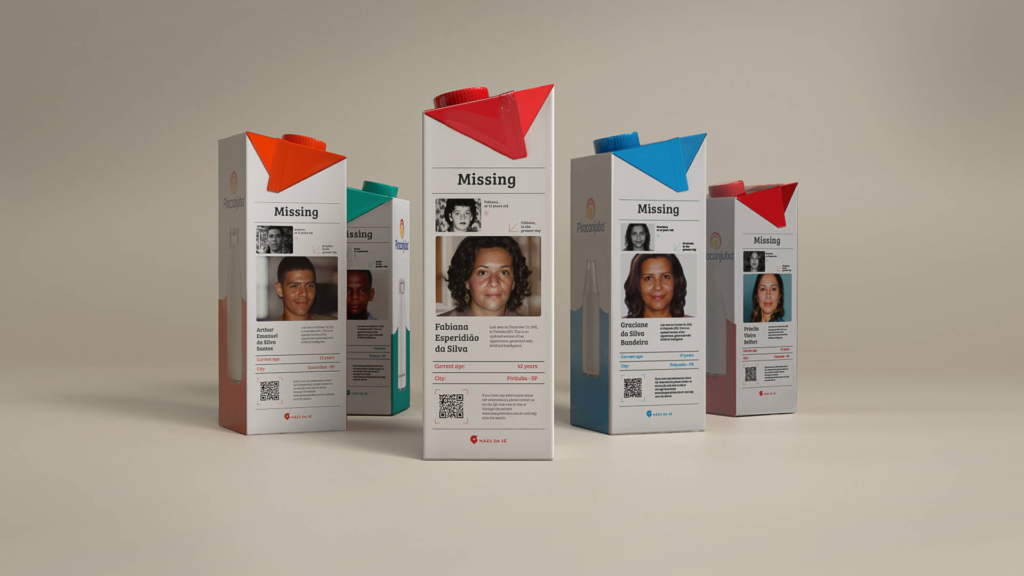
The milk carton missing persons campaign is one of advertising’s most culturally embedded formats. It began in the United States in the 1980s, when dairy companies started printing photographs of missing children on their packaging, and became so widespread that it entered the language as a cultural reference. By the 1990s, it had largely disappeared, replaced by digital databases and social media alerts. In February 2025, Brazilian dairy brand Piracanjuba and agency Ampfy brought the format back, with one significant upgrade: the photographs on the cartons are not the old images from the day the person disappeared. They are AI-generated portraits of what those people most likely look like today.
The Problem in Brazil
In Brazil, one person disappears every six minutes. The country’s scale compounds the problem in ways that do not apply in smaller markets. Brazil’s geography spans continental distances, with vast remote regions where internet penetration is limited or entirely absent. Digital missing persons campaigns, social media alerts, and online databases reach the urban, connected population effectively. They do not reach the communities where many of the searches need to happen.
Piracanjuba identified a distribution asset it already possessed that addressed that gap precisely. The brand has 98% household penetration across Brazil, including areas without reliable internet access. Its milk reaches the kitchen tables of Brazilian families in communities that no social media campaign can reach. The packaging that holds that milk was, Ampfy identified, the most effective available media channel for a missing persons campaign in Brazil.
The Technology
The innovation that makes The Missing PortrAIts different from the 1980s milk carton format is the photograph itself. When someone disappears and years or decades pass, the last available photograph becomes increasingly less useful as a recognition tool. A child who disappeared at age seven looks nothing like they would at twenty-five. A teenager who went missing in 2005 looks nothing like they would in 2025. The gap between the available image and the current face of the missing person is the fundamental barrier to recognition.
Piracanjuba and Ampfy worked with Probabilistic Image Synthesis, an AI-driven technique developed in collaboration with a criminal expert. The system analyses data from each missing person’s family characteristics, including physical features, aging patterns, and inherited traits from parents and siblings, and uses that data to generate a realistic portrait of how the missing individual most likely appears today. The resulting images are not simple age filters. They are forensically informed probabilistic portraits, produced with the same methodology used in criminal identification work.
Each updated portrait was then printed on Piracanjuba’s milk packaging and distributed in supermarkets near the last known locations of the missing individuals. The distribution strategy is as precise as the image technology. A carton carrying the AI-aged portrait of someone last seen in a specific neighbourhood is placed in the supermarkets of that neighbourhood, maximising the probability that someone who actually knows the missing person will encounter the image.
The Partnership
The campaign was developed in partnership with Instituto Mães da Sé, one of Brazil’s most respected and globally referenced organisations for missing persons advocacy. Founded by mothers of disappeared individuals, the institute has built decades of expertise in missing persons cases, documentation, and family support. Its endorsement and involvement gave the campaign the credibility and access to case files required to produce the AI-aged portraits responsibly and accurately.
Ivanise Esperidião da Silva, president of the Mães da Sé Association, described what the partnership provided to the organisation’s work: “A brand as big as Piracanjuba, which has the beautiful goal of helping people, elevates our cause and gives us visibility and reach that we have never had before.”
The Scale and the Results
Three hundred million milk cartons carried Missing PortrAIts portraits in the campaign’s first phase. The cartons were distributed across Brazil, with targeted placement near the last known locations of each missing individual. Families who had been searching for years, in some cases for decades, found their relatives’ updated portraits appearing in the supermarkets they visited weekly.
In the first month of the campaign, eight families were reunited with missing members. That result, eight confirmed reunions in a single month, is the outcome that all other campaign metrics exist to support. The campaign also generated over US$10 million in earned media coverage and increased brand preference for Piracanjuba among the families and communities who encountered it.
Lisiane Campos, marketing director at Piracanjuba, confirmed that the initiative is open-ended: “Missing PortrAIts is a long-term initiative. We are very committed to it and already looking towards its follow-up next year.” The first phase has no set end date, and subsequent phases are planned to introduce new images as additional cases are processed.
The Broader Argument the Campaign Makes
The campaign’s framing device is a question that most AI conversations in 2025 were not asking: much is said about the dangers of artificial intelligence, but what if we could use AI for hope?
The question addresses a genuine tension in public discourse. AI image generation has been most prominently discussed in the context of deepfakes, misinformation, and the displacement of creative workers. Probabilistic Image Synthesis, applied to the faces of people who have been missing for years, represents the same technology in its most directly humane application. It produces an image not to deceive or entertain but to help a stranger recognise someone they know.
The Missing PortrAIts campaign is not simply a creative use of AI. It is a demonstration that the tool itself is neutral, and that what it produces depends entirely on the purpose it is directed toward. A dairy brand turned its packaging into a nationwide search platform and used forensic AI to give the search a fighting chance. Eight families in the first month would not disagree with that characterisation.
Campaign Name: The Missing PortrAIts
Agency Name: Ampfy / CCO: Fred Siqueira, Andrea Siqueira / Executive Creative Director: Bruno Érnica / Creative Director: Fabio Guima / Production: Piloto
Brand Name: Piracanjuba
Location: Brazil (national; 300 million milk cartons; February 2025; ongoing)