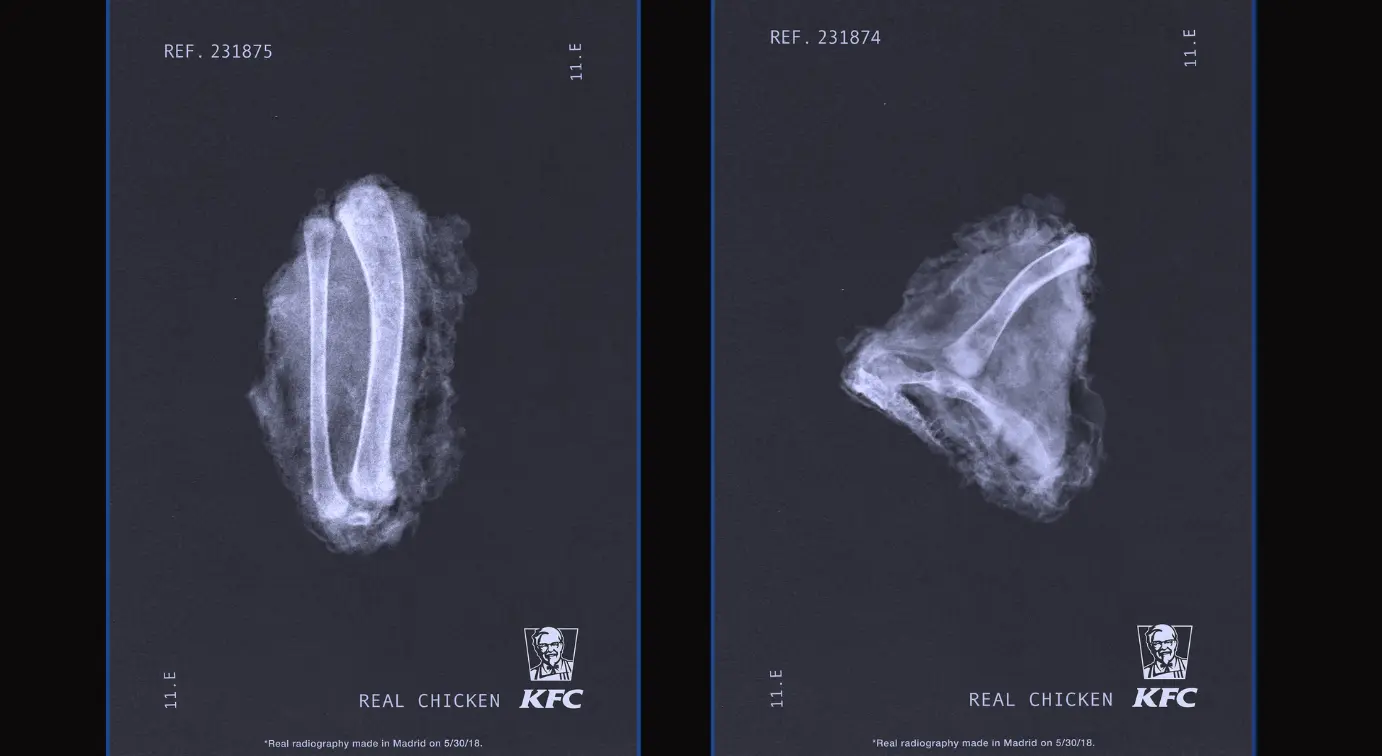
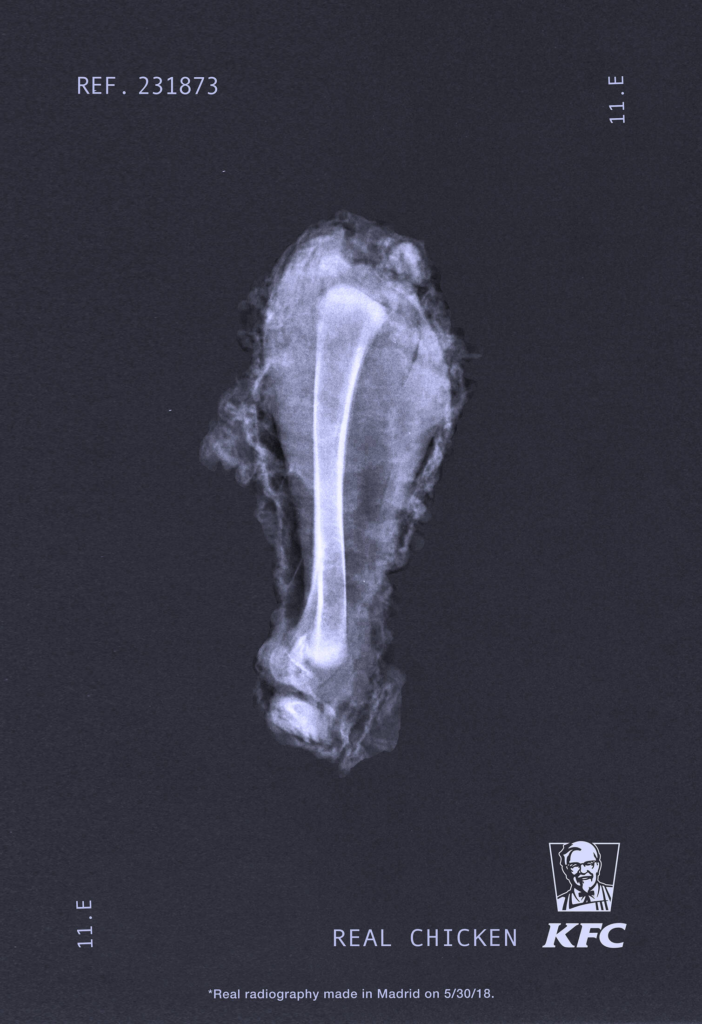
When people started questioning whether fast-food chicken was actually chicken, most brands responded with better food photography, cleaner packaging, and more confident product claims. KFC Spain and agency PS21 took a different position. They booked time with medical radiography specialists in Madrid, took actual KFC wings, breasts, and drumsticks into the room, and had them professionally X-rayed. The unretouched scans became outdoor advertisements. The bones were the proof.
The Problem the Campaign Identified
PS21’s research for KFC Spain in 2018 identified two specific and interconnected consumer concerns about fast food quality in the Spanish market. The first was the belief, driven significantly by competitors’ product controversies, that the chicken in fast-food restaurants was not genuine chicken but a processed blend of meat, filler, and additives. The second was a broader, more structural distrust of food advertising itself. Spanish consumers had become sufficiently media-literate to understand that food photography was styled, retouched, and produced under controlled studio conditions that bore little resemblance to what appeared in the actual packaging. They knew that what they saw in ads was not what they received across the counter.
Those two beliefs combined to create a communications problem that conventional advertising tools could not resolve. A more beautiful photograph of a KFC product would be dismissed as another example of professional food styling. A verbal claim about quality would be treated as exactly that: a claim. KFC needed a format of evidence that the audience’s existing scepticism could not easily dismiss.
The Solution
The campaign’s creative premise is straightforward to the point of seeming obvious in retrospect. A medical X-ray shows the interior of the subject exactly as it exists at the moment of imaging. It cannot be retouched in a way that changes the factual content. The bones of a genuine chicken piece are anatomically distinct from any processed product and recognisable to any viewer who has ever looked at a medical X-ray. If KFC’s chicken was real, the X-rays would show real chicken bones. If the X-rays showed real chicken bones, the argument was made.
PS21 contacted radiography specialists in Madrid and arranged for actual KFC pieces to be put through the same imaging process used in medical diagnosis. Wings, breasts, and drumsticks were X-rayed individually. The resulting images were the untouched diagnostic scans, exactly as they came out of the machine, with the bones clearly visible inside the fried coatings.
Those scans were produced as large-format outdoor advertisements, displayed on illuminated lightboxes across Madrid so the X-rays could glow from behind exactly as they would on a hospital display panel. The visual register borrowed directly from medical environments: dark background, white bone structure, the clinical aesthetic of a diagnostic image that most people associate with the professional and institutional authority of healthcare rather than the promotional context of fast food advertising.
Two words appeared at the bottom of each execution: “Real chicken.”
Why the Format Was the Right Answer
The lightbox display is the campaign’s most considered production decision. A printed X-ray image on a standard outdoor surface would still look like a designed advertisement. An illuminated X-ray on a lightbox looks like a medical display, which is precisely the visual code that triggers the kind of credibility the campaign needed. The audience’s familiarity with the visual language of healthcare gave the format its authority before a single word was read.
The campaign also addressed the retouching problem at its root. The product photographs that Spanish consumers had learned to distrust were trusted to make the food look better than it was in real life. An X-ray does the opposite. It makes the product look less appetising, showing the raw anatomical structure beneath the golden, crispy exterior. A brand that is willing to X-ray its product and display the result publicly is implicitly making the strongest possible claim about the product’s authenticity: one that requires no verbal assertion because the evidence is the advertisement.
The Campaign as a Category Statement
Chicken X-Rays belongs to the category of advertising that earns its credibility by doing something the audience did not expect from a brand in its category. Fast food advertising is expected to show the product at its most appealing. KFC Spain showed it in the least appealing format available, specifically because that format carried more persuasive authority than any photograph could.
The campaign did not ask the audience to trust KFC’s word. It asked them to look at the bones.
Campaign Name: Chicken X-Rays / Real Chicken
Agency Name: PS21, Madrid
Brand Name: KFC Spain
Location: Madrid, Spain (outdoor lightbox campaign, 2018)