Most Durga Puja campaigns announce themselves. The Kaash phool sways in the breeze. A family reunites at the airport. The Dhak plays over a montage of pandal lights. By the time the brand name appears, the viewer has already processed the festival as a backdrop and the emotion as something manufactured for the occasion. Coca-Cola and Ogilvy India took a different position for Puja 2023. They placed a bottle of Coke on a dinner table and let a character the size of your thumb experience the entire festival from its surface.
The Eye That Started Everything
The film’s opening image is the one that sets everything else in motion. The iconic Durga Puja eyes appear on screen: the kohl-lined, elongated gaze that adorns every idol, every pandal banner, every piece of festive illustration in Bengal. Anyone who has grown up with or near Durga Puja recognises those eyes before a single word of the film has played. They are the visual shorthand for the festival itself, the one image that requires no context to place the viewer exactly where and when the story is happening.
From inside those eyes, a tiny illustrated character emerges. He is drawn in the style of traditional Bengali folk art, flat, warm, and immediately recognisable as belonging to the visual vocabulary of the festival. He descends onto the surface of a table mat beneath a chilled bottle of Coke and begins to live Puja in the only way available to him: from the dinner table up.
What the Character Experiences
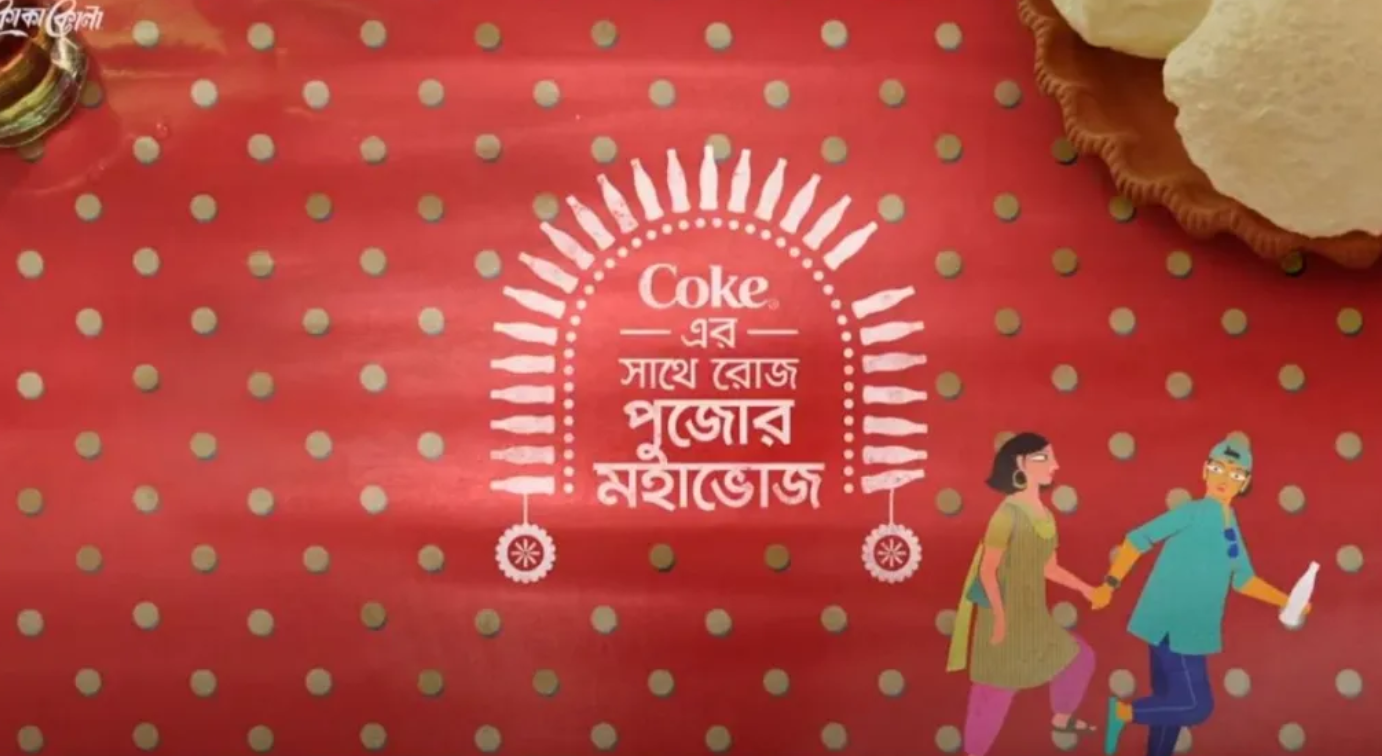
The film is called Thala Hopping, a Bengali-English phrase for the act of moving between food plates during the Puja feast, which is one of the festival’s most consistent and most beloved rituals. The character does exactly that. He moves across the table mat from plate to plate, from motif to motif, encountering the food, the noise, the crowds, and the specific texture of the five-day festival as it is actually lived rather than as it is usually depicted.
He keeps one eye on his chappal. Anyone who has attended a Puja pandal understands why. The unsupervised sandal is one of the festival’s most reliable anxieties, the thing that ensures no celebration is ever completely without consequence.
He navigates the Dhak beats, the fairground lights, the food stall chaos, and the specific kind of joyful overwhelm that Durga Puja produces in anyone who has experienced it. All of this emerges not from live footage, not from real actors, not from the conventional visual language of Indian festive advertising. It emerges from the surface of a table mat, rendered by illustrator Joyeeta Bose whose traditional folk art illustrations gave the character and his world their visual identity.
The live-action food on the table above him was choreographed to move in sync with his journey. When the character encounters a plate of luchis in the illustration, actual luchis move on the table above him. The two layers of reality, the animated world of the table mat and the physical world of the feast, move together throughout the film without ever acknowledging each other directly. The character does not look up at the food. The food does not look down at the character. They share a moment and a table and a bottle of Coke without breaking the specific logic of the world the film has created.
The Coke That Was Always There
The bottle of Coke sits in the frame from the moment the character appears. It is not introduced as a product. It is not held up to the camera. It does not appear with a tagline or a jingle. It is simply present, throughout the entire journey, as the one constant in a festival that is defined by its movement, its noise, and its beautiful, exhausting excess.
The campaign line, Coke-er Shaathe Roj, Pujo’r Mahabhoj, translates as “Grand Puja festivities and food, with a Coke every day.” The Coke in the tagline is the Coke on the table. The table is where the character lives. The character is living Puja. The circularity is the campaign’s entire creative structure, and it holds because every element within it earns its place.
Sujoy Roy, Executive Creative Director at Ogilvy, described the creative position that produced the film: “Pujo is so much more than kaash phool, kolakuli and a customary Durga Puja jingle. It is a melting pot of flavours, characters and quirks. We didn’t just want to make a piece of communication that celebrates the generally accepted clichés of Pujo. For us, the real magic of Pujo lies in the minute brush strokes, the intricate moments of love and camaraderie. This film offers an unconventional perspective to Durga Puja celebrations. Seen yet unseen.”
The Sound That Carried It
The film is accompanied by a song composed specifically for the campaign that makes no attempt to function as a conventional Puja jingle. It captures the sensory energy of the festival rather than describing it, moving with the character’s journey across the table rather than narrating it from outside.
Why the Approach Worked
The campaign’s most significant creative decision was the one it did not make. Ogilvy India and Coca-Cola chose not to represent Durga Puja through any of the images that most reliably signal the festival to a national audience. The campaign doesn’t include any idol, immersion or family reunion, which is the subject of most festival campaigns.
Instead, there is a character small enough to live under a plate, experiencing the festival through the food, the chaos, the company and the chappal anxiety, with a bottle of Coke beside him throughout. The festival is present in every frame without being shown in any of the conventional ways that most brands rely on to make their association with it legible.
Arnab Roy, Vice President of Marketing at Coca-Cola India and South-West Asia, described the brand’s ambition in the Bengali market: “Coca-Cola has always endeavoured to become a part of India’s cultural fabric. Our Durga Puja campaign is a passionate attempt to blend into the rich canvas of the ethnic traditions of Bengal.”
Blending into the rich canvas is different from stamping the brand onto it. The Thala Hopping character blends in because he was drawn from the same visual tradition as the festival he inhabits. He belongs to the table mat the way the eyes belong to the idol. The Coke bottle belongs to the feast the way the campaign’s tagline says it does: as a daily companion through the most extraordinary five days of the Bengali year.
Campaign Name: The Real Magic of Pujo / Coke-er Shaathe Roj, Pujo’r Mahabhoj / Thala Hopping
Agency Name: Ogilvy India / Executive Creative Director: Sujoy Roy / Entrant: Subhajit Mukherjee / Production: Hungry Films / Illustrator: Joyeeta Bose
Brand Name: Coca-Cola India
Location: India (digital and TV; Durga Puja, October 2023)