
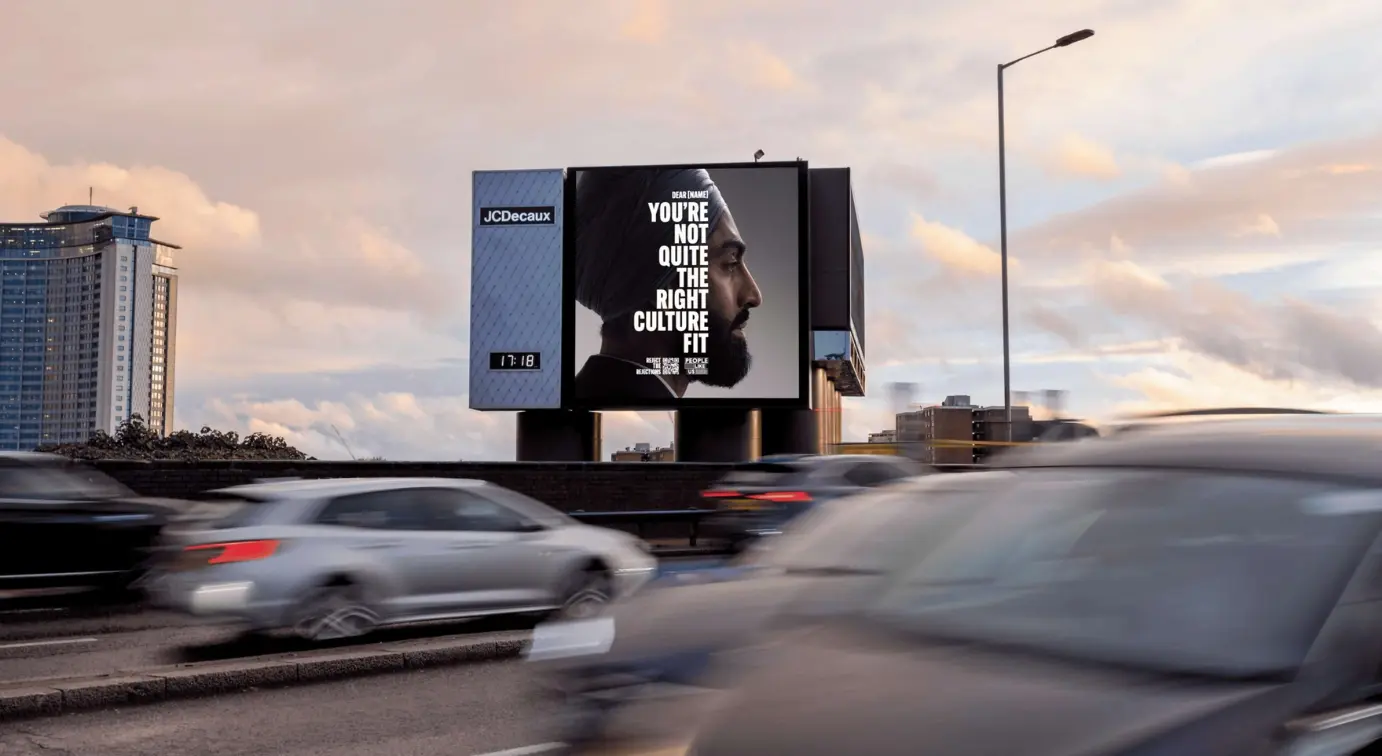
In the UK, automated hiring software is now rejecting candidates within minutes of them applying, sometimes before the application deadline has even closed. The impact falls hardest on ethnic minority jobseekers. People Like Us, the UK’s leading workplace equity non-profit, and Worth Your While, a Copenhagen-based independent creative agency, launched Reject the Rejections in September 2026 to make that system’s consequences impossible to look away from.


The Research
The campaign is built on original research conducted by People Like Us and Censuswide across 2,000 UK jobseekers. The findings reveal the extent to which automated screening has changed the experience of applying for work, and whose experience it has changed most severely.
60% of all candidates have altered or hidden elements of their CV from fear of being rejected by automated screening. Among ethnic minority candidates, that figure rises to 70%. Ethnic minority candidates are nearly three times more likely to remove their country of origin from their CV compared with white candidates: 14% versus 5%. Some have removed their name, their faith, or other markers of identity that they fear will trigger an automated rejection.
Ethnic minority candidates are also more likely to be rejected within the first hour of applying: 41% compared with 32% of white candidates. A UCL study of over 100,000 live graduate applications confirmed ethnic minority candidates are disproportionately rejected at the screening stage despite having similar qualifications.
Three quarters of all candidates surveyed did not know they may have the right to request a human review of an automated decision. That knowledge gap is one of the specific problems the campaign was built to address.
The Film
The campaign’s creative centrepiece is Dear [Name], a four-minute film starring Ebenezer Gyau, the British actor known for Amandaland, Black Mirror, and Suspect, directed by American-Pakistani filmmaker Amara Abbas through new-land productions.
The film is set inside an anonymous waiting room, separated from a hiring team on the other side of a two-way mirror. Gyau is surrounded by other ethnic minority job seekers. He performs the language of real rejection emails sent to real ethnic minority candidates as a spoken-word piece, moving through the familiar corporate register of exclusion: “After careful consideration, we’ve made the decision to move forward in a different direction.” “Not quite the right culture fit for the team.”
The waiting room eventually ends when a phone on the wall rings. The hiring decision has been made. The only white applicant in the room is given the job.
The film takes the automated rejection email, an object so routine and so depersonalised that most recipients process it in seconds and move on, and restores to it the weight it carries for the person receiving it. Gyau’s performance converts the sanitised language of algorithmic elimination into something that takes four minutes to deliver and cannot be processed quickly.
The Problem the Campaign Names
Sheeraz Gulsher, co-founder of People Like Us, was careful to frame the campaign’s argument without positioning employers as deliberate discriminators: “Employers aren’t the villains here, most resort to automations in good faith to cope with a surging volume of applicants, and four in ten did it believing they were reducing bias. Good faith isn’t governance, though. When 82% of the employers who checked found outcomes vary by ethnicity, ‘we didn’t know’ stops being a defence.”
The point is structural rather than intentional. Automated hiring tools trained on historical data inherit the biases embedded in that data. A system trained on the CVs of previously successful candidates at a company with a homogeneous workforce will learn, without any deliberate instruction, to penalise CVs that deviate from that template. The deviance can be a name, a university, a residential area, a gap in employment, or a country of origin. The system does not know it is discriminating. That is precisely what makes the discrimination difficult to challenge.
Tim Pashen, Creative Director and Partner at Worth Your While, described the structural shift that automation introduces to a pre-existing problem: “Erasing parts of identity pre-dates automation. Decades of UK research on name bias demonstrate how this has been impacting workers. But automation adds speed and scale, and removes the person who could be asked why. When a machine can reject you before a human has even had a chance to see you, efficiency starts to look a lot like exclusion.”
The Practical Tool
Alongside the film, People Like Us launched a free online tool developed with Planes Studio, available at rejections.plu.org.uk. Any rejected candidate can use it in two clicks to ask their prospective employer whether automated screening was used on their application, and to invoke their potential right to a human review under existing data protection and equality legislation.
The tool converts awareness into action. A candidate who watches the film and recognises their own experience in it can immediately use the tool to take a concrete step. People Like Us is simultaneously calling on the UK government to mandate disclosure of automated or AI-assisted screening in job adverts and to introduce mandatory independent bias audits of automated recruitment tools.
The Distribution
JCDecaux Community Channel is supporting the campaign across 19 large-format London screens from September 16, 2026, followed by a national rollout in November. A 30-second version of the film will run in cinemas with Pearl & Dean from October 2. The national reach converts a campaign built around a specific workplace injustice into a public conversation that extends well beyond the communities most directly affected by it.
Campaign Name: Reject the Rejections / Dear [Name]
Agency Name: Worth Your While / Film Production: new-land / Director: Amara Abbas / Online Tool: Planes Studio / OOH: JCDecaux Community Channel / Cinema: Pearl & Dean
Brand Name: People Like Us
Location: United Kingdom (film, OOH, cinema, digital; launched September 16, 2026)