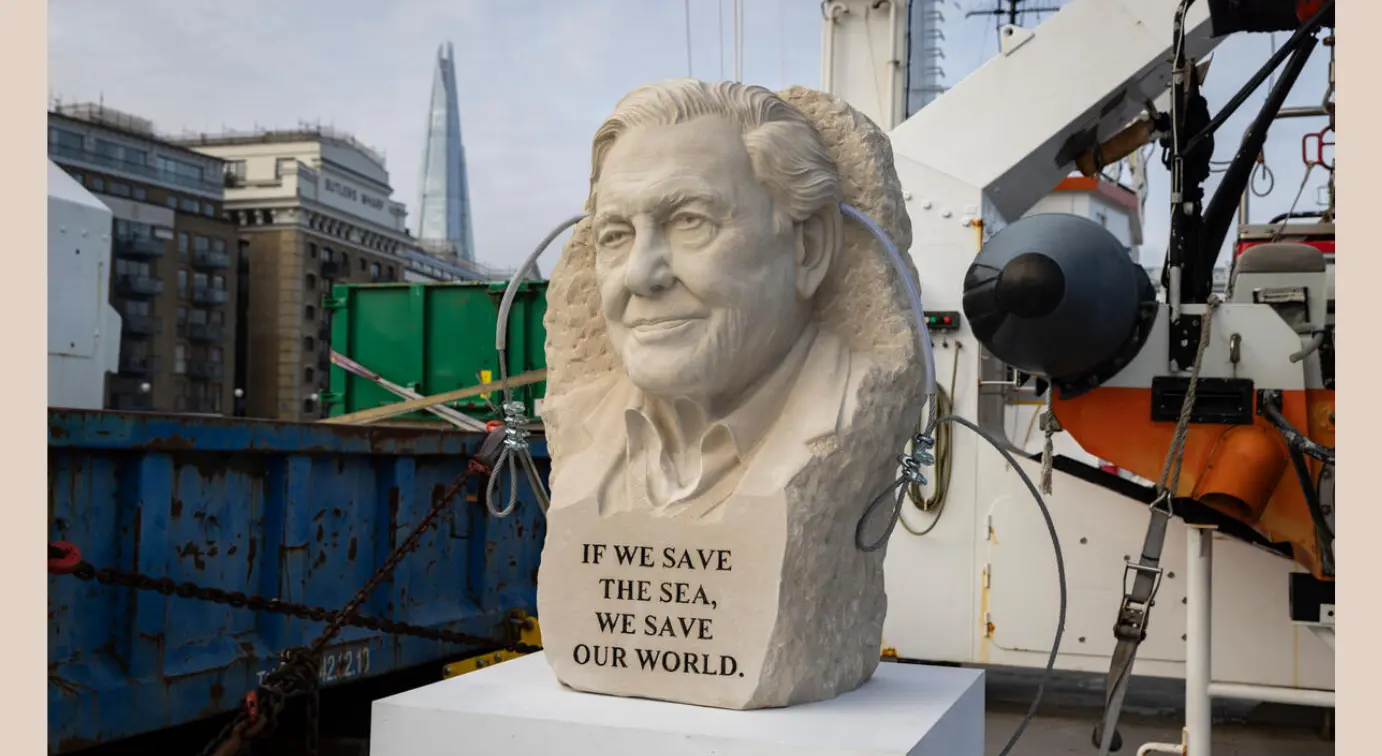
Greenpeace has carved Sir David Attenborough’s face into a limestone boulder and plans to drop it onto the North Sea seabed. The “Attenboulder” is the final stone in an underwater barrier built to stop bottom trawlers from dragging their nets through a protected area set up for harbour porpoises.
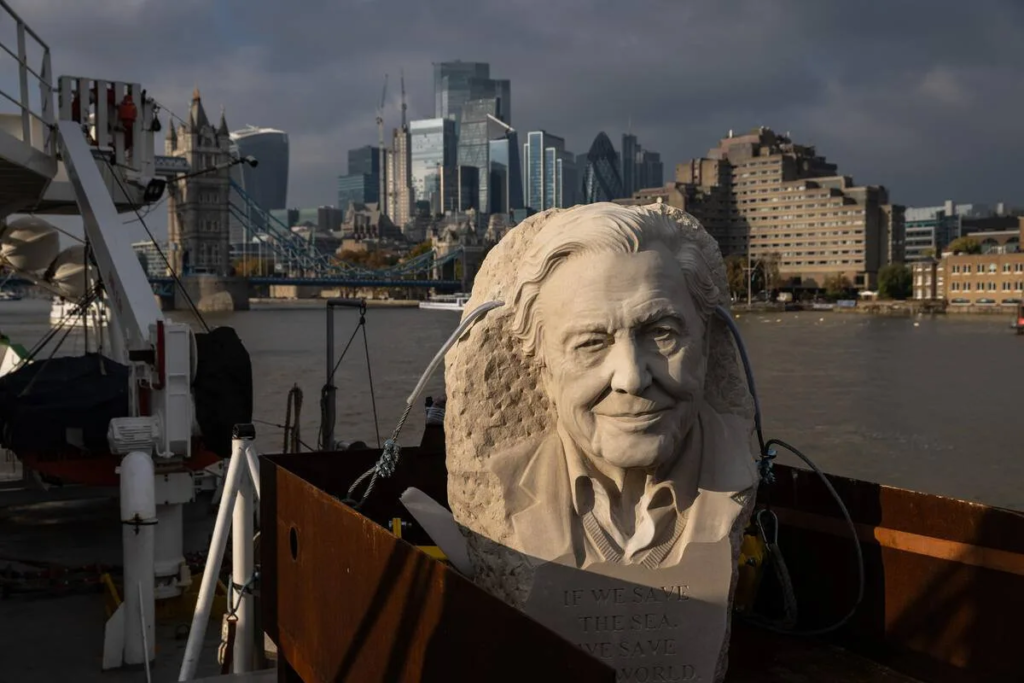
A Face on the Thames
Greenpeace unveiled the boulder on November 10, aboard its ship Arctic Sunrise on the River Thames near Tower Bridge in London. The timing matched the broadcast of Blue Planet III, the latest series in Attenborough’s ocean documentaries, which has renewed public interest in protecting the sea.
Greenpeace calls Attenborough a “legendary ocean defender.” It argues that the government’s lack of action insults his years of work bringing the oceans into British living rooms.
Why Boulders Stop Trawlers
Bottom trawling drags heavy nets along the seabed. Boulders placed on the sea floor snag those nets and make the area impossible to fish this way.
Greenpeace announced on November 2 that it had already placed 9 boulders in the Southern North Sea marine protected area, off England’s east coast. Six MPs, including Kerry McCarthy and Dr Roz Savage, signed them, along with actors Simon Pegg and Benedict Cumberbatch. The barrier has closed 116 sq km, or 45 square miles, of the sanctuary to bottom trawling. The Attenboulder is meant to complete it.
The boulders cannot stop every vessel or every type of fishing. They are a physical stand-in for a ban that only the government can impose.
The Sanctuary in Name Only
The Southern North Sea protected area covers about 14,266 square miles and supports around 20% of the UK’s North Sea harbour porpoise population. It is also the UK’s most bottom-trawled marine protected area. According to an Oceana report, it saw 30,936 hours of bottom trawling in 2025.
Greenpeace says the problem is wider. Since Blue Planet II aired in 2017, the government has created 23 new offshore marine protected areas, bringing the total to 78, but most still have no limits on destructive fishing. In 16 of the new areas, overall fishing activity has increased, and activity by industrial vessels over 24 metres has risen 15%. Over the same period, total fish in UK waters fell by over 40%, and 6 in every 10 fish stocks declined, according to analysis by the Blue Marine Foundation.
Over the past month, Arctic Sunrise has patrolled the area. In a single weekend, its crew contacted 7 industrial fishing vessels over 33 metres long and asked them to stop fishing in the protected zone.
The Government Pushes Back
On November 5, the Marine Management Organisation wrote to Greenpeace demanding that it stop placing boulders and threatening legal action. Greenpeace says it intends to finish the barrier anyway.
The group is asking the government to stop threatening peaceful protesters, to properly protect UK seas and to create new marine sanctuaries on the Atlantic high seas.
“The public is falling in love with our oceans all over again thanks to Blue Planet III,” said Will McCallum, joint executive director of Greenpeace UK. “The government’s inaction makes a mockery of the term ‘marine protected area’,” he added. He said the zones are supposed to be “safe havens for wildlife,” not “killing grounds.”
Where the Face Goes Next
Once it is lowered into the North Sea, the Attenboulder will sit on the seabed with the other boulders, in the path of any net that tries to cross it.
Attenborough has spent decades showing Britain its oceans on screen. Greenpeace is now putting his face where the cameras rarely go.
Campaign Name: Not mentioned (the “Attenboulder,” part of Greenpeace’s boulder barrier)
Agency Name: Not mentioned
Brand Name: Greenpeace UK
Location: River Thames, London (unveiling) and the Southern North Sea marine protected area (barrier)