One in every seven Ecuadorians uses their own name as their password. It is one of the most common and most exploitable habits in digital security, and it is also the kind of statistic that disappears the moment a person closes the article they read it in. Banco Pichincha and Delta MullenLowe needed a format that would make the same point in a way that was impossible to look away from. They found it in Ecuador’s biggest football match.
What Happened During the Match
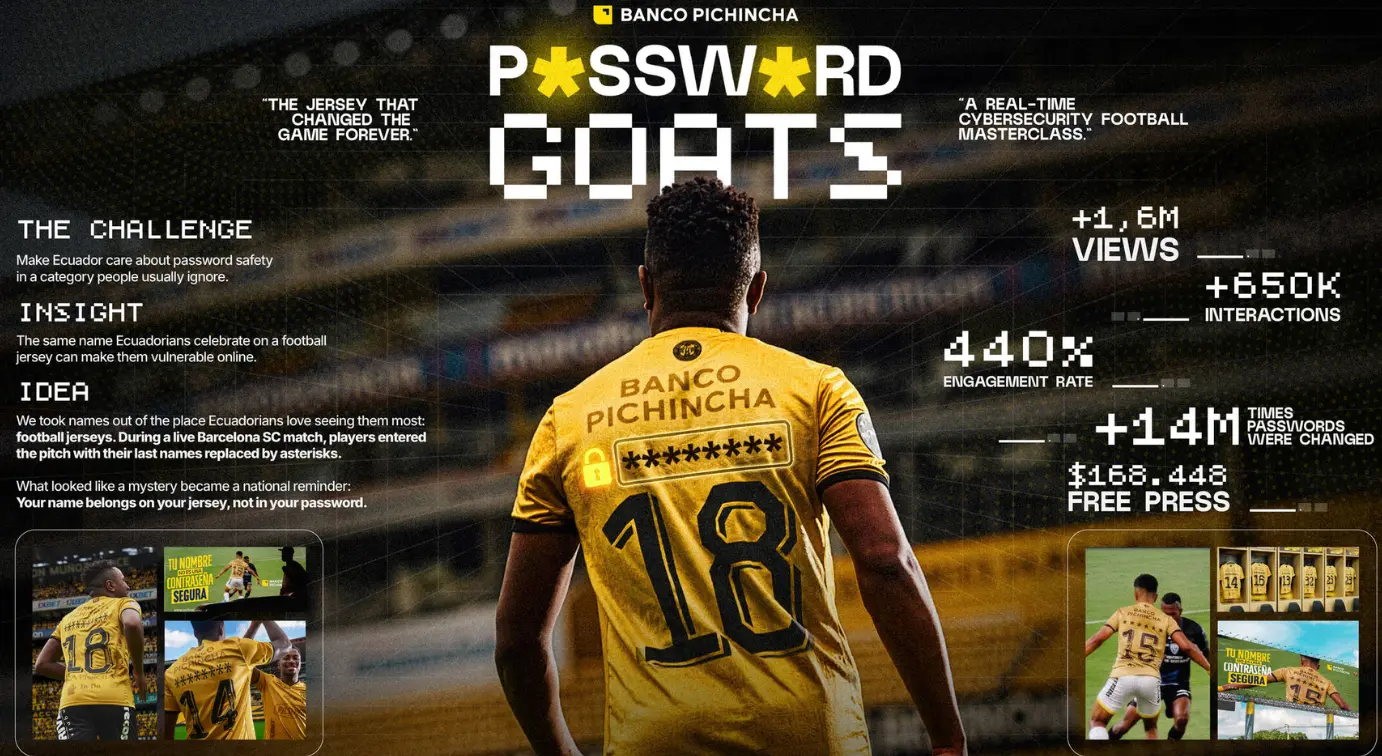
In May 2026, during the highly anticipated Clásico del Astillero between Barcelona SC and Independiente del Valle, something unusual appeared on every broadcast graphic, every jersey lineup, and every stadium display. The players’ names were gone. In their place were asterisks: the universal symbol for a hidden password.
Fans watching at home and in the stadium were immediately confused. The match was being contested by some of Ecuador’s most recognisable footballers, men whose names every fan in the country knew by heart, and none of those names were visible anywhere. The broadcast graphics showed ****** where Enner Valencia’s name should have been. The lineup cards were rows of asterisks.
The mystery resolved moments later when Banco Pichincha revealed the message: “If your password is your name, hackers already know it.”
Why the Football Match Was the Right Medium
Banco Pichincha is Ecuador’s leading bank and one of the country’s biggest football sponsors. Those two facts created a specific creative opportunity. The football match gave the bank access to millions of Ecuadorians simultaneously, in a state of high attention, on a platform where they were already watching text-based information, player names, statistics, graphics, as part of their normal viewing experience.
The asterisk is a digital convention so familiar that most Ecuadorians encounter it daily without thinking about it. It is what appears in the password field when you type your login credentials on any device. Placing it in a football broadcast context, where names are the information viewers expect to see, created an immediate and involuntary awareness of the convention’s meaning. The viewer’s brain expected names and saw symbols. The gap between those two things is the entire campaign.
The stunt worked because it required no explanation to generate confusion, and the explanation that followed, the cybersecurity message, arrived with the full emotional charge of a mystery resolved rather than a lesson delivered.
The Problem It Was Addressing
Ecuador faces the same digital security vulnerabilities as most markets where smartphone and internet adoption has outpaced security literacy. Passwords derived from personal names are among the first entries in any automated hacking tool’s dictionary attack library. A person whose password is their own first name has a bank account that is, in functional terms, easier to access for a hacker than for the account holder using two-factor authentication.
As Ecuador’s leading bank, Banco Pichincha has a direct commercial interest in its customers’ digital security practices. A customer whose account is compromised because their password is their name is a customer whose trust in their bank has been damaged through no fault of the institution. The campaign serves both the customer’s financial security and the bank’s long-term relationship with them.
The Campaign Beyond the Match
The activation extended beyond the live broadcast into integrated and outdoor components. Influencer marketing through agency Atis, handled by Managing Director Jessika Solórzano and her team, amplified the conversation on social media before, during, and after the match. Out-of-home and digital media placements, planned by Right Angle Media, extended the asterisk visual into the broader media environment around the event.
The Password Goats name refers to the “GOAT” cultural designation, Greatest of All Time, applied to football’s elite players. The campaign’s argument is that using your own name as a password, even if you are considered a GOAT, makes your accounts among the easiest to compromise. The name connects the football context to the cybersecurity argument in a single compressed phrase.
Campaign Name: Password Goats
Agency Name: Delta MullenLowe / CCOs: André Pedroso, Marco Tapia / Art Director: Sebastián Echeverría / Production: Bang Motion and Films / Influencer Marketing: Atis / Media: Right Angle Media
Brand Name: Banco Pichincha
Location: Ecuador (integrated, digital, OOH, broadcast; May 2026)