In the United Kingdom, the number of arrests in London for conspiracy to cause public nuisance has increased tenfold since 2019. Of more than 600 arrests made under these anti-protest powers, only 18, roughly 2.8%, were ever charged. The law was being used not to prosecute protesters but to remove and intimidate them. Greenpeace and ELVIS identified that gap between arrest and charge as both the campaign’s brief and its creative opportunity.
The Campaign
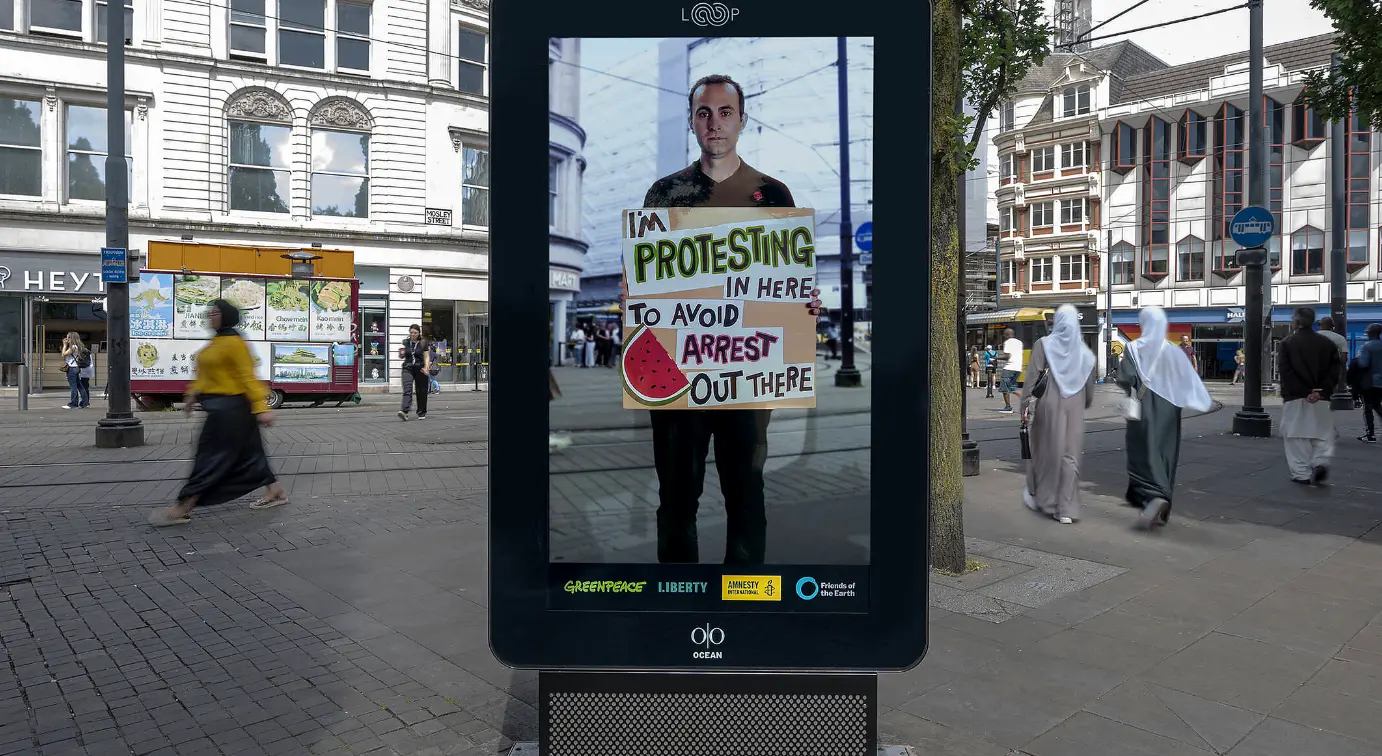
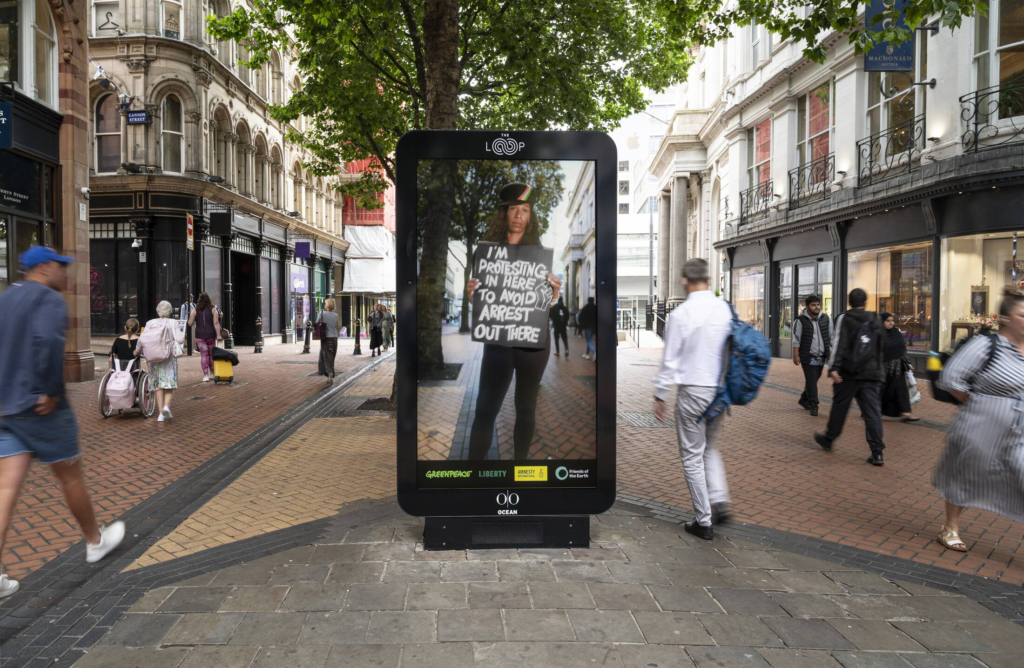
They Can’t Arrest This Billboard launched on July 3, 2025, as a simultaneous digital protest across three UK cities. Six high-profile activists appeared life-size on Digital Out of Home screens on Ocean Outdoor’s city centre Loop networks in Birmingham and Manchester, and in a high-footfall area of Westfield Stratford in London. Each activist was filmed as if standing on the street. Each held a placard carrying the same line: “I’m protesting in here to avoid arrest out there.”
The six activists and the issues they represent are: Khalid Abdallah, actor and protestor for Palestinian rights; Dr Helen Salisbury, GP and protestor for Keep Our NHS Public; Andy Greene, disability rights activist with Disabled People Against the Cuts; Andrew McParland, climate activist and Greenpeace UK board member; Jen Reid, author and Black Lives Matter activist; and Sahanika Ratnayake, an academic who protests on environmental issues. Each is a real person who has protested in public in the past and faces genuine legal risk in doing so again under the current legislative environment.
Outdoor audiences moving along the virtual OOH protest routes encountered the activists in sequence, exactly as they would in a real-life demonstration moving through a public space. A scannable QR code on each screen provided more information about which democratic rights are at risk under the Crime and Policing Bill currently making its way through Parliament.
The Legislation That Made the Campaign Necessary
The campaign specifically targets two pieces of legislation passed since 2022: the Police, Crime, Sentencing and Courts Act 2022 and the Public Order Act 2023. Together, these laws significantly expanded police powers to restrict protests, introduced new offences around causing serious disruption, and criminalised the kind of slow-walking and assembly that had previously been considered lawful demonstration.
Liberty, one of the campaign’s partner organisations, has consistently argued that these powers are disproportionate and have been applied unevenly, with a chilling effect on peaceful protest well beyond the cases that result in arrest or charge. The arrest-to-charge ratio that Greenpeace documented, 600-plus arrests, 18 charges, is the statistical evidence of that chilling effect in practice.
Caroline Davison, Managing Director and Sustainability Lead at ELVIS, described what the campaign was built to make visible: “The freedom to make your voice heard is a cornerstone of democracy. Yet in recent years, this freedom has been progressively eroded by legislation that has left many activists afraid to even attend a peaceful demonstration. With this campaign, we wanted to draw the public’s attention to the increasing restrictions placed on peaceful protest and to call for a return to the rights that underpin our democracy.”
The Creative Decision
The campaign’s most precise creative decision is the medium. A billboard cannot be arrested. It cannot be moved on. It cannot be charged with conspiracy to cause public nuisance. Placing the protesters inside DOOH screens does not protect the activists outside on the street, but it creates an image that the legislation cannot touch, which is the campaign’s entire argument made physical and visible across three city centres simultaneously.
The placards each activist holds do not describe the campaign’s argument. They are the campaign’s argument. “I’m protesting in here to avoid arrest out there” contains the full brief in eleven words. The placard does what a placard has always done: it names the issue, it identifies the person, and it signals their refusal to be silent, even when silence is what the law is designed to produce.
The Recognition and the Partners
The campaign was awarded the Gold prize in the non-profit category of Ocean Outdoor’s annual Digital Creative Competition, which recognises work that pushes the boundaries of DOOH as a medium. The campaign was developed in partnership with Amnesty International UK, Friends of the Earth, and Liberty, each of which forms part of the broader coalition calling on the government to reverse the anti-protest legislation.
The campaign is not asking for anything beyond what existed in the United Kingdom before 2022. It is asking for the restoration of rights that were not considered controversial when they were exercised, before two Acts of Parliament made their exercise legally risky.
Campaign Name: They Can’t Arrest This Billboard
Agency Name: ELVIS / Managing Director: Caroline Davison / Media Partner: Ocean Outdoor
Brand Name: Greenpeace UK
Location: Birmingham, Manchester, Westfield Stratford, London, United Kingdom (DOOH; launched July 3, 2025)