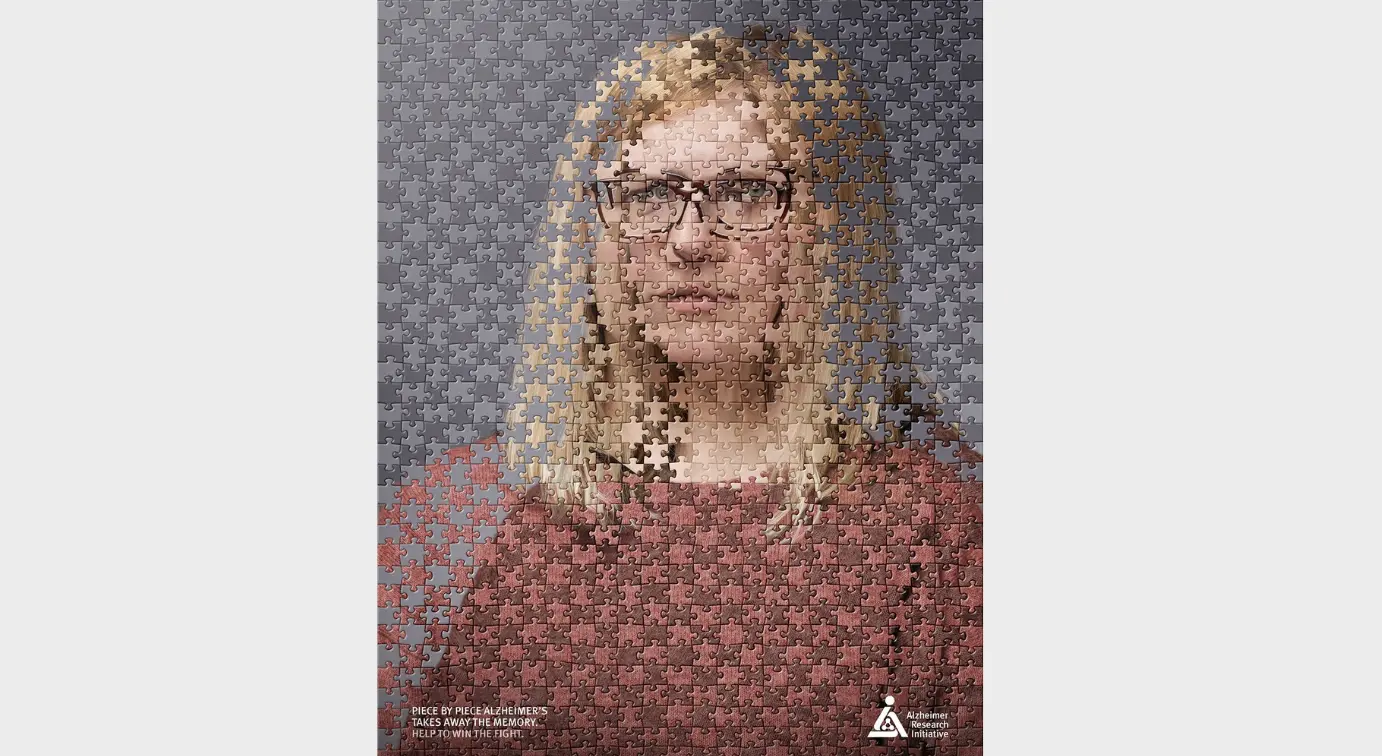
A family portrait is one of the most emotionally loaded objects in a home. It holds the faces of the people who matter most, fixed at a moment in time, proof that they existed and that you existed together. For someone with Alzheimer’s disease, that same photograph becomes something else entirely: a collection of faces that no longer connect to names, memories, or meaning. BBDO Group Germany made that experience visible in April 2018 through a campaign for Alzheimer Forschung Initiative that turned four family portraits into something their subjects would no longer be able to recognise.
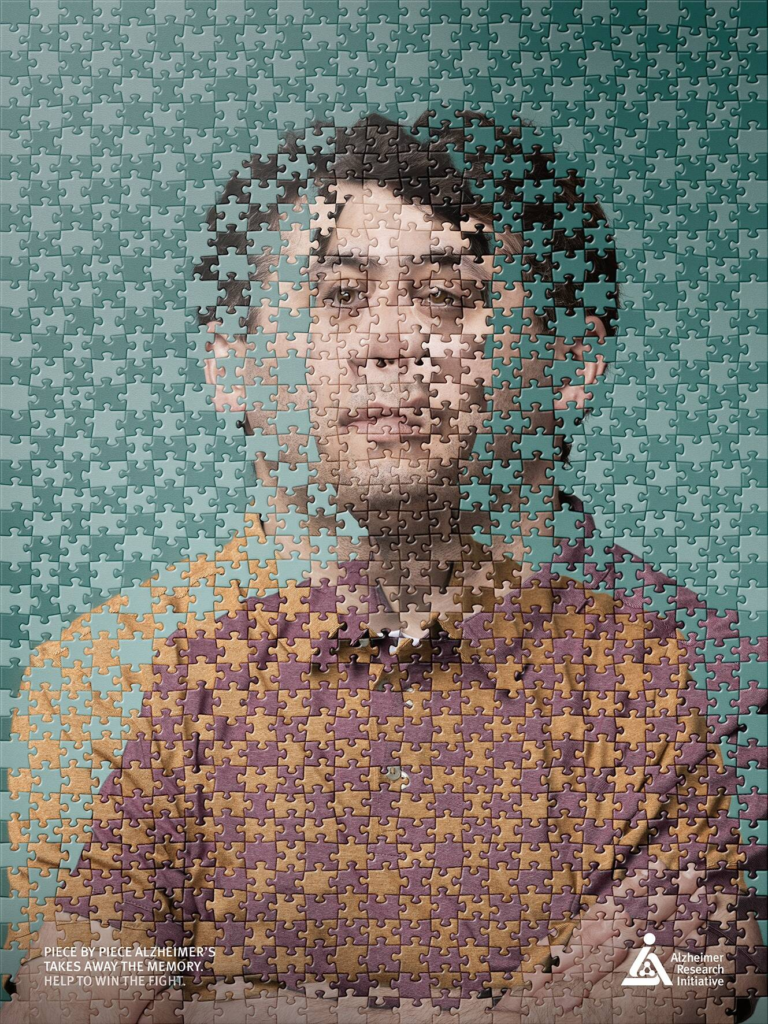
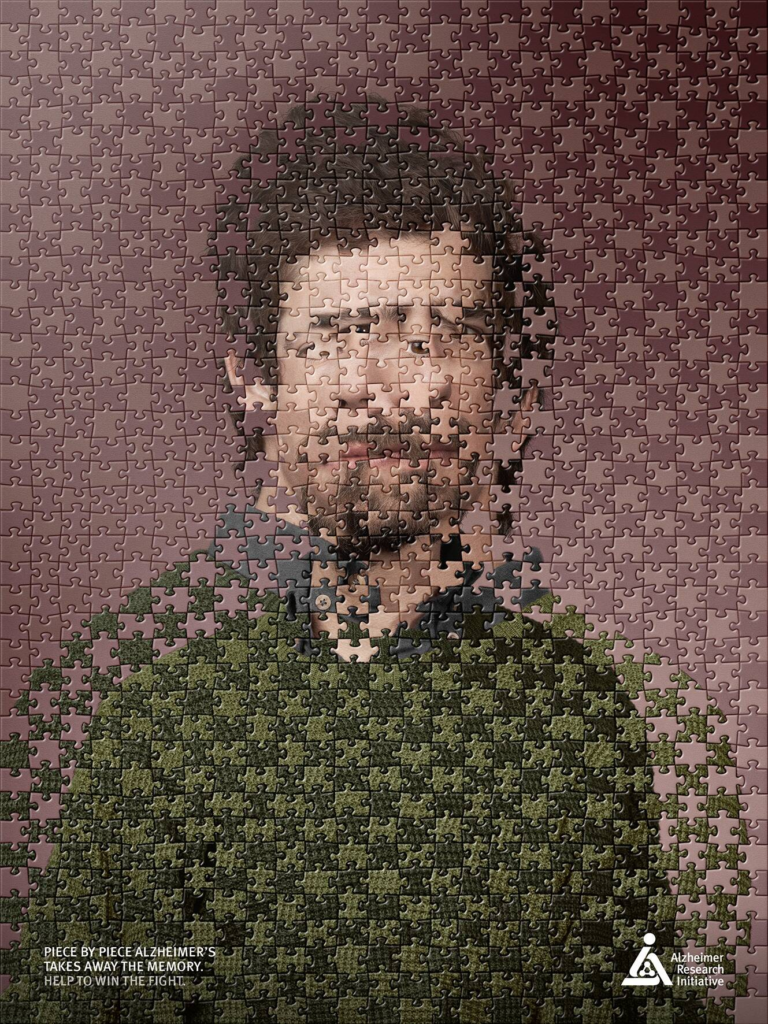
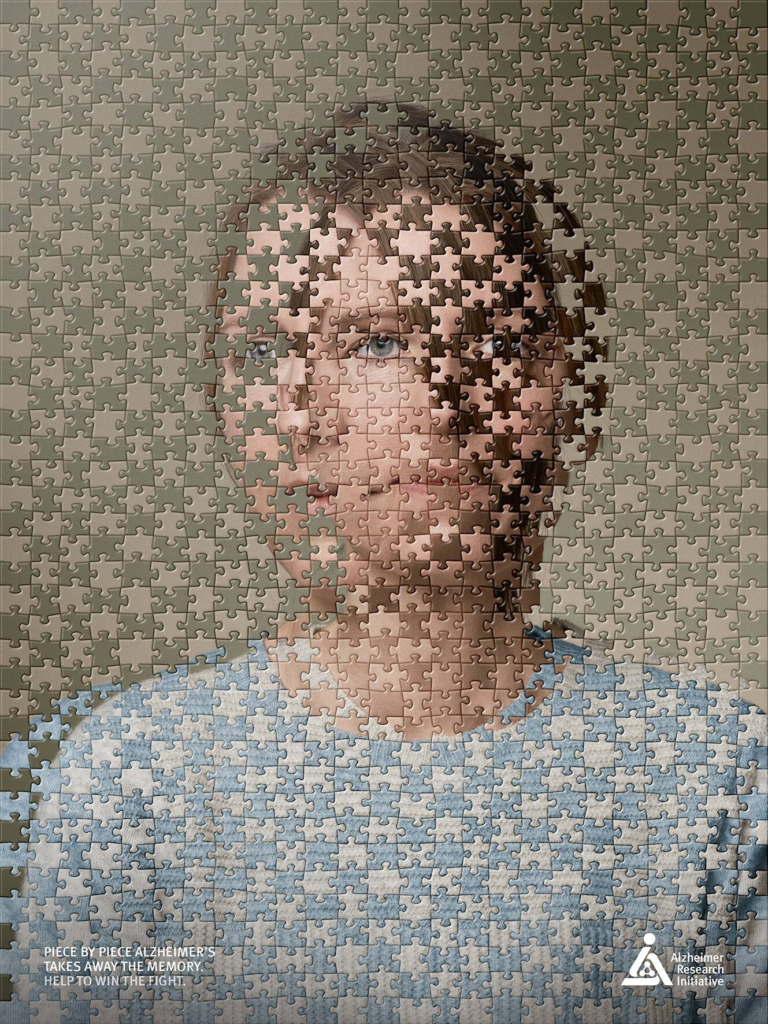
The Campaign
Remember Me is a four-piece print campaign in which each image shows a family portrait that has been physically cut into pieces and reassembled incorrectly. The photographs are real portraits of real families. Their faces are present in each image. But each face has been cut, shuffled, and recombined so that Sarah’s eyes sit above Farhad’s nose, a child’s chin rests beneath an elder’s forehead, a husband’s hairline appears above a stranger’s expression. The result is a face that is simultaneously familiar and completely unrecognisable. You know you are looking at a person. You cannot tell who.
The jigsaw technique used in the campaign was developed by Alma Haser, a German-born portrait photographer based in the UK whose practice is built around cutting, folding, and reassembling photographic prints to create layered, three-dimensional imagery. Her Cosmic Surgery portrait series, in which she printed duplicate photographs and folded origami shapes from one to place onto the other, established the specific visual language that BBDO identified as the precise available analogy for how Alzheimer’s scrambles facial recognition. Haser’s technique is not digital manipulation. It is a physical act performed on a physical print, which gives each image in the campaign a texture and a presence that a screen-based technique would not have produced.
The Scale of the Problem in Germany
At the time of the campaign’s publication, 1.2 million Germans were living with Alzheimer’s disease. Alzheimer Forschung Initiative, the German foundation dedicated to funding Alzheimer’s research, projected that figure would reach three million by 2050. Despite those numbers, public understanding of what Alzheimer’s actually does to a person’s experience, as opposed to the clinical fact of memory loss, remained limited. The campaign was built to close that gap in a format that could be felt rather than simply processed.
Germany does not have a cultural tradition of large-scale public Alzheimer’s awareness campaigns. The disease carries significant social stigma, and families managing a relative with Alzheimer’s frequently do so in private. BBDO’s brief was to produce something that reached beyond the community of carers and patients and into the general public, creating a first-person experience of the disease’s most isolating consequence: the moment a loved one’s face becomes unrecognisable.
Why the Format Works
A clinical description of Alzheimer’s facial recognition loss is accurate but not experiential. A statistic about the number of Germans living with the disease is important but not felt. The Remember Me portraits are neither of those things. They are pictures of people who look like they should be recognisable, whose faces contain all the elements of identity, eyes, mouth, nose, hairline, and yet cannot be resolved into anyone the viewer knows or can name.
That experience, of looking at a face and being unable to make it cohere into a person, is the specific sensation Alzheimer’s produces in its patients when they look at the people they love. The campaign does not describe that sensation. It produces it in the viewer, using nothing more than scissors, photographic prints, and the jigsaw idea Alma Haser had already been exploring in her own artistic practice.
The campaign’s tagline names each portrait by the first name of the person being forgotten: Remember Me, Sarah. Remember Me, Farhad. The name is the only information the viewer has. The face in front of them cannot confirm it.
The Recognition
Remember Me won a Silver Lion at the Clio Awards 2018 in Print and Out of Home Technique, a Bronze Lion in the Clio Health category, a D&AD Pencil in 2019 in Public Service Poster Advertising, and a Merit Award at The One Show 2019 in Print and Outdoor. The D&AD and One Show recognition confirmed the advertising industry’s assessment that the campaign had achieved something in the print medium that most campaigns of any format do not: making an abstract condition physically present for the viewer who has never experienced it.
Campaign Name: Remember Me
Agency Name: BBDO Group Germany, Düsseldorf / CCO: Wolfgang Schneider / Creative Managing Director: Kristoffer Heilemann / Executive Creative Directors: Daniel Haschtmann, Tobias Feige / Creative Directors: Sebastian Steller, Jacobo Concejo / Art Directors: Martino Monti, Dejan Handjiski / Jigsaw Idea: Alma Haser / Copywriter: Sebastian Steller / Photographer: Stefan Kranefeld
Brand Name: Alzheimer Forschung Initiative
Location: Germany (print campaign, April 2018)