
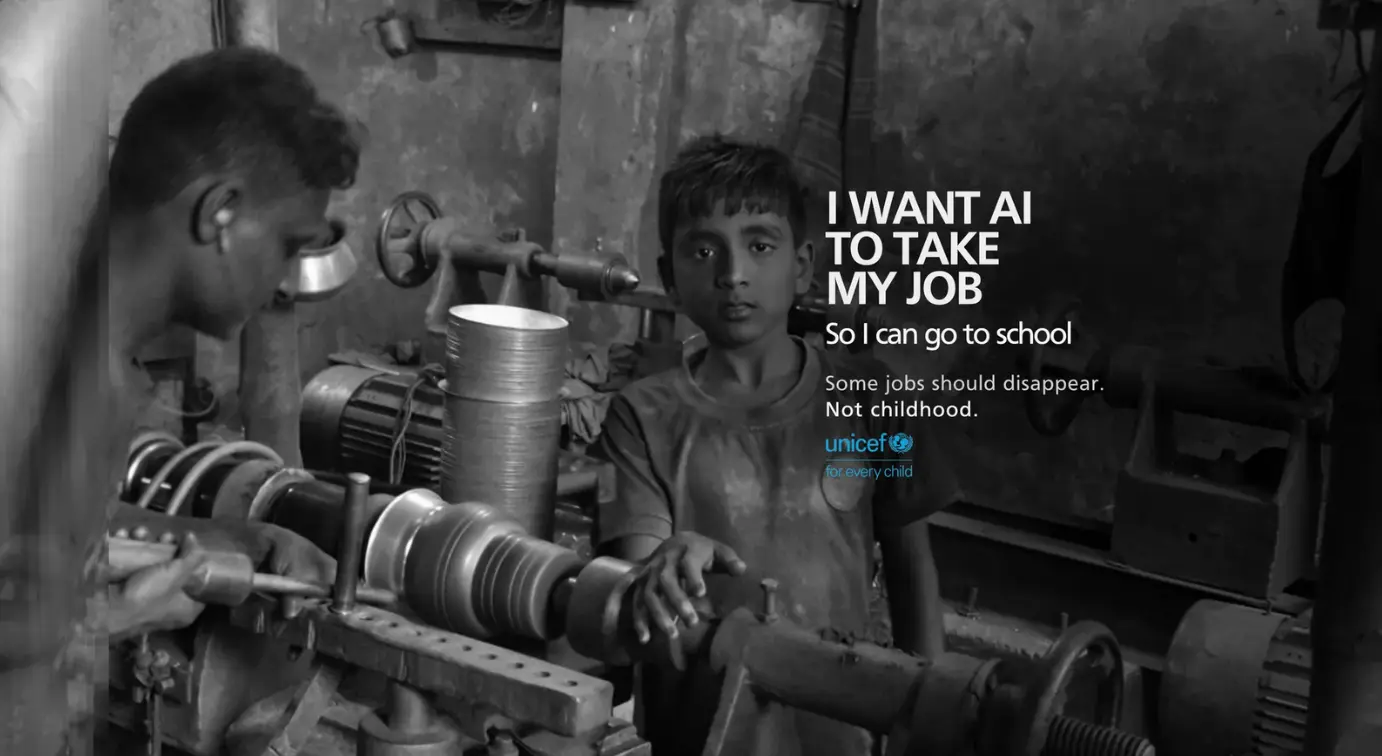
Every conversation about artificial intelligence replacing jobs is built around adult anxiety. Careers disrupted. Livelihoods threatened. Identities erased by automation. UNICEF and copywriter and designer Arun Anoop looked at that conversation and found the one person for whom the fear runs in the opposite direction: a child doing work they should never have been doing at all.
The Campaign
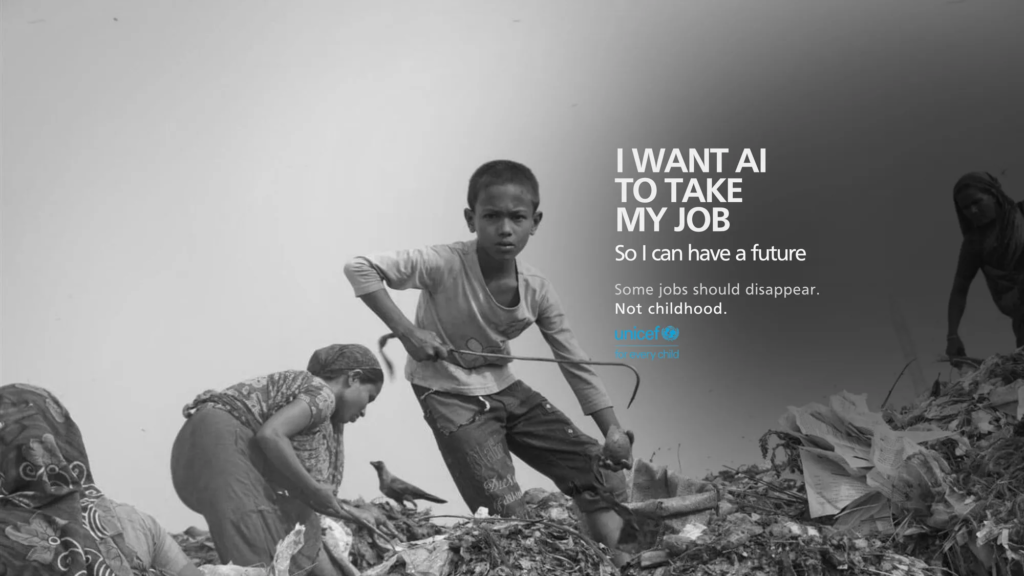
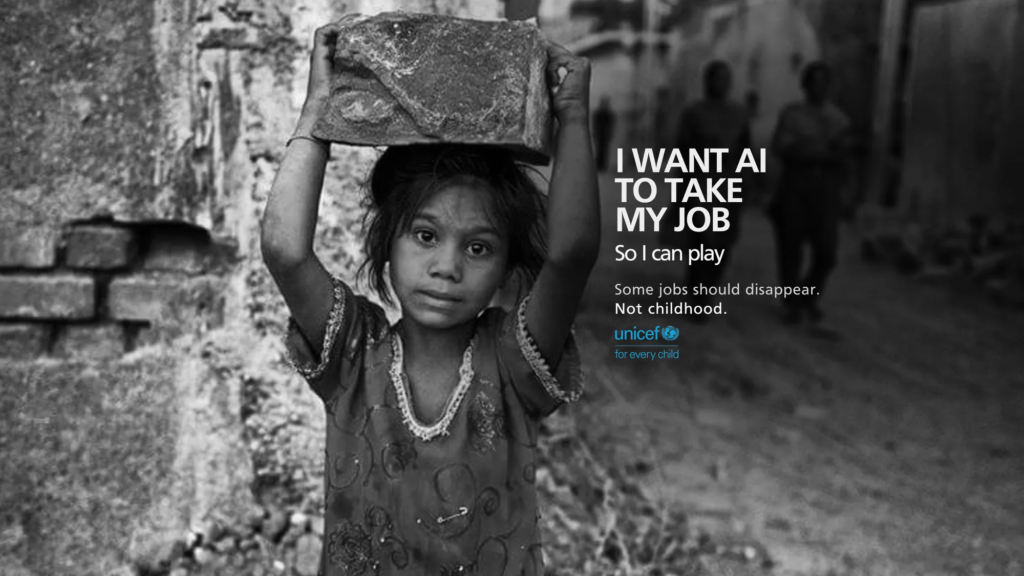
I Want AI to Take My Job is a print campaign published in May 2026. The headline appears inside child labour environments: workshops, factories, construction sites, and homes where children are working instead of being in school, playing, or simply being children.
“I WANT AI TO TAKE MY JOB.”
The line is designed to feel wrong the moment it is read. It does not feel wrong because it is incorrectly written. It feels wrong because the speaker is a child. Every adult who has read a headline about automation replacing workers has encountered that sentence as a statement of threat or loss. Here it arrives as a statement of hope. The switch forces the viewer to stop and stay with the discomfort of what they are looking at.
The supporting lines that follow each headline execution make the campaign’s argument explicit without over-explaining it. “So I can go to school.” “So I can be a child.” The closing line that anchors the campaign delivers its final point with the simplest available structure: “Some jobs should disappear. Not childhood.”
The Reversal the Campaign Is Built On
The campaign’s creative mechanism is a single, precise reversal of speaker and context. The same words that carry adult professional anxiety carry something entirely different when placed in the mouth of a child working in a factory or a construction site. The audience arrives at the image expecting one emotional register and encounters another.
That switch does not require explanation. It requires only the image, the headline, and the moment of recognition that follows. A child wanting to be replaced by a machine is not a statement about technology. It is a statement about what that child’s life currently contains and what it should contain instead.
The campaign deliberately avoids the visual language of technology. There are no robots, no digital interfaces, no speculative imagery of automated futures. The settings are physical, ordinary, and immediately uncomfortable. That restraint is the campaign’s most considered production decision. Making the campaign look futuristic would place the viewer in the debate about artificial intelligence. Keeping it grounded in the immediate physical reality of child labour keeps the viewer in the debate about the children themselves.
The Scale of the Problem the Campaign Names
The issue behind the campaign is not hypothetical. According to UNICEF and ILO estimates released in 2025, nearly 138 million children were engaged in child labour globally in 2024. Approximately 54 million of those children were in hazardous work likely to affect their health, safety, or development. The industries where child labour is most prevalent include agriculture, domestic work, manufacturing, mining, and construction, precisely the environments where adults most frequently discuss the threat of automation.
The cultural timing of the campaign is what gives it its particular edge. Artificial intelligence and job displacement have dominated public conversation for three years running. That conversation has generated widespread anxiety, legislative activity, and significant media coverage. Child labour, which affects 138 million children across sectors that predate any discussion of automation, receives a fraction of that attention despite representing a crisis of documented and ongoing scale.
I Want AI to Take My Job uses the current conversation as a door. The audience enters through the AI headline and finds child labour on the other side. The campaign does not ask people to abandon the AI conversation. It asks them to notice what they have been looking past while having it.
Why the Format Works
The print format suits the idea precisely. A single image, a headline that stops the viewer, and a short follow-up line are sufficient to deliver the entire argument. The campaign does not need a film, a data visualisation, or a multi-channel activation to work. It needs a reader to pause, read, and feel the wrongness of a child wanting a machine to take their job.
That wrongness is the campaign’s entire creative output. Not a solution. Not a technical argument about automation policy. A sentence placed in a context that makes its meaning impossible to avoid.
The best social impact advertising uses the language of the moment without becoming trapped by the trend it borrows from. I Want AI to Take My Job is not about artificial intelligence. It uses artificial intelligence to make an argument about childhood that should not have needed a new technology debate to be heard.
Campaign Name: I Want AI to Take My Job
Agency Name: Not mentioned / Copy and Design: Arun Anoop
Brand Name: UNICEF
Location: Not mentioned (print campaign, May 2026)


