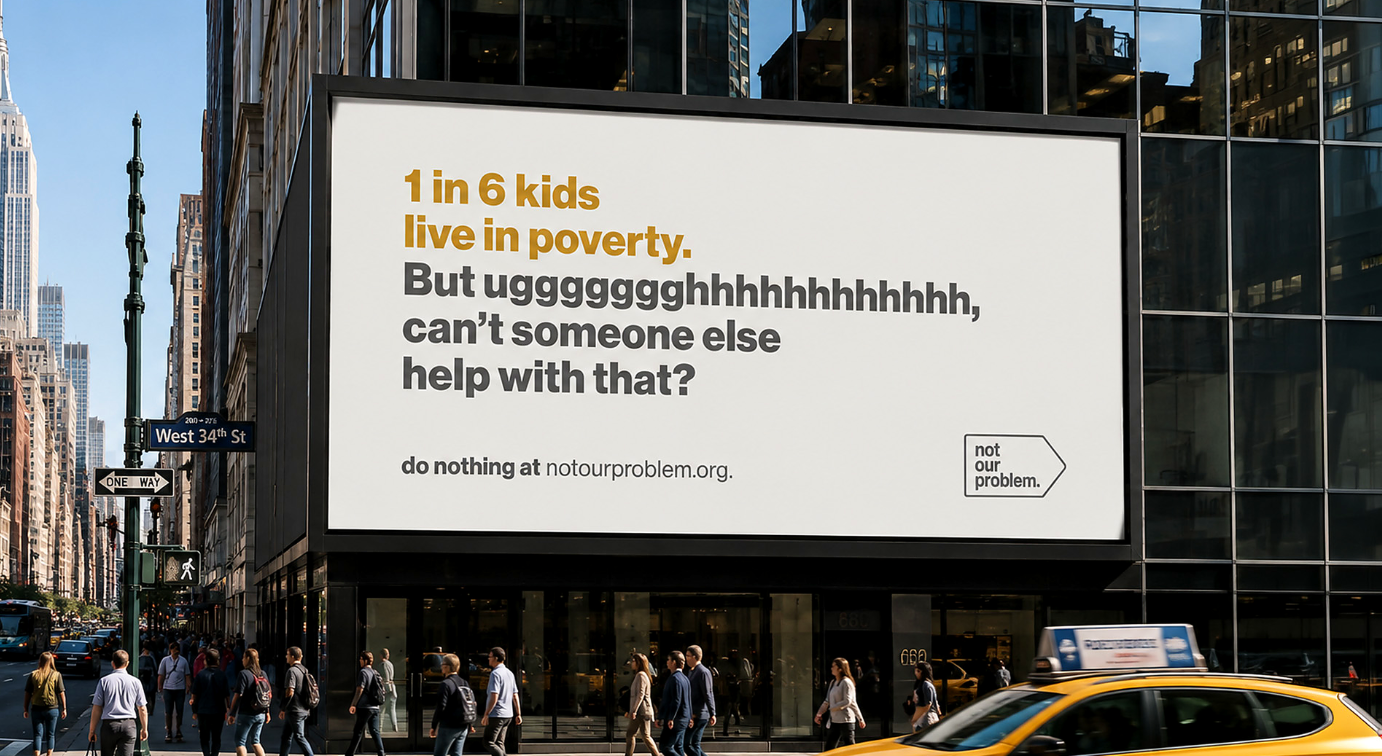
Child poverty is not an invisible problem in the United States. 11 million children are currently destitute in the US alone, and yet most adults are unwilling to take the time to help. The barrier is not ignorance. Most people are aware that child poverty exists. The barrier is the specific, ordinary, entirely human tendency to assume that someone else will handle it. Comic Relief US and Quality Meats decided to give that tendency a name, a logo, a website, and a satirical advertising campaign of its own.
The Campaign
This one is for the people committed to doing absolutely nothing about childhood poverty. That is the satirical premise behind “Not Our Problem,” a PSA featuring ordinary people proudly explaining why childhood poverty simply is not their responsibility. NotOurProblem.org is completely fake. But the excuses behind it are painfully real.
The ad, directed by Brad Morris, includes testimonials from people who confidently explain why childhood poverty is not their concern. “I’m taking a stand,” says one person, and another finishes the sentence: “Then I’m sitting back down.”
Throughout the spot, a cast of ordinary people confidently explain why childhood poverty is not their concern, standing up to “take action” against standing up in the first place, culminating in a deadpan reveal that redirects viewers to real solutions.
The Out-of-Home
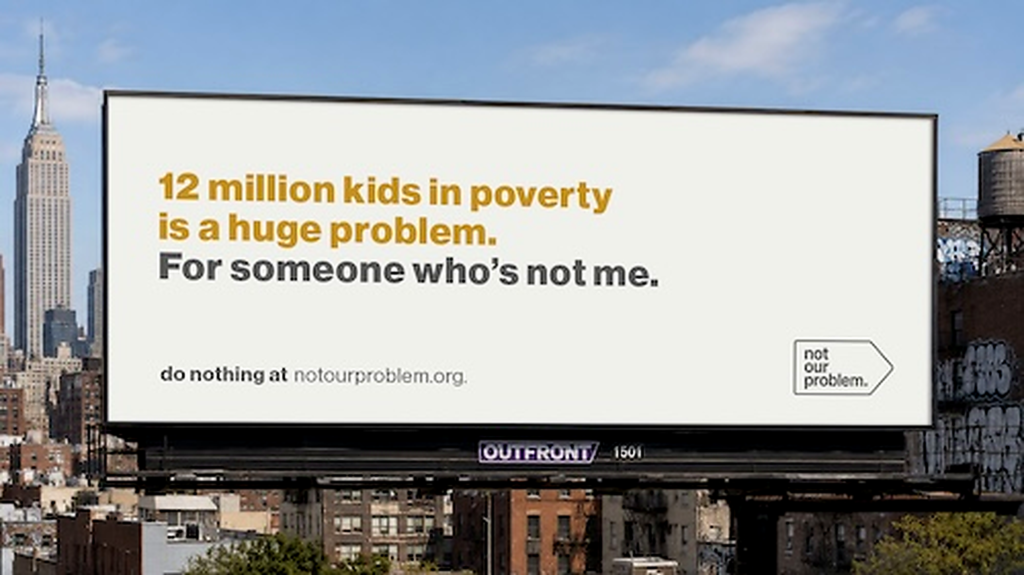
The campaign’s OOH executions are the sharpest expression of the satirical premise. A large-format billboard in New York, placed with the Empire State Building visible in the background, carries the line: “12 million kids in poverty is a huge problem. For someone who’s not me. Do nothing at notourproblem.org.”
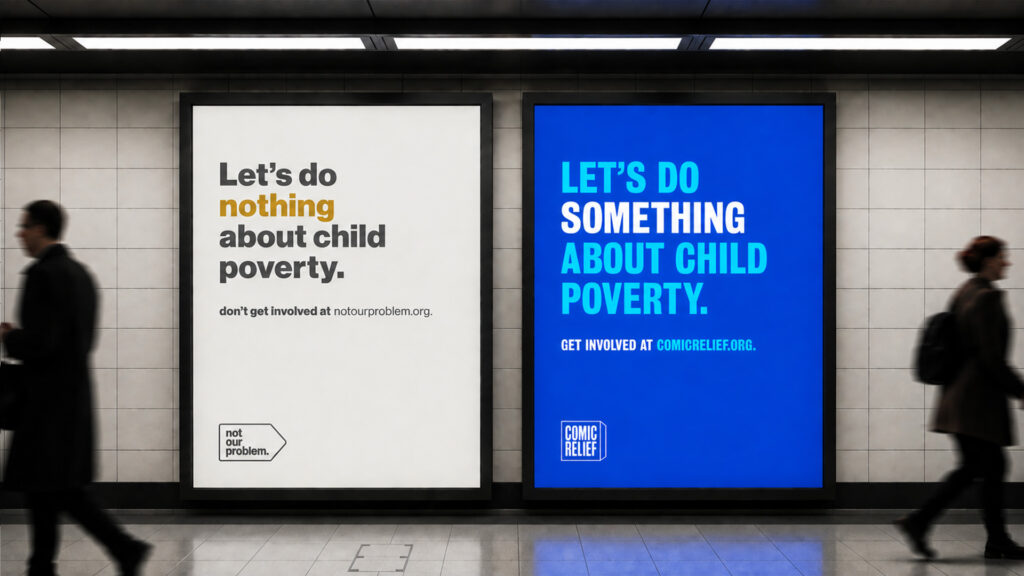
A second execution, placed in subway stations as a side-by-side pair, shows two boards with near-identical copy pointing in opposite directions. On the left, in “Not Our Problem” branding: “Let’s do nothing about child poverty. Don’t get involved at notourproblem.org.” On the right, in Comic Relief blue: “LET’S DO SOMETHING ABOUT CHILD POVERTY. GET INVOLVED AT COMICRELIEF.ORG.”
The side-by-side format makes the campaign’s structural logic visible in a single glance. The satirical nonprofit and the real nonprofit occupy the same physical space, the same typography scale, the same poster frame, separated only by colour and one word. The viewer sees both simultaneously, which means the joke and the call to action land at the same moment rather than in sequence.
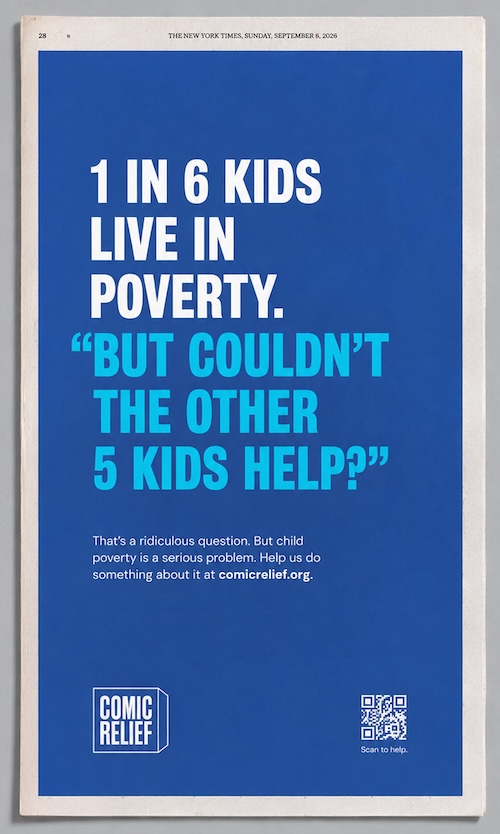
Out-of-home and print placements in the Not Our Problem voice lean fully into the satire, while Comic Relief branded messaging counters by turning the joke into a direct call to action: “Someone should do something about childhood poverty. How about you, person reading this?”
The Strategic Logic
The campaign challenges the so-called bystander effect through a short film and out-of-home advertising that spotlights people’s indifference to the issue.
The bystander effect is the documented psychological phenomenon in which individuals are less likely to offer help in a situation when other people are present, because each person assumes that someone else will act. Applied to systemic social problems like child poverty, the bystander effect scales: the larger and more visible the problem, the more easily any individual can assume that the scale of the problem places its solution beyond their personal responsibility.
The PSA gives everyday apathy a name, a logo and a campaign of its own. When those familiar excuses are said out loud, they sound completely absurd.
Michele Ganeless, Chief Executive Officer of Comic Relief, described the urgency behind the campaign’s satirical approach: “Childhood poverty is a national problem happening in our own backyards, it is entirely solvable, and we can’t afford to wait any longer.”
The Activation Layer
Kicking off on September 19 in Los Angeles at the historic Paramount Pictures Studio Lot, these in-real-life gatherings give people the opportunity to meet their neighbours and connect directly with local organisations working to end childhood poverty. The inaugural festival in LA pairs hands-on volunteering with entertainment, and features comedy performances from groups including The Groundlings and UCB.
The neighbourhood festival format is the campaign’s most considered strategic decision. The satirical campaign names the bystander effect and makes it absurd. The festival removes the bystander condition entirely by placing people in a room with neighbours they already share a community with and local organisations who need help they can actually provide. The campaign moves from naming the problem of inaction to creating the conditions for action.
Why the Format Works
Traditional cause advertising asks the audience to care about a problem. The “Not Our Problem” campaign asks the audience to recognise themselves in a character who does not care, which is a significantly more effective psychological approach for the specific barrier it is trying to overcome.
A person who watches the film and recognises their own internal monologue in the excuses being offered aloud has been reached in a way that a statistic cannot reach them. The laughter produces the recognition. The recognition produces the discomfort. Comedy draws audiences in, then confronts them with the uncomfortable truth behind the joke. As the campaign puts it: “It would be funnier if it weren’t so true.”
This is Comic Relief’s first dedicated, brand-focused national campaign and extends from national reach into neighbourhood action. The fake nonprofit website redirects immediately to Comic Relief’s real donation and volunteer page, converting the joke’s traffic into genuine charitable action.
Campaign Name: Not Our Problem
Agency Name: Quality Meats / Co-Founders and Co-CCOs: Brian Siedband and Gordy Sang / Creative Directors: Matt McCabe and Alyssa Trocina / Director: Brad Morris / DoP: Beth Napoli / Post: Echobend
Brand Name: Comic Relief US
Location: United States (TV, OOH, print, digital, audio, social; neighbourhood festivals in Los Angeles and Philadelphia; launched September 2026)