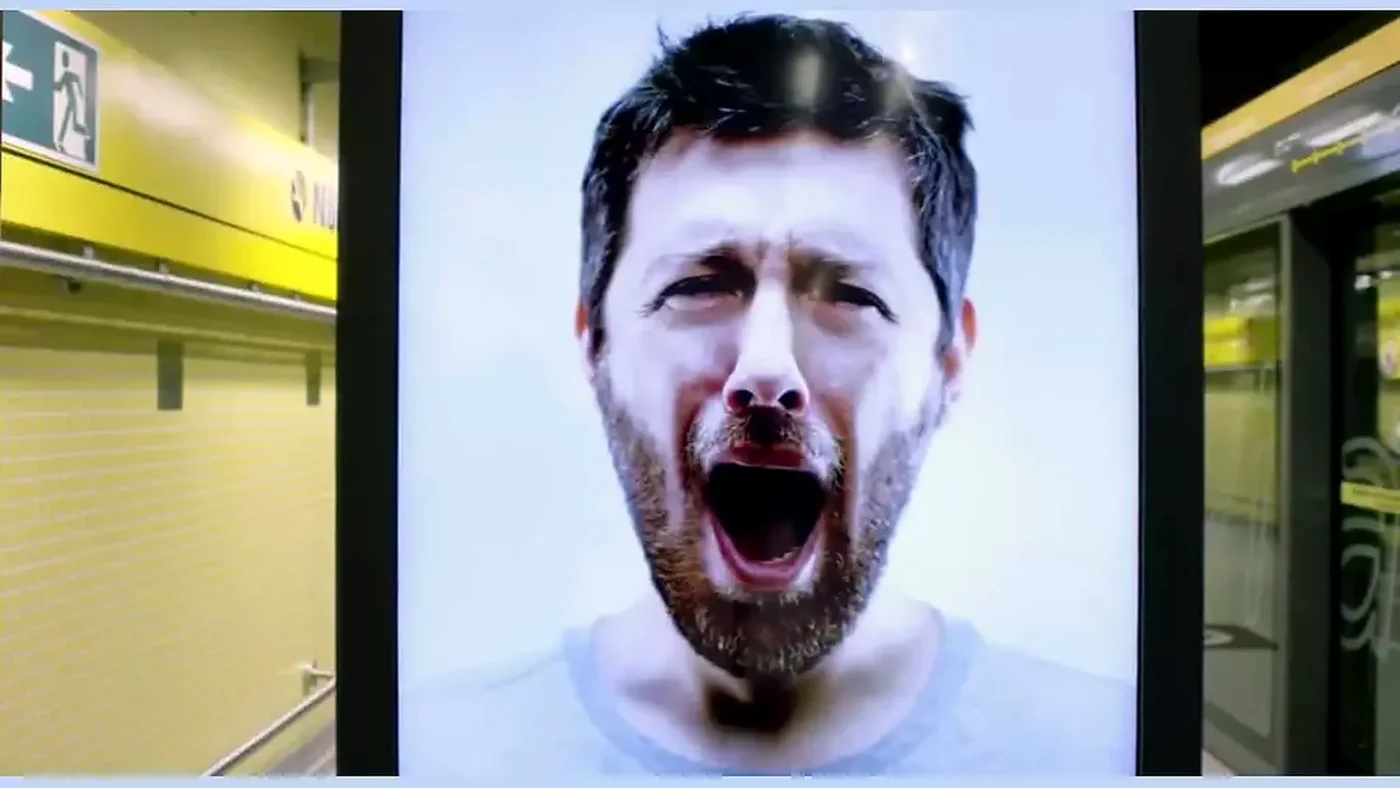
Most coffee advertising tells you that you need coffee. Café Pelé and Lew’Lara\TBWA made your body tell you instead. In May 2015, inside the Fradique Coutinho metro station in São Paulo during morning rush hour, a digital billboard played a video of a man yawning. By the time most commuters had passed it, they were yawning too, and a crew of brand ambassadors was already approaching with free espresso shots.
The Science Behind the Stunt
Contagious yawning is one of the most consistently documented involuntary human responses in behavioural science. Approximately 70% of people yawn when they see someone else yawn, read about yawning, or even think about it at length. The precise neurological mechanism remains a subject of ongoing research, with theories ranging from mirror neuron activation to empathic response, but the outcome is consistent: exposure to a yawn produces a yawn. Café Pelé and Lew’Lara\TBWA identified this as the most direct available route to making a commuter feel the specific sensation that coffee is designed to address, without a single word of product communication.
How the Billboard Worked
The installation at Fradique Coutinho was a digital panel equipped with a hidden motion sensor. When a commuter walked close to the screen, the sensor registered their presence and triggered the video of a man yawning. The frequency and intensity of the on-screen yawning scaled with the number of people in the vicinity. The more commuters gathered or passed, the more the man on the screen yawned, and the more the contagion spread through the crowd.
After the yawning sequence played out, the screen changed. The message that replaced the yawning man read: “Did you yawn too? It’s time for coffee.” At that precise moment, Café Pelé brand ambassadors appeared on the platform with trays of espresso shots, distributing free coffee to the commuters who had just been involuntarily persuaded they needed it.
The full creative team from Lew’Lara\TBWA included Chief Creative Officer Manir Fadel, Executive Chief Creative Felipe Luchi, Copywriter Lucas Veloso, and Art Directors André Mezzomo and Digo Souto.
The Creative Logic
The Contagious Billboard is a precise structural inversion of how advertising usually works. Standard advertising presents a product benefit and asks the consumer to project themselves into a scenario where they would need it. The Contagious Billboard skipped the projection. It produced the need in real time, using the viewer’s own biology as the mechanism, and then arrived with the solution in the same moment.
Felipe Luchi, Executive Chief Creative at Lew’Lara\TBWA, described the underlying principle the campaign was built on: Marketing 101 instructs that advertisers must create a need for the product and then demonstrate how it fulfils that need. The Contagious Billboard demonstrated how those two principles could be executed simultaneously, using technology and physical interaction together rather than separately.
The timing of the activation was as considered as the mechanism. Morning rush hour at a busy São Paulo metro station is precisely the environment where genuine tiredness and the desire for coffee are most likely to be present before the billboard introduces anything. The campaign arrived in a setting where its argument was already partially true for most of its audience, and simply made the truth visceral rather than conceptual.
Why It Has Been Studied Since 2015
The Contagious Billboard is still referenced across advertising curricula, experiential marketing case studies, and behavioural science discussions more than a decade after it ran. Its longevity as a reference point reflects what it achieved structurally. It is one of the earliest documented examples of a brand using biometric or behavioural response data, in this case the count of passing commuters as a proxy for social contagion conditions, to deliver a dynamic and physically participatory brand experience in a transit environment.
The campaign predates the widespread use of facial recognition and emotion-tracking in advertising, making the motion sensor’s blunt simplicity part of its appeal. The technology required was minimal. The insight required was precise. A yawning man on a screen in a subway station was enough, because 70% of the people walking past were always going to do the rest.
Campaign Name: The Contagious Billboard
Agency Name: Lew’Lara\TBWA, São Paulo / Chief Creative Officer: Manir Fadel / Executive Chief Creative: Felipe Luchi / Copywriter: Lucas Veloso / Art Directors: André Mezzomo, Digo Souto
Brand Name: Café Pelé
Location: Fradique Coutinho Metro Station, São Paulo, Brazil (May 2015)