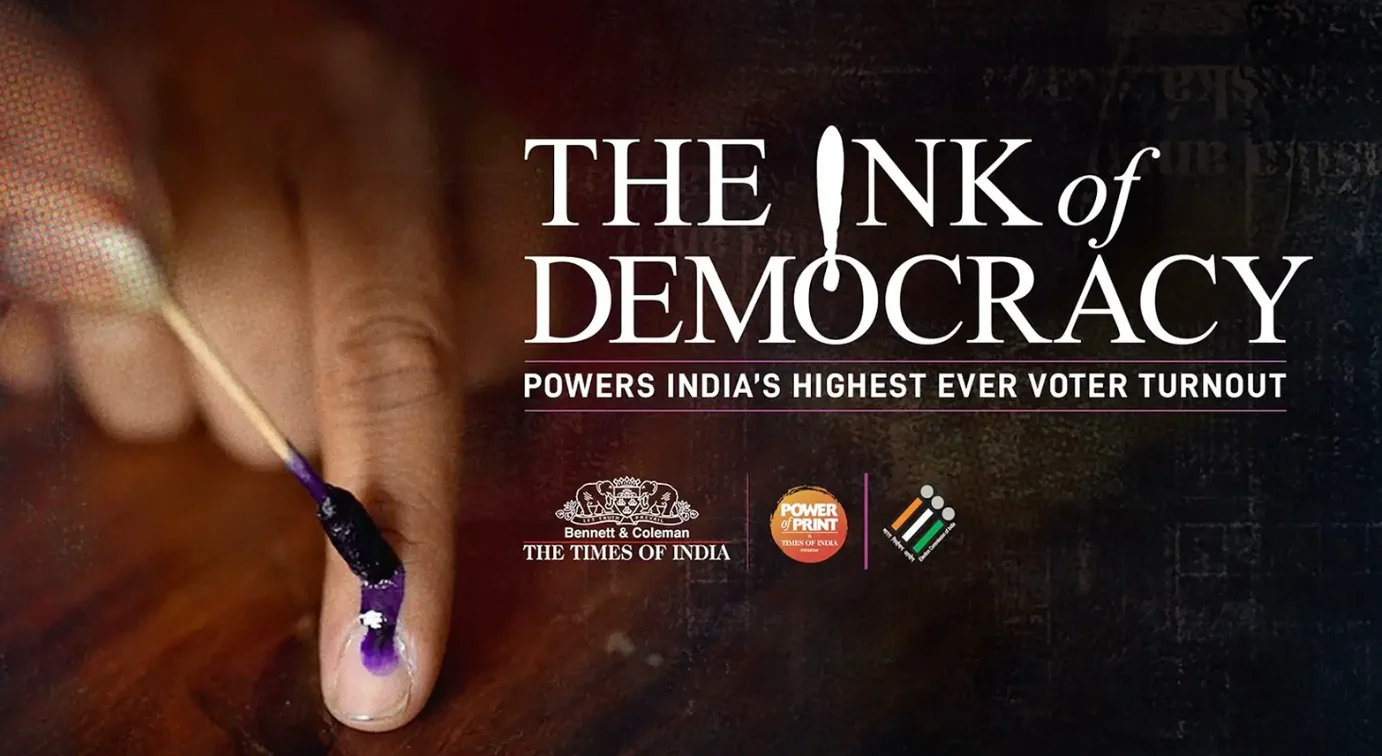
In India’s 2024 General Elections, 642 million people were eligible to vote. Roughly one in three did not. That absence had a physical consequence nobody had calculated before: 7,500 litres of electoral ink went unused. The purple ink applied to voters’ fingers at polling stations to prevent duplicate voting, one of India’s most recognisable democratic symbols, simply sat in containers across the country because the people it was meant to mark never showed up.
The Times of India and Havas Creative India decided to make that waste visible in the one medium where visibility was guaranteed: the newspaper itself.
The Campaign
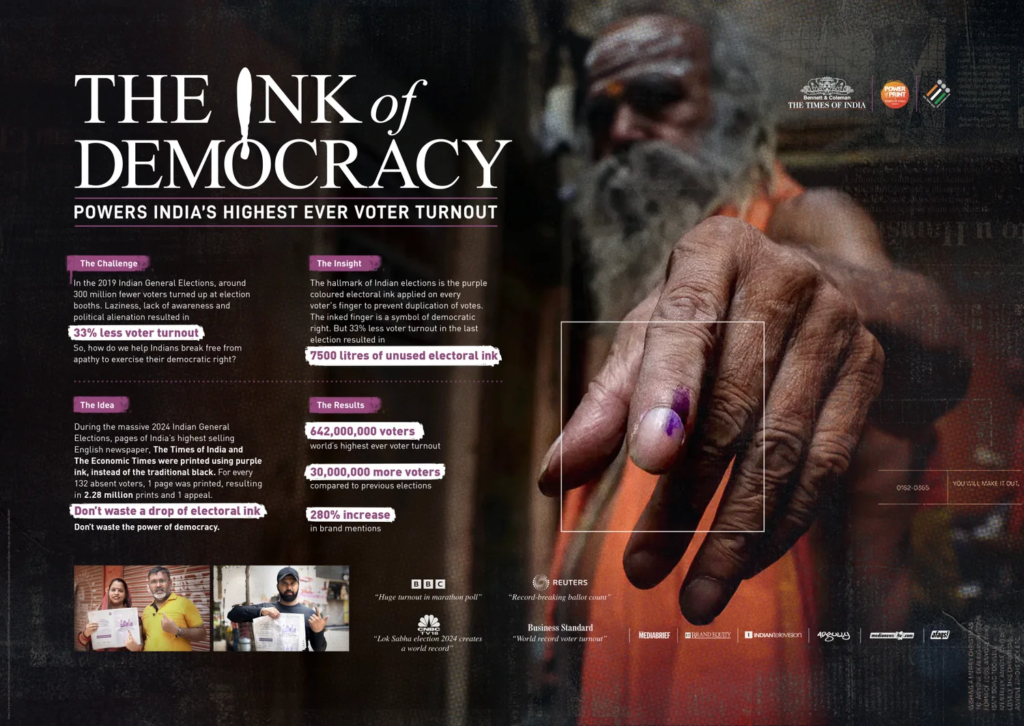
The Ink of Democracy campaign printed pages of The Times of India and The Economic Times in purple ink instead of black for the 2024 Indian General Elections. The calculation that drove the print decision was precise: for every 132 voters who stayed home, one newspaper page was printed in purple. Across Delhi, Mumbai, Bengaluru, and Kolkata, 2.28 million pages went out in that colour, timed to hit readers just before those cities were scheduled to vote.
The copy on each page was direct: “Don’t waste a drop of electoral ink. Don’t waste the power of democracy.”
The medium is the message in its most literal form. The purple ink on the page is the same colour as the mark that proves someone voted. Before elections, it was a reminder. After elections, it would become proof. The campaign moved it to the day before, turning an ink colour that symbolised participation into a public record of what gets wasted when people choose not to participate.
Why It Works
Voter apathy campaigns typically communicate through statistics. Percentages and turnout charts hold the data but not the feeling. Ink of Democracy gave the problem a physical form that readers could hold in their hands, look at, and immediately connect to something they already understood.
The colour purple carried no new meaning. It was the meaning. Every Indian who had voted before knew what the mark on their finger meant. Seeing that colour on their morning newspaper, without having been to a polling booth, landed the argument before a single word was read.
The choice of English-language newspapers as the medium was also considered rather than default. Urban voter turnout in India has consistently lagged behind rural turnout. English newspaper readership maps almost exactly onto the urban demographic the campaign most needed to reach: city residents whose abstention rates were the highest and whose polling schedules were the ones approaching that morning.
The Recognition
Havas Creative India won India’s first Gold Lion at Cannes Lions 2025 in the Print and Publishing category for Ink of Democracy. The One Show recognised it as a Direct Marketing winner in Print. Reported results include a 280% increase in brand mentions across social media with high positive sentiment for The Times of India following the campaign’s release.
Campaign Name: Ink of Democracy
Agency Name: Havas Creative India / Production: Galloping Horse Production Pvt Ltd / Music: Mr Pink Music
Brand Name: The Times of India / Bennett Coleman & Co Ltd
Location: Delhi, Mumbai, Bengaluru, Kolkata, India