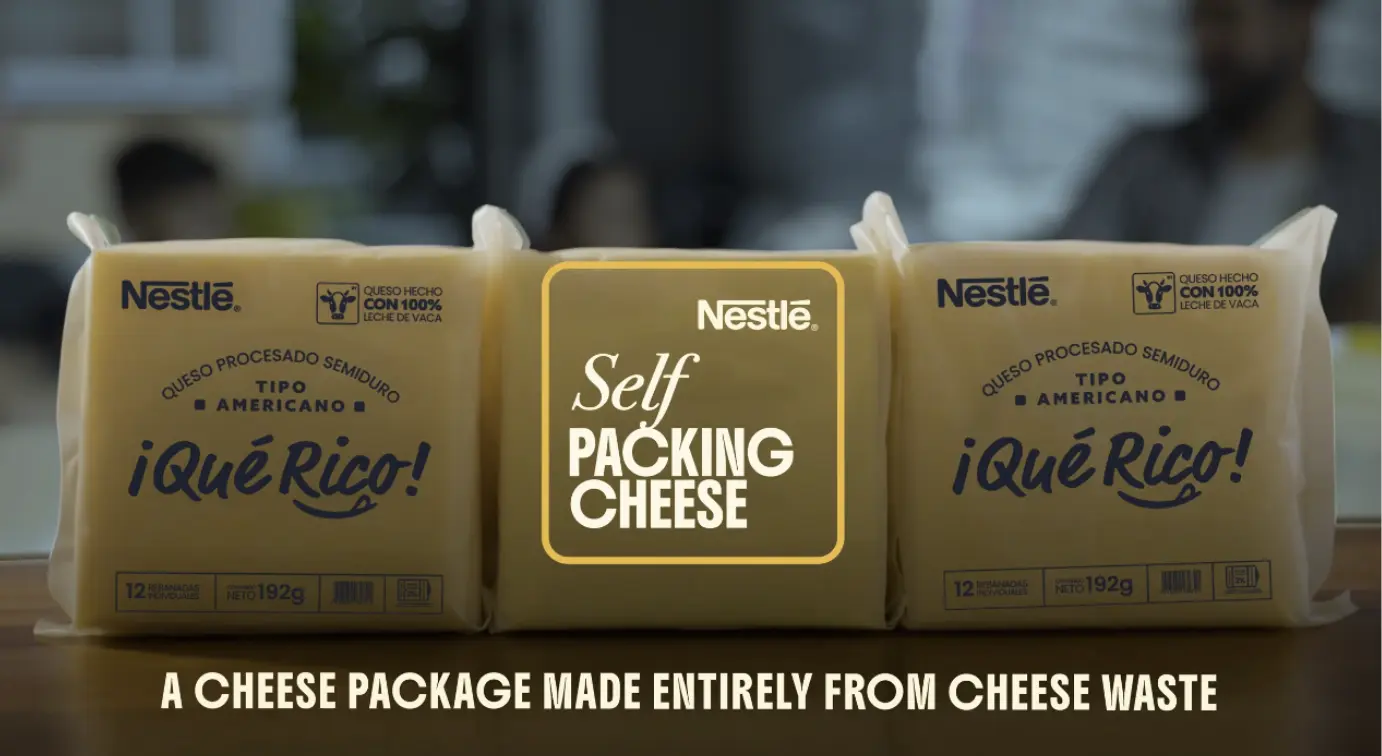
Every block of cheese that Nestlé produces generates a byproduct that most of the industry discards: whey. Billions of litres of it are produced globally every year. Left untreated, it depletes oxygen in rivers and lakes and damages ecosystems. In a pilot that launched in Panama in May 2025, Nestlé Central America and Ogilvy Colombia found a use for it that no consumer goods brand had attempted before. They turned it into the packaging that wraps the cheese it came from.
The Problem With Cheese Packaging
The plastic film used to wrap cheese has the same fundamental tension as most food packaging: it protects the product inside while creating waste that cannot easily be managed after consumption. Traditional plastic takes approximately 900 years to decompose. The food industry has been aware of this problem for decades without a solution that works at commercial scale, maintains food safety standards, and does not require an entirely new supply chain to implement.
Nestlé and Ogilvy Colombia identified that the solution to the cheese packaging problem was already present in the cheese manufacturing process itself. Chemical engineer Adrianna Sarmiento, who worked on the project, described the discovery directly: “We discovered that the solution was in the cheese itself. That’s why we created bioplastic from whey.”
The Science
Cheese whey is the liquid that remains after milk has been curdled and strained during cheesemaking. It is rich in proteins, lactose, and other compounds that have historically been considered low-value byproducts, despite having chemical properties similar to plastic precursors. In the Self-Packing Cheese process, whey undergoes a biotechnological transformation in which microorganisms are blended with the byproduct in a controlled laboratory environment. The fermentation process converts the whey’s components into polyhydroxyalkanoate, known as PHA, a biopolymer that replicates the functional properties of conventional plastic film.
The resulting compound initially takes the form of small pellets, which are then processed with injected air and transformed into thin, translucent, plastic-like sheets. These sheets form the packaging that wraps the finished cheese. The material meets FDA international food safety standards, maintaining the product’s nutritional properties, taste, and freshness without modification. The same film biodegrades in approximately 300 days under natural conditions, compared to 900 years for conventional plastic.
The Pilot
The Self-Packing Cheese innovation is currently being tested as both primary and secondary packaging for Nestlé’s ¡Qué Rico! cheese brand in Panama. The production target for the pilot is 5,500 tonnes of cheese wrapped entirely in 100% biodegradable whey-based packaging. A commercial rollout timeline has not been announced, but the pilot is described by both Nestlé and Ogilvy as a foundation for broader industry adoption rather than a one-market solution.
Kim Waigel, Director of Communications and Corporate Affairs at Nestlé Central America, described the initiative’s ambition: “Self-Packing Cheese is a milestone in our journey toward a circular economy. It’s a powerful example of how innovation can drive sustainable change and deliver real value to the communities we serve.”
The Ogilvy Impact Lab
Self-Packing Cheese is the first project from Ogilvy Colombia’s Impact Lab, an internal initiative designed to produce advertising solutions that function as genuine product and technology innovations rather than simply creative campaigns. The Impact Lab team identified the whey opportunity within the cheesemaking supply chain and developed the packaging concept alongside Nestlé’s technical teams and external biotechnology specialists.
Gastón Potasz, Chief Creative Officer of Ogilvy Colombia, described the philosophy behind the Impact Lab: “In pursuit of our creative excellence goals, we open our Impact Lab, a pioneering initiative designed to craft advertising solutions that seamlessly blend sustainability, technology, and innovation. We are proud of delivering ideas that inspire meaningful change in society and deliver tangible results for our clients. ‘Self-Packing Cheese’ stands as a clear testament to the significant accomplishments of the Impact Lab, as we identified an extraordinary opportunity in cheese production: utilising the whey to produce its own bio packaging, drastically reducing plastic usage. The product serves as a complete solution on its own.”
Fabio Quiroga, CEO of Ogilvy Andina, described the scale of what the innovation represents beyond the pilot: “SPC is a ground-breaking, real and tangible innovation, with significant potential to revolutionise the future of packaging due to its scalability. I couldn’t be prouder of the team, and grateful to our client Nestlé for letting us make ideas with purpose come true.”
The Double Impact
The Self-Packing Cheese project addresses two problems simultaneously. The first is the plastic waste generated by cheese packaging, a category where sustainable alternatives have been difficult to develop without compromising food safety or shelf life. The second is the whey waste generated during cheese production, a problem that affects the broader dairy industry globally and has documented environmental consequences when whey is discharged into water systems without treatment.
By converting one problem into the solution for the other, the Self-Packing Cheese creates what the project’s team describes as a circular economy within a single product category. The cheese wraps itself. The waste from making it becomes the tool for protecting it. Both problems disappear from the supply chain at the same time.
The campaign was shortlisted for the Innovation category at Cannes Lions 2025, placing it in the international conversation about where advertising and product innovation intersect. Whether or not it wins at that level, it has already demonstrated something more commercially significant: the packaging of the future may have been sitting in a cheesemaker’s waste container the entire time.
Campaign Name: Self-Packing Cheese / SPC
Agency Name: Ogilvy Colombia / Ogilvy Andina
Brand Name: Nestlé Central America / ¡Qué Rico!
Location: Panama (pilot production; launched May 2025)