In Bolivia, only one in four women know how to perform a breast self-examination or recognise the early symptoms of breast cancer. The awareness gap is not new. Campaigns addressing it are not new either. What Ogilvy Bolivia found, working with Ketal Hipermercados in October 2023, was a context in which that education could happen naturally, repeatedly, and without any clinical barrier between the message and the person it needed to reach: the supermarket fruit aisle.
The Insight
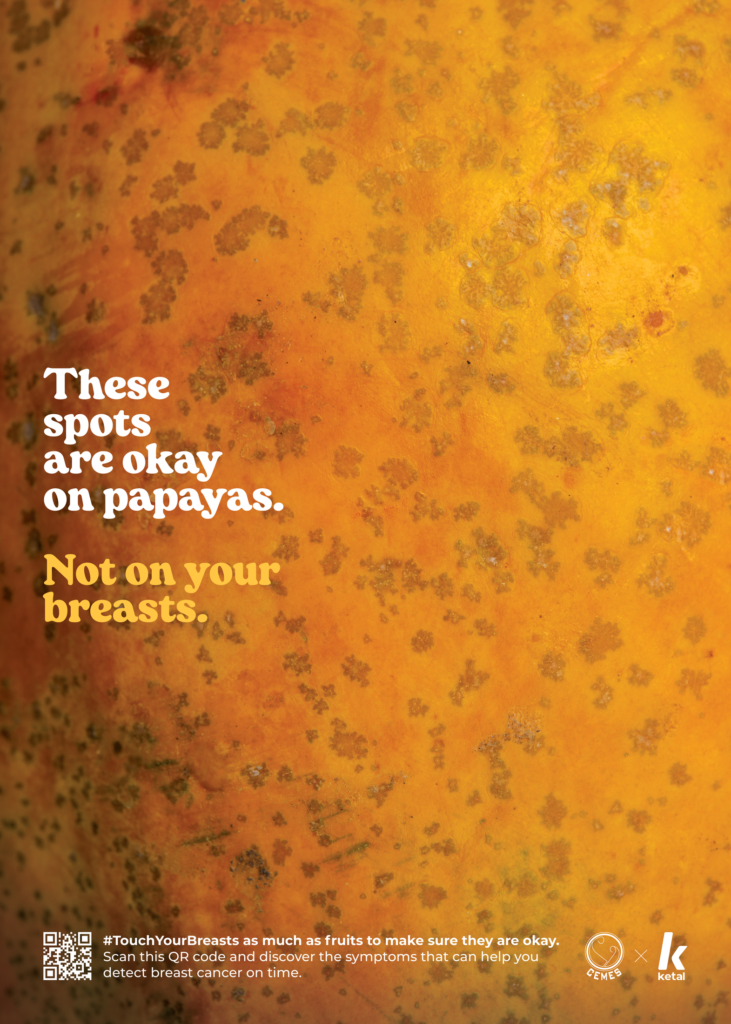
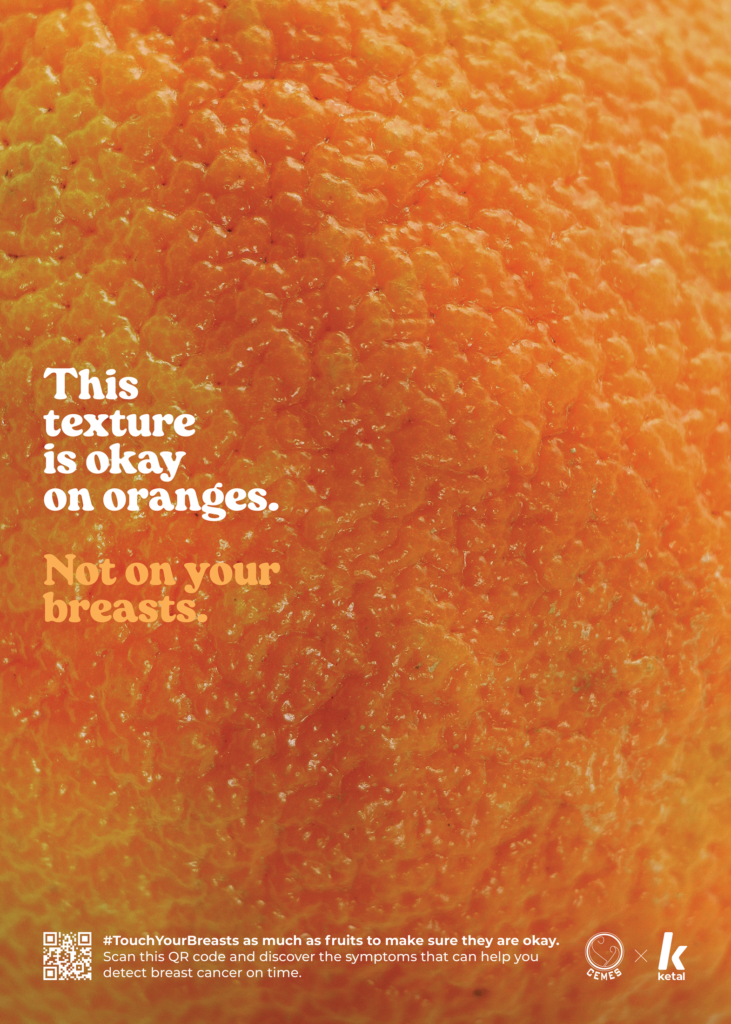
The campaign’s founding observation is both medically precise and visually immediate. The main symptoms of breast cancer, when they appear on the skin, share their visual character with things that every shopper already looks for when selecting fruit. Lumps beneath the skin look like the bumps on an avocado. Changes in skin texture look like the pitted surface of an orange, a condition clinicians sometimes describe as peau d’orange, French for “orange skin,” which is already the medical term for that specific breast cancer symptom. Abnormal spots on the skin look like the discolouration on a papaya or a mango.
That parallel is not manufactured for the campaign. The peau d’orange clinical term confirms that the visual connection between breast cancer symptoms and fruit skin has been documented in medical literature for over a century. Ogilvy Bolivia found the connection, named it, and built a campaign in the one environment where it was most actionable.
Henry Medina, Chief Creative Officer at Ogilvy Bolivia, described the campaign’s founding logic: “We realised that the main symptoms of the disease also appear on the skin of fruits, so we combined this finding with an insight as common as it is universal: when we go to the supermarket, we’ve all touched the fruits to see if they’re in good condition. A similar action to what we should do with our breasts.”
The Executions
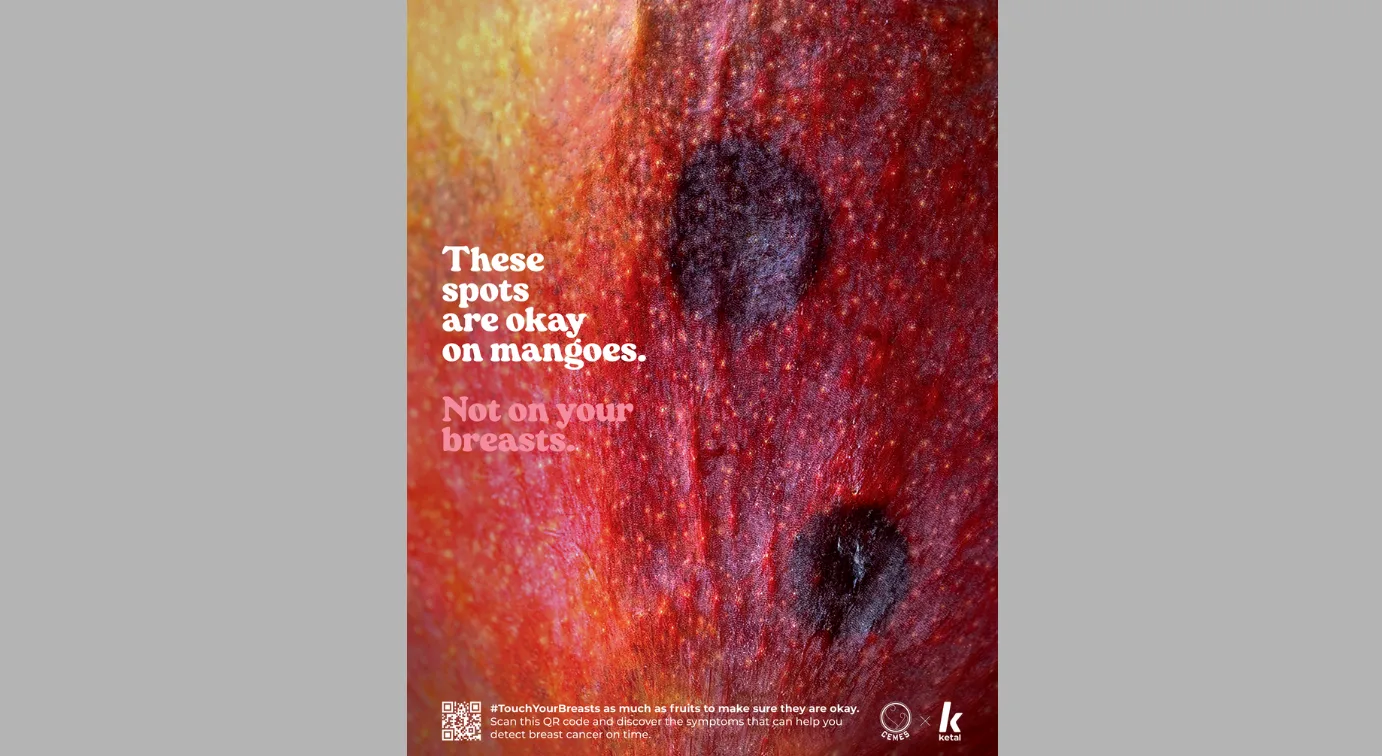
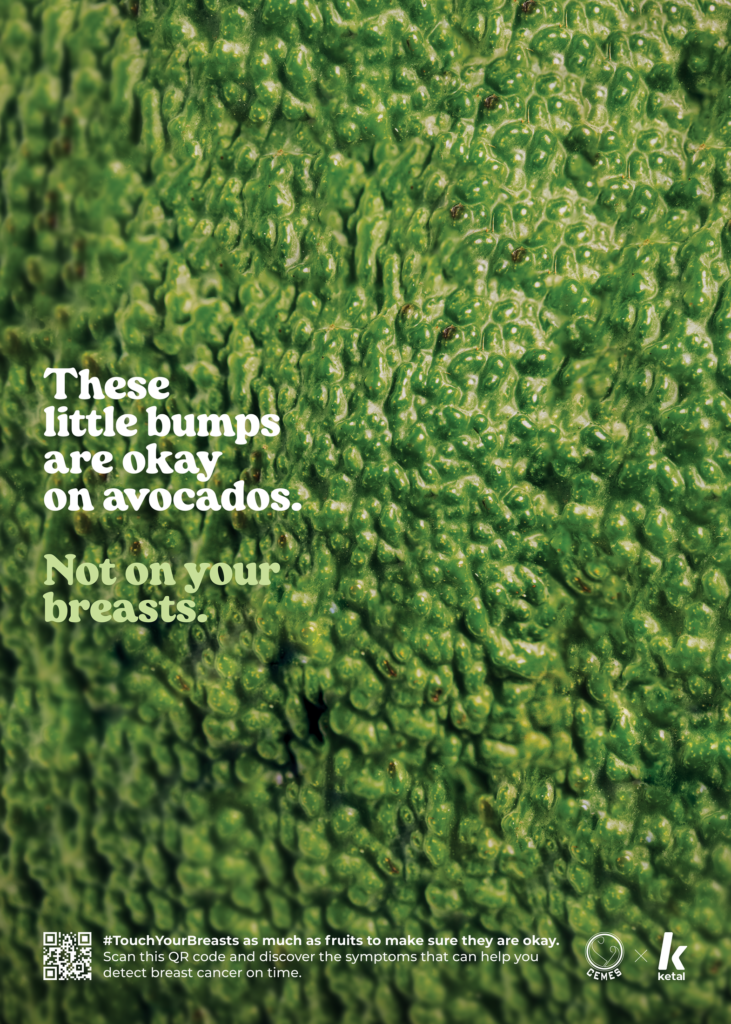
Three print executions were produced, each one a close-up macro photograph of a different fruit, shot at the level of detail that makes the texture immediately tactile. Each image carries two lines of copy and a campaign hashtag.
The avocado execution reads: “These little bumps are okay on avocados. Not on your breasts.” The orange execution reads: “This texture is okay on oranges. Not on your breasts.” The papaya execution reads: “These spots are okay on papayas. Not on your breasts.” At the bottom of each execution, the hashtag #TouchYourBreasts is accompanied by the line: “Touch your breasts as much as fruits to make sure they are okay. Scan this QR code and discover the symptoms that can help you detect breast cancer on time.” A QR code links to information about self-examination and breast cancer screening, produced in partnership with one of Bolivia’s leading clinics.
The visual approach is deliberately non-clinical. There are no medical diagrams, no statistics in large type, no photographs of patients or hospital environments. The only images are the fruit. The effect is that a person standing in a supermarket can encounter the campaign while doing exactly what the campaign is describing, touching fruit to assess its condition, and have the connection between that action and breast self-examination arrive without resistance.
The Permanent Installation
The campaign was not a limited-run advertising spend. Ketal Hipermercados made #TouchYourBreasts a permanent feature inside its supermarkets, placing the executions in the fruit and vegetable sections where the visual parallel between the poster and the physical products on the shelf is direct and continuous. Every shopper who passes the fruit aisle, at every Ketal location, every day the supermarket is open, encounters the campaign in the context it was designed for.
Ogilvy Bolivia confirmed that the first recognition the campaign received was not an award but Ketal’s commitment to the permanent installation. The commercial brief had been accomplished before the campaign reached any award show.
The partnership with a leading Bolivian clinic extended the campaign beyond awareness into action. The QR code on each execution connects shoppers directly to screening services, closing the gap between recognition and clinical follow-up that most awareness campaigns leave open.
Why the Format Works
Breast cancer awareness campaigns face a specific and consistent creative problem. The subject is one that many women prefer not to think about, which means campaigns that announce themselves as breast cancer content risk triggering avoidance rather than engagement. The clinical register of most health communication, diagrams of the human body, medical terminology, explicit descriptions of symptoms, compounds that avoidance by framing the subject as something that belongs in a doctor’s office rather than in everyday life.
#TouchYourBreasts resolves that problem by arriving before the subject has been announced. A person reads “These little bumps are okay on avocados” and is already engaged before the second line tells them what the bumps mean in a different context. The fruit is not a metaphor that needs to be decoded. It is a familiar object whose properties the shopper already understands, and the campaign simply places that existing knowledge next to a new application.
Creative Bloq’s coverage of the campaign noted that print advertising has “the unique ability to speak to audiences on a more personal level,” and that the #TouchYourBreasts campaign demonstrated “how simple graphics and candid copy can be a powerful marketing tool.” The minimalism of each execution, one fruit, two lines, one QR code, ensures nothing competes with the observation the campaign is making.
The Scale of the Opportunity
Ketal Hipermercados operates across Bolivia as one of the country’s leading supermarket chains, serving a population of approximately two million in its primary markets. The permanent installation of the campaign inside those stores means the educational reach of the three executions is not measured in a campaign period but in the cumulative footfall of a retail network operating year-round. Henry Medina confirmed that in the campaign’s initial period, the message had already reached approximately one million of the two million people in its primary market.
The campaign also reached an international audience when it circulated on advertising and design platforms in 2024, generating coverage in Creative Bloq, LBBOnline, Yahoo Lifestyle, and advertising press across multiple continents. Its simplicity, the macro fruit photography, the two-line structure, the medically precise but visually immediate parallel, travelled across languages and contexts without requiring any adaptation.
Campaign Name: #TouchYourBreasts / #TouchYourBreasts as much as fruits
Agency Name: Ogilvy Bolivia / Chief Creative Officer: Henry Medina / Creative Copywriters: Henry Medina and Gerson Irazabal / Creative Team: Josué Tello Guevara and Fiorella Montoya Puémape / Graphic Designers: Andrés Vega, Adrian Alexander Poma, Kevin Xolio Quiroz / Project Manager: Claudia Rojas Vasquez
Brand Name: Ketal Hipermercados / President: Daniel Pasten / CMO: Andrés Alejandro Zamora P. / Head of Marketing: Andrea Carolina Peña Arancibia
Location: Bolivia (permanent installation across Ketal Hipermercados stores; launched October 2023)