Plastic pollutes the environment for up to 400 years. That statistic has been repeated in environmental campaigns for decades. Most people have heard it, processed it briefly, and moved on. Greenpeace Germany and fischerAppelt Berlin decided that the number needed to be made visual rather than stated, and the most precise available visual was a grave.
The Campaign
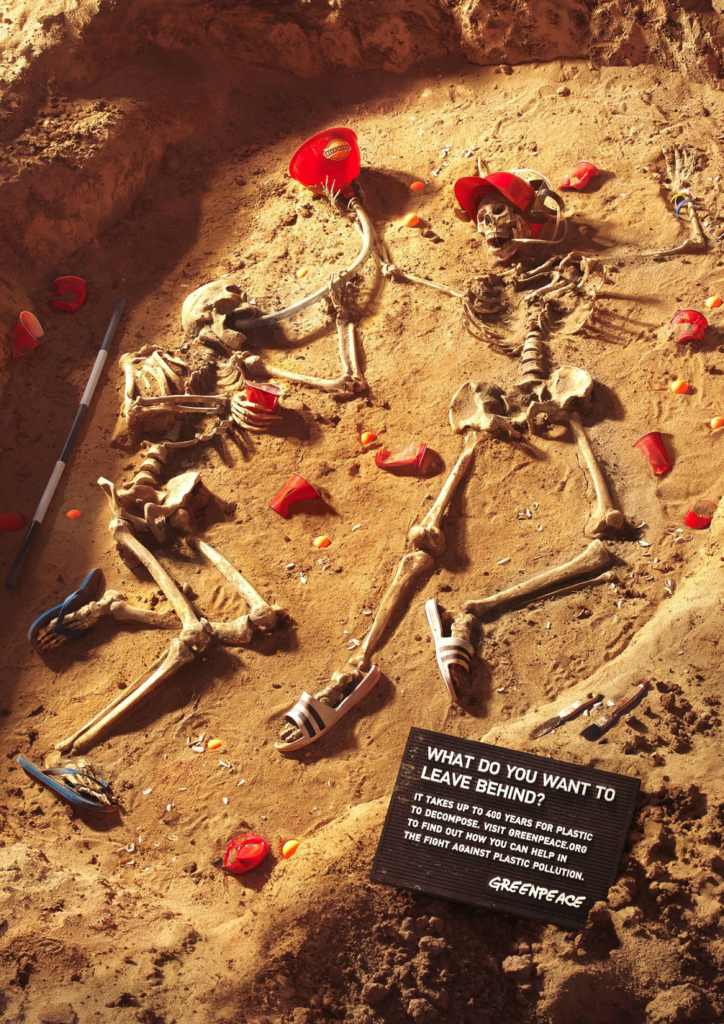
Plastic Legacy, published in Germany in December 2019, is a three-piece print campaign built around a single, unsettling premise: what if we died today? The campaign answers that question as an archaeological scenario set in the distant future.
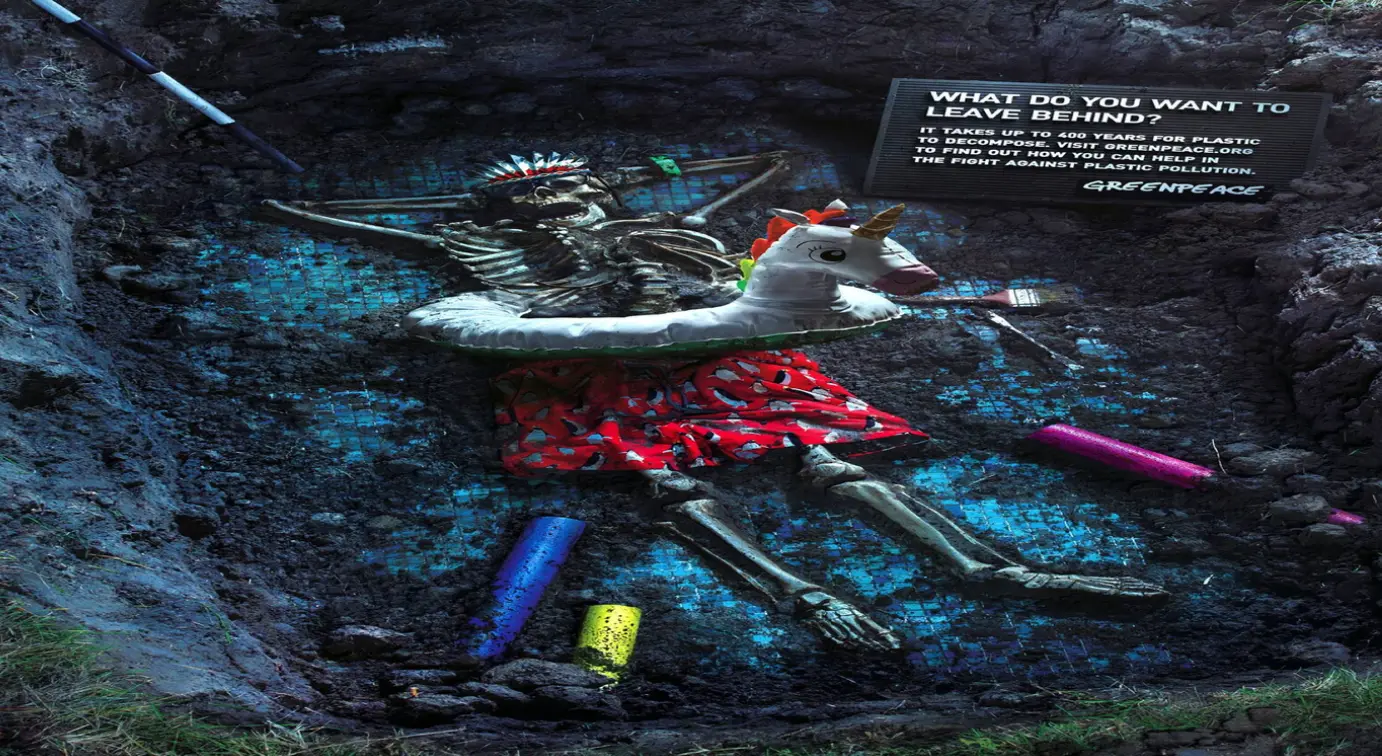
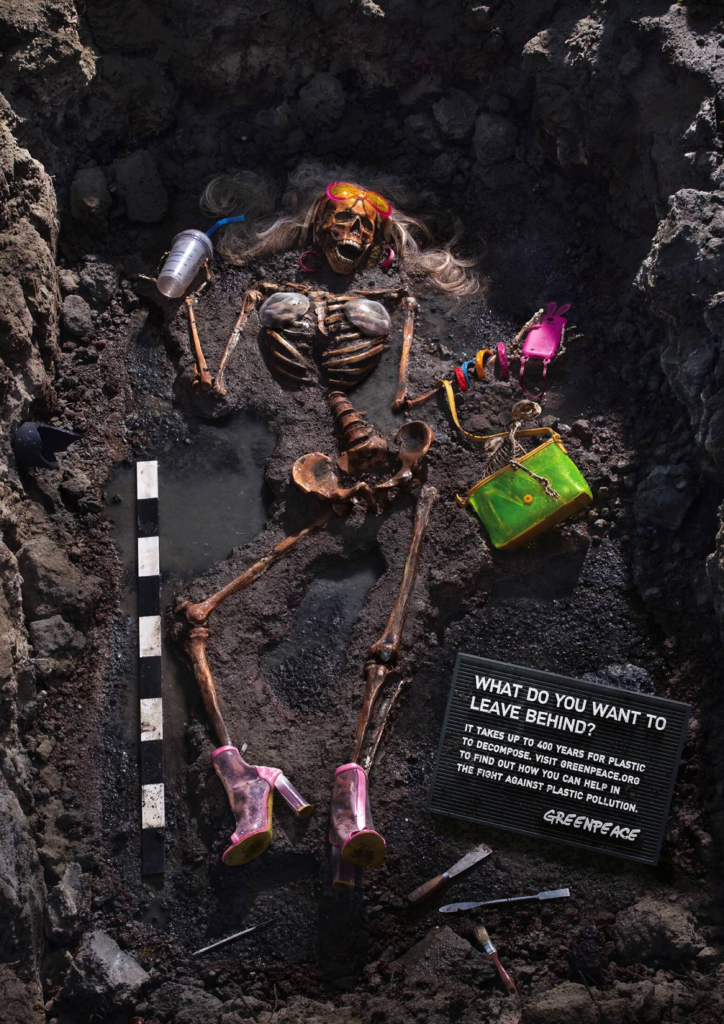
Each execution shows an archaeological excavation. Beneath the soil, a human skeleton is preserved alongside the plastic waste it generated during its lifetime. A person who drank from plastic bottles, used single-use bags, bought products in plastic packaging, and went about an ordinary modern life has left behind a precise and durable record of that life in the form of plastic waste that will remain intact long after their bones have disintegrated.
The excavations are not presented as warnings. They are presented as findings, the kind of matter-of-fact documentation that an archaeologist produces when they encounter evidence of a past civilisation. The archaeologist in the image does not comment. The skeleton does not comment. The plastic does not need to.
The campaign’s question, what do you want to leave behind, is embedded in that image rather than printed alongside it. The answer is already visible in the frame.
Why the Archaeological Format Works
Environmental advertising faces a consistent and documented problem: the gap between the scale of the problem and the individual’s sense of agency is so large that the communication designed to motivate action frequently produces paralysis or disengagement instead. A statistic about 400 years of pollution is easy to dismiss because 400 years is not a timescale that the human brain processes emotionally. A photograph of someone’s own skeleton buried alongside their own plastic waste is not.
The excavation format closes the temporal gap by collapsing it into a single image. The person in the frame is not a future generation. They are a contemporary person. The plastic around their bones is the kind of plastic that everyone who sees the advertisement has used. The campaign does not ask the viewer to care about a future they will not live to see. It asks them to look at what they are already making inevitable.
EcoLife’s description of the campaign’s visual strategy captured what the archaeological register achieves that conventional environmental photography cannot: “Plastic and its increasingly drastic effects on the environment is one of the greatest challenges of our time, but above all of the future.” The future is the point. Most environmental advertising brings the future to the present through projection and prediction. Plastic Legacy brings the present to the future through excavation and documentation.
The Executions
Three print executions were produced, each one showing a different person’s remains alongside different types of plastic waste. The variety across the three images reflects the variety of plastic pollution sources: the plastic is not the product of a single industrial decision but of thousands of ordinary individual choices accumulated across a lifetime. A different excavation, a different skeleton, a different pile of plastic, and yet the same underlying fact: the plastic is still there. The person is not.
The illustrative quality of the archaeological imagery, produced through Carioca Studio, gives each execution a visual texture that sits between documentary photography and archaeological drawing. The precision of the detail makes the scenario feel plausible rather than speculative, which is the most critical visual decision in the campaign. An image that looks like science fiction allows the viewer to distance themselves from it. An image that looks like genuine fieldwork documentation does not.
The Recognition
Plastic Legacy was recognised at the 2020 ADC Awards in the Illustration category, confirming the advertising industry’s assessment of what fischerAppelt Berlin had achieved in the print medium. The campaign won for what the One Club jury identified: a visual answer to a problem that had previously been addressed primarily through statistics and projections.
Campaign Name: Plastic Legacy
Agency Name: fischerAppelt Berlin / Executive Creative Director: David Morales / Creative Director: Philip Bolland / Senior Art Director: Jessica Philip / Copywriter: Max List / Art Buyer: Johanna Merensky / Production: Carioca Studio
Brand Name: Greenpeace Germany
Location: Germany (print campaign; December 2019)