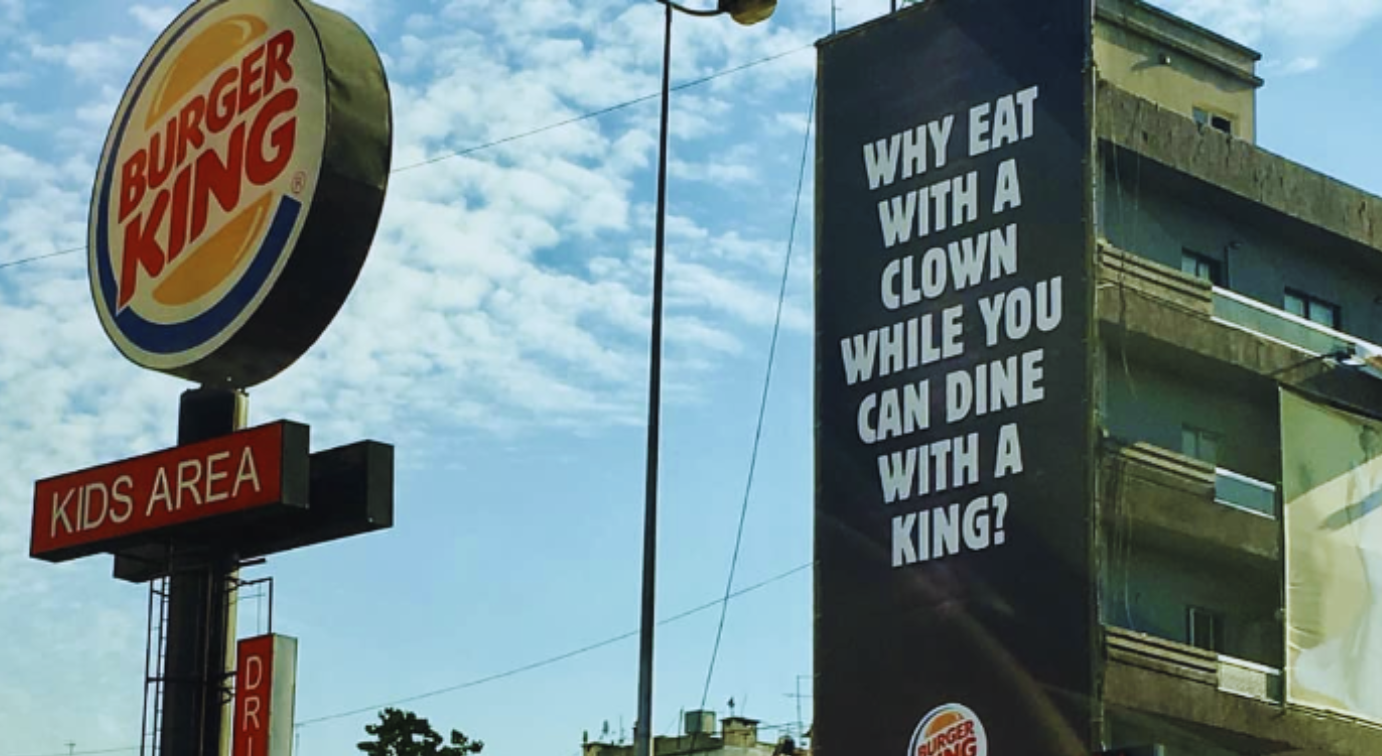
McDonald’s introduced Ronald McDonald in 1963. It spent the next six decades building one of the most recognisable mascots in the history of consumer marketing. Burger King spent the same period finding increasingly creative ways to turn that mascot into a liability. The Lebanon building-wrap, photographed on the Jal el Dib highway in Beirut, is the simplest and sharpest version of an argument Burger King has been making in different formats across multiple countries for years.
The Lebanon Billboard
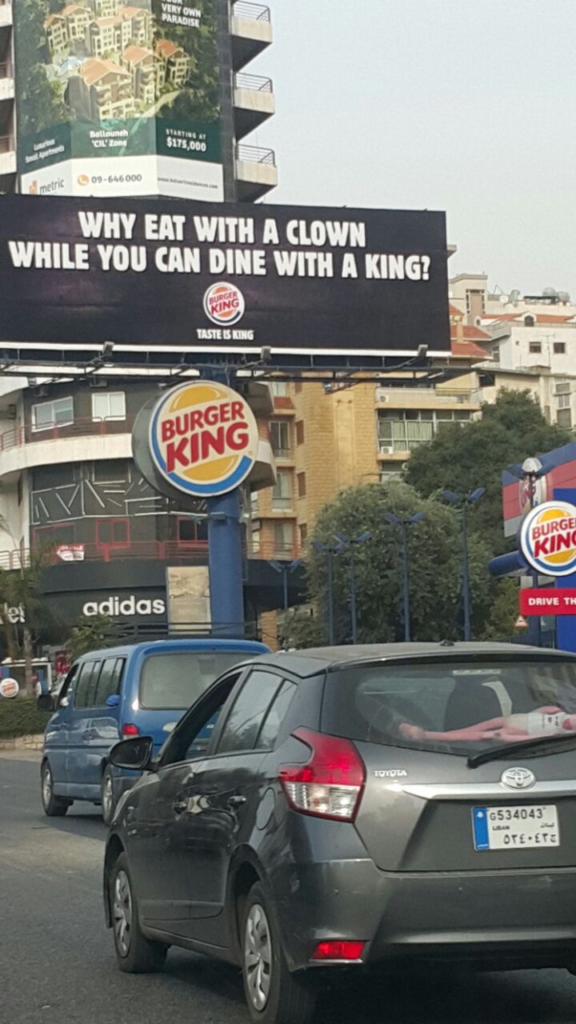
First spotted on the Jal el Dib highway in Beirut in 2016, the Burger King building-wrap carried seven words in white type on black: “Why eat with a clown while you can dine with a king?” The competitor was not named. It did not need to be. Every driver on the highway to Beirut who read it knew immediately who the clown was, and who the king was, and why the distinction was being made on the side of a building.
Blog Baladi, one of Lebanon’s leading media blogs, reported at the time that this was the first instance of the Burger King vs McDonald’s advertising war playing out on Lebanese soil, and noted that the line had been used by Burger King in other markets previously. The building was visible from both directions of travel, giving every commuter and driver two passes at the same message.
The line is structurally perfect for a competitive billboard because it requires the viewer to supply the competitor’s identity themselves. Burger King said nothing accusatory. It asked a question. The clown is the viewer’s own inference, which means the viewer’s own mind did the competitive work.
The “It” Cinema Stunt, Germany, 2017
In September 2017, German agency Grabarz and Partner partnered with Burger King to run what became known as the longest Burger King advertisement in history. A screening of the horror film “It,” whose villain is Pennywise, a child-murdering clown, proceeded normally for its full two-hour runtime. As the film neared its end, the screen went black. A spotlight appeared with the text: “The moral is: never trust a clown.” A smaller spotlight followed at the bottom of the screen: the Burger King logo.
The audience responded with laughter and applause. The hashtag #nevertrustaclown was launched alongside the activation. Burger King had waited two hours and spent nothing on media to make its point about Ronald McDonald.
The Russian Ban Attempt, 2017
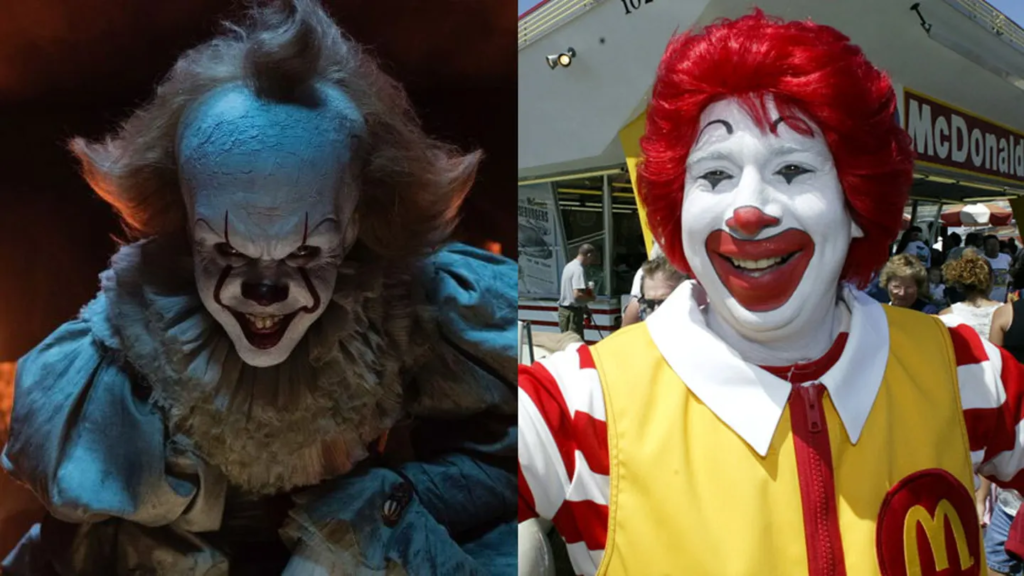
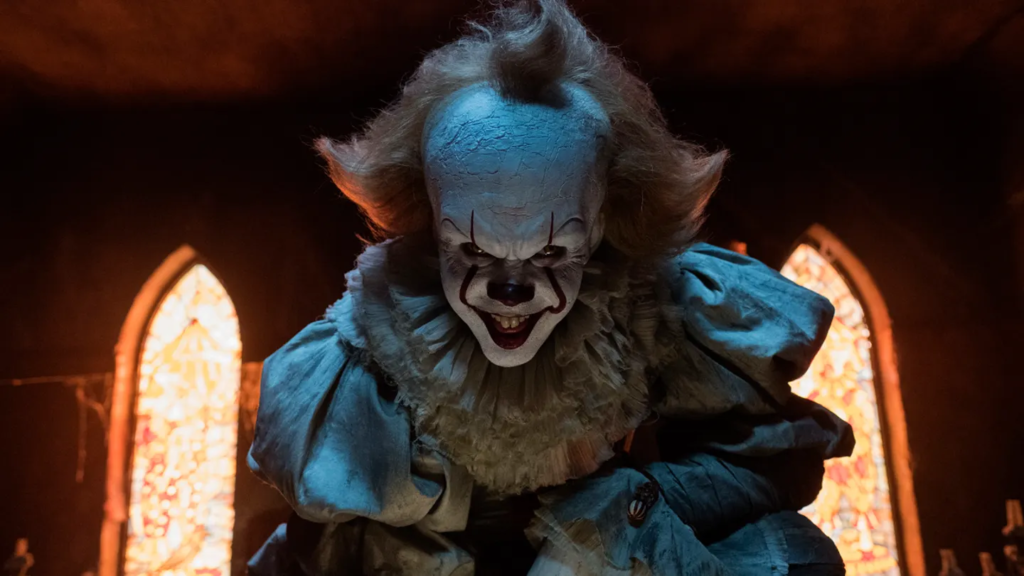
Burger King Russia filed a formal complaint with Russia’s Federal Anti-Monopoly Service demanding that “It” be banned from Russian cinemas. The stated reason: Pennywise was an “exact copy” of Ronald McDonald, including the colour scheme and the way the character lures children with balloons. The complaint argued that the film was therefore functioning as free advertising for McDonald’s.
The FAS confirmed it had received and was evaluating the complaint. Russian social media reacted with widespread sarcasm. The Hollywood Reporter and Variety both covered the filing. “It” had already grossed $14 million in Russia at the point the complaint was made, and remained in more than 100 cinemas across the country. The ban was never implemented. The coverage was enormous.
The Halloween Clown Night, UK, 2017
The Leicester Square Burger King in London announced that any customer who arrived dressed as a clown on Halloween night between 7pm and 3am would receive a free Whopper. The first 500 customers qualifying would be eligible. The promotional video accompanying the announcement showed a child being followed through darkened streets by a clown with a striking resemblance to Ronald McDonald, who eventually arrives at Burger King and demands a Whopper himself.
The campaign line was: “Come as a clown, eat like a king.”
The Clown-Free Birthday Party, 2019
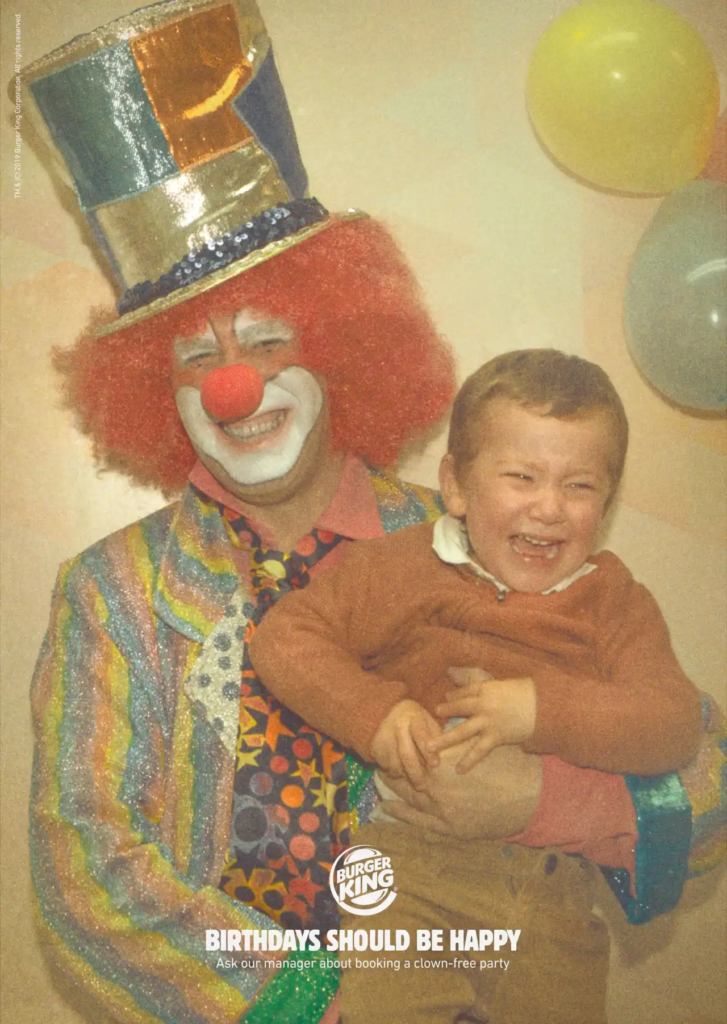
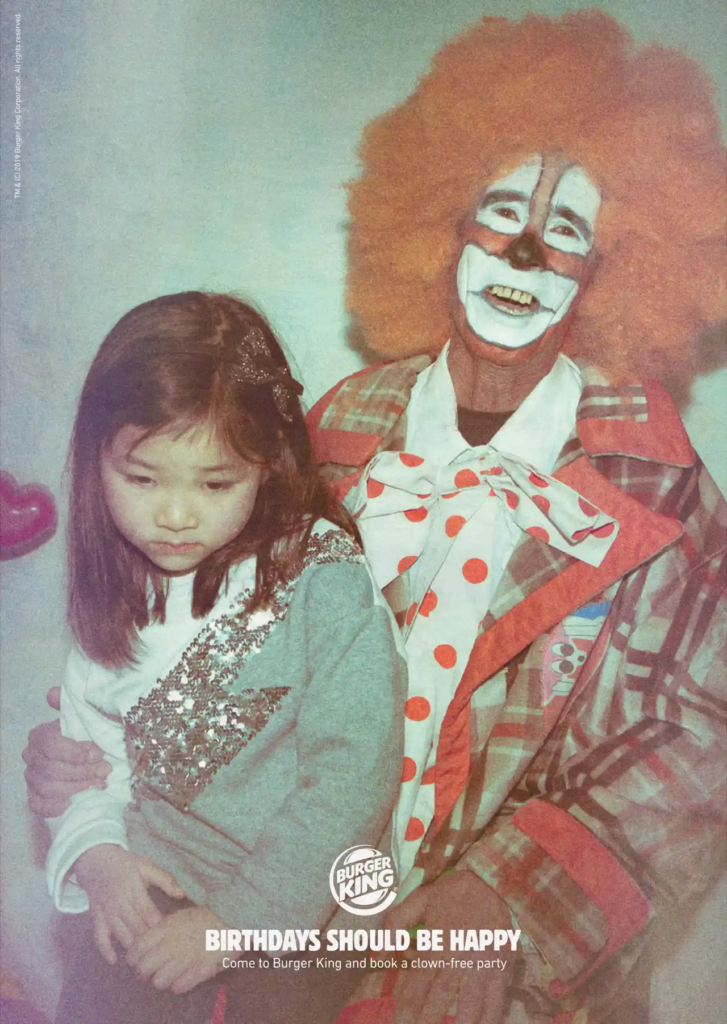
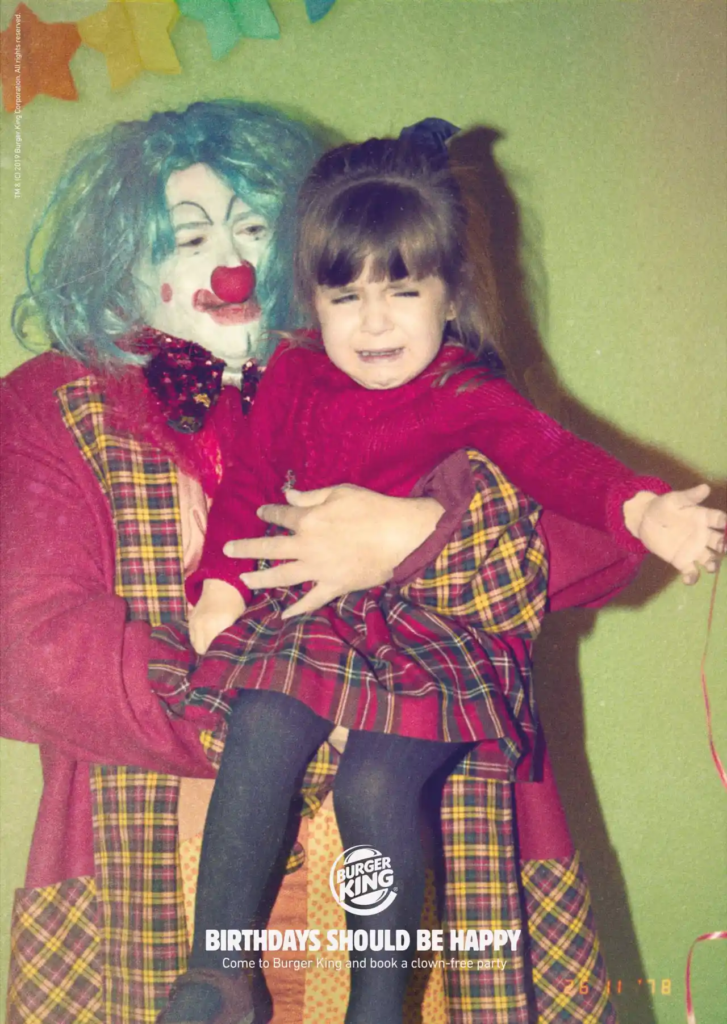
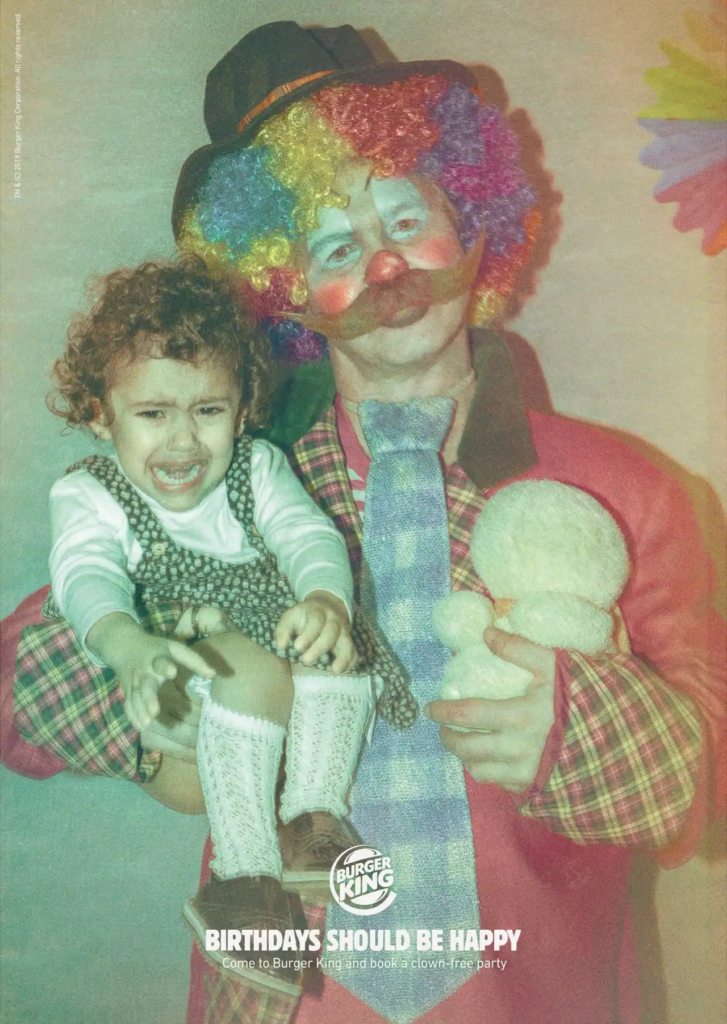
In 2019, LOLA MullenLowe, a Spanish agency responsible for multiple Burger King campaigns targeting McDonald’s, produced a birthday party campaign for Burger King that ran a series of print ads showing children visibly terrified on clowns’ laps. The headline: “Birthdays should be happy.” The subhead: “Ask our manager about booking a clown-free party.”
Marcelo Pascoa, Burger King’s head of global marketing at the time, stated: “We prefer to be on the good side of children’s memories, not the scary ones, like the traumatized kids in these ads.”
The Strategic Logic
Ronald McDonald was introduced as a friendly, child-welcoming mascot designed to associate McDonald’s with joy and family comfort. Burger King’s sustained creative strategy has been to take that same mascot and reframe it as inherently unsettling, using cultural moments, horror films, Halloween, birthday anxiety, and a highway in Beirut to make the same point across decades. The clown that McDonald’s built to attract families has become, through Burger King’s persistent creative pressure, a recurring punchline.
The Lebanon building-wrap is the version of that argument that requires the least explanation and leaves the most lasting impression. Seven words. One question. A building on a highway. The clown you supplied yourself.
Campaign Name: Not mentioned (multiple Burger King competitive campaigns against McDonald’s)
Agency Name: Not mentioned (Lebanon billboard) / Grabarz and Partner (Germany, “It” cinema activation) / LOLA MullenLowe (birthday party campaign, 2019)
Brand Name: Burger King
Location: Jal el Dib, Beirut, Lebanon (billboard) / Germany (cinema activation) / Russia (ban filing) / London, United Kingdom (Halloween activation) / Global (birthday party print campaign)