Most dessert campaigns sell the product through appetite. McDonald’s France and TBWA\Paris sold the McFlurry through recognition, building a campaign around the specific, sometimes uncomfortable moments of daily life where a cold dessert feels like the only appropriate response.
The Proposition
The campaign runs on a single line: “Whatever the reason, yours deserves a McFlurry.” The executions underneath it never show anything other than a McFlurry. The creative work is entirely in the copy, delivered across a series of OOH billboards that pair two contrasting scenarios on the same board, each one pointing toward the same product regardless of which side of the emotion the viewer is standing on.
The Executions
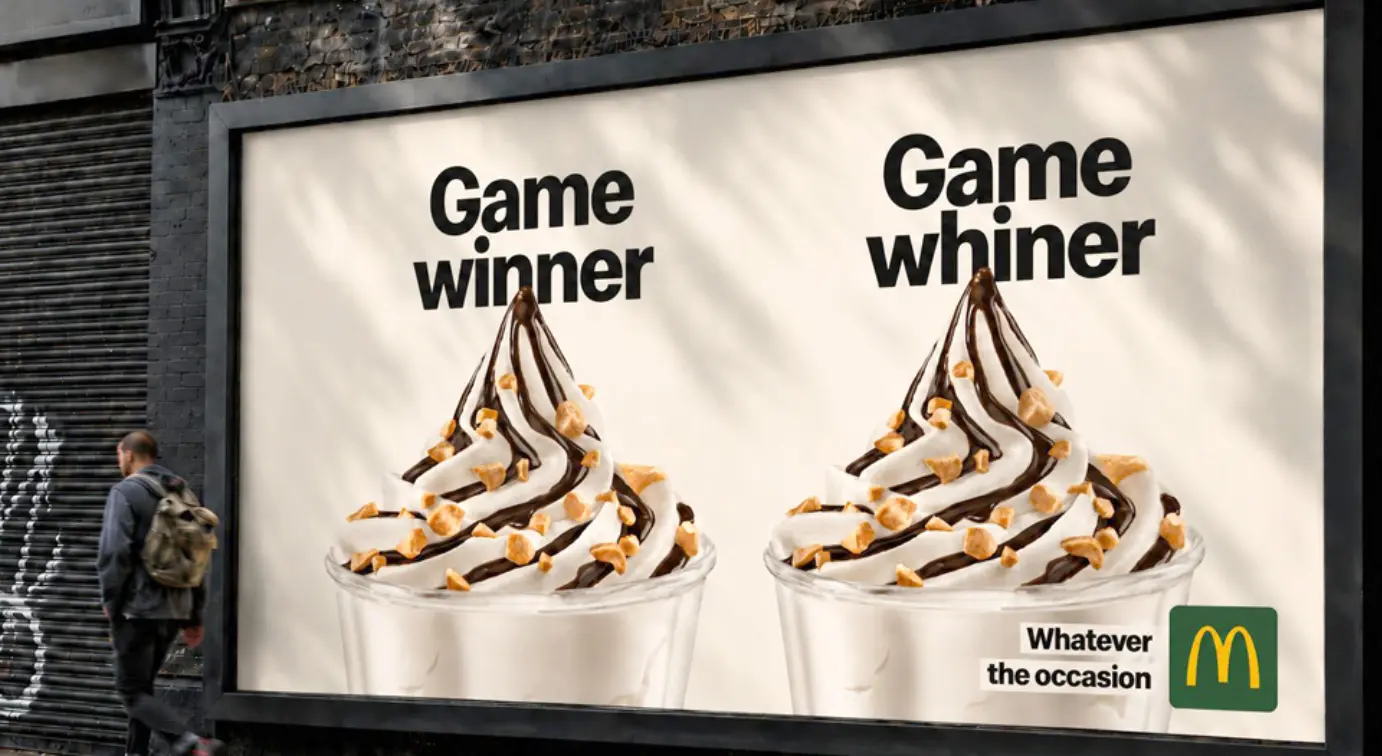
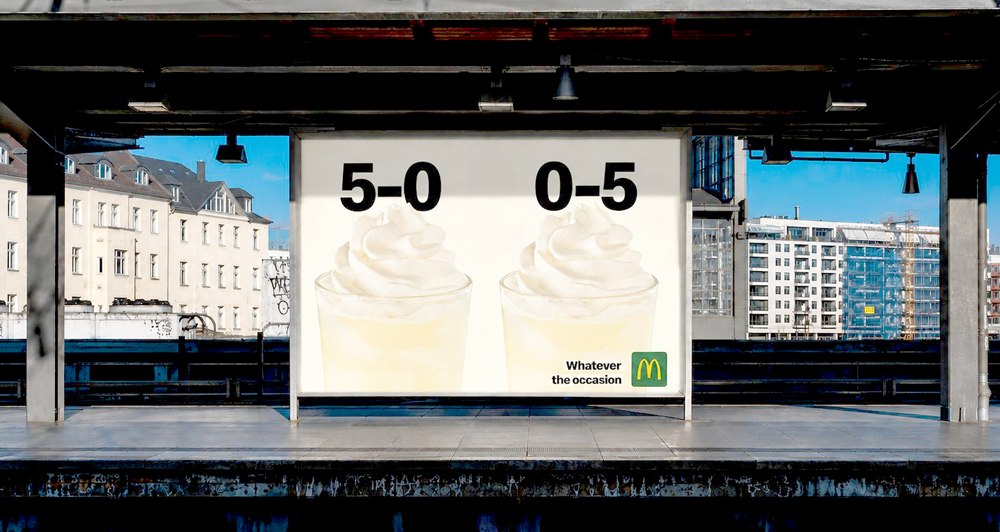
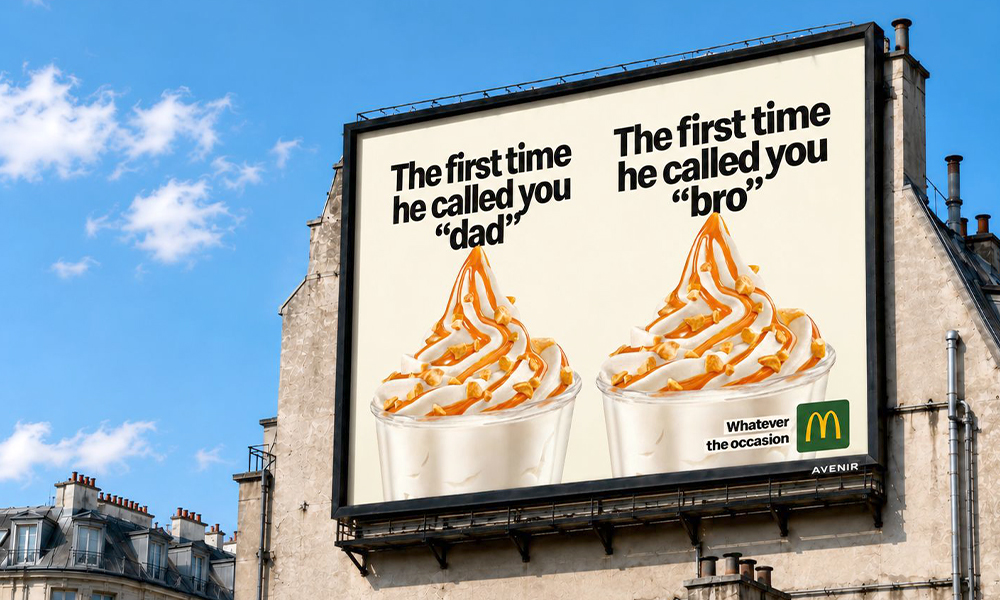
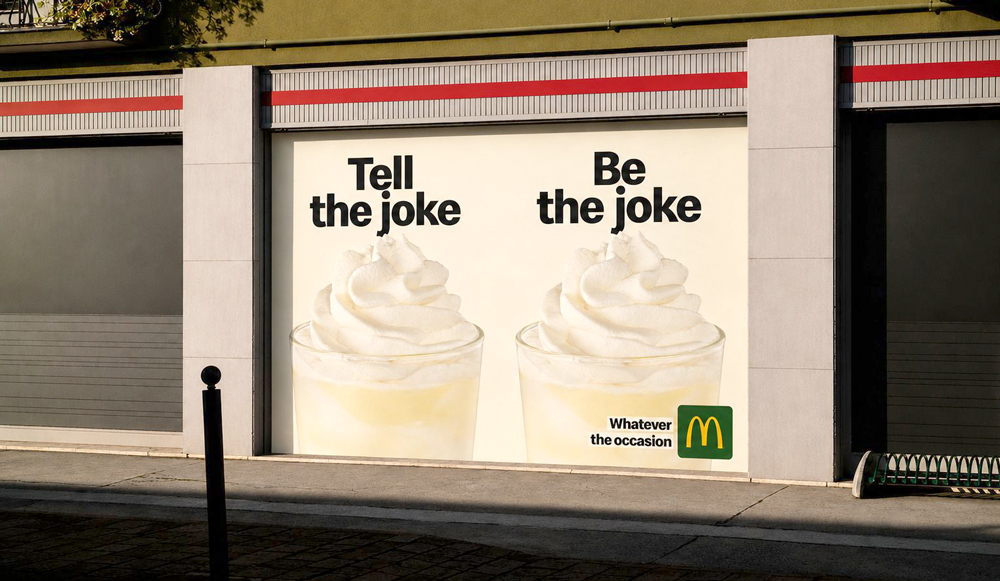
Each billboard holds two headlines, one celebrating, one commiserating, with identical McFlurry imagery beneath both. “Game winner” sits next to “Game whiner.” “The first time he called you ‘dad'” faces “The first time he called you ‘bro.'” A scoreboard reading 5-0 is placed beside one reading 0-5. “I found my boyfriend on a dating app” runs alongside “I found your boyfriend on a dating app.” “Tell the joke” sits next to “Be the joke.”
Every pairing identifies a specific, universally recognisable life moment from both sides of the outcome. The product does not change. The occasion does not change. Only the emotional register shifts between the two headlines, and the McFlurry is present for both.
Why the Format Works
OOH advertising at its most effective does one thing: it catches a passer-by mid-thought and inserts a brand into a context they were already carrying. The McDonald’s France campaign does this through contrast rather than aspiration. It does not ask the viewer to imagine themselves in a better moment. It identifies the moment they are already in, or the one they fear, and places the product beside it without judgment or instruction.
The copy is also constructed to land on re-read. “I found my boyfriend on a dating app” reads as celebration on the first pass and then shifts entirely on the second. The billboard rewards a second look without requiring it. That double-take quality is what makes the campaign travel from physical OOH placement into social media screenshots and word of mouth, extending the campaign’s media life without additional spend.
The visual restraint compounds the effect. Clean typography. Minimal background. The McFlurry front and centre in every execution. There is nothing to look at except the words and the product, which means there is nothing to distract from the moment of recognition when the headline lands.
The Broader Strategy
The campaign is the latest in McDonald’s France’s long history of copy-led OOH work, a consistent creative tradition at TBWA\Paris that has produced some of the most shared French outdoor advertising of the last decade. Where most fast food campaigns compete on value or product innovation, McDonald’s France has consistently used wit as a brand differentiator, treating its OOH as a creative medium rather than simply a media channel.
Positioning a dessert as appropriate for every occasion, win or lose, celebration or consolation, seems simple. Building a campaign that makes that position feel specific rather than generic requires a level of creative precision that most brands in the category do not attempt. The McFlurry campaign achieves it by never describing the product and instead cataloguing the human moments the product is quietly present for.
Campaign Name: Not mentioned
Agency Name: TBWA\Paris
Brand Name: McDonald’s France
Location: France (OOH national rollout)