Environmental campaigns have spent decades showing melting ice caps, dying oceans, and oil-covered birds. Men have largely continued behaving the same way. Danish NGO Plastic Change and independent creative agency Worth Your While identified a different entry point, one that is considerably more personal and considerably harder to scroll past.
The Idea
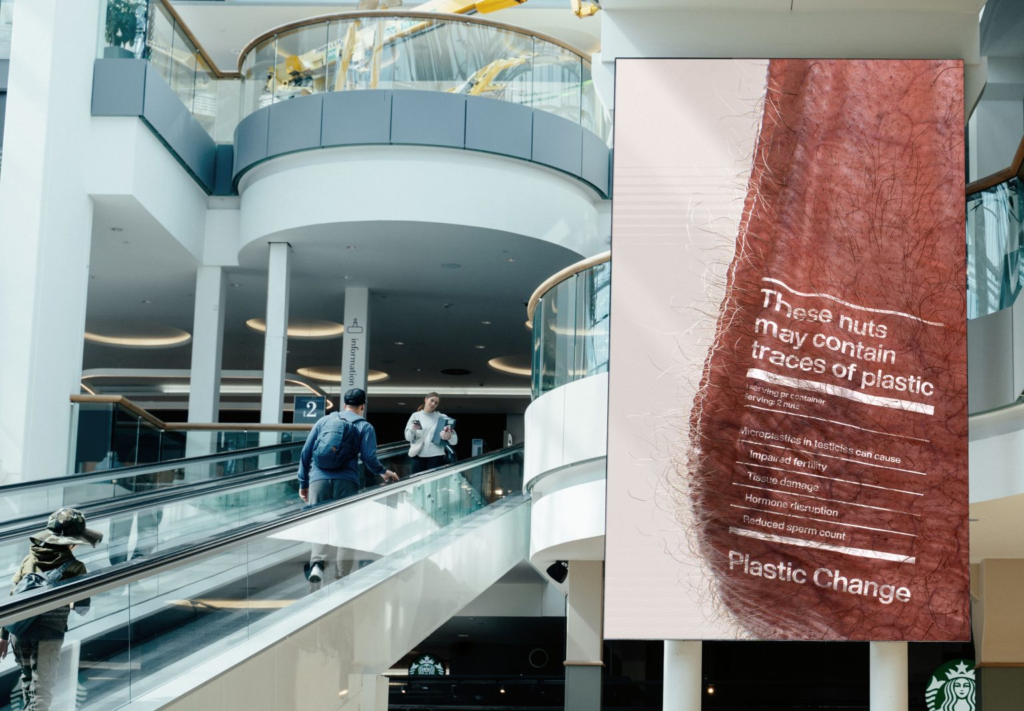
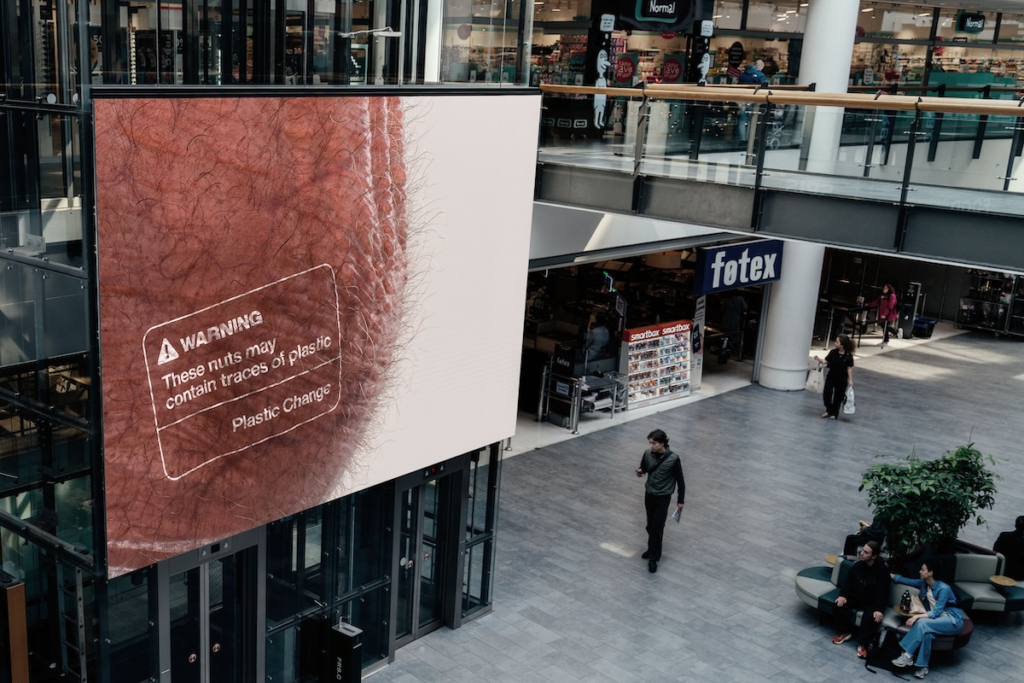
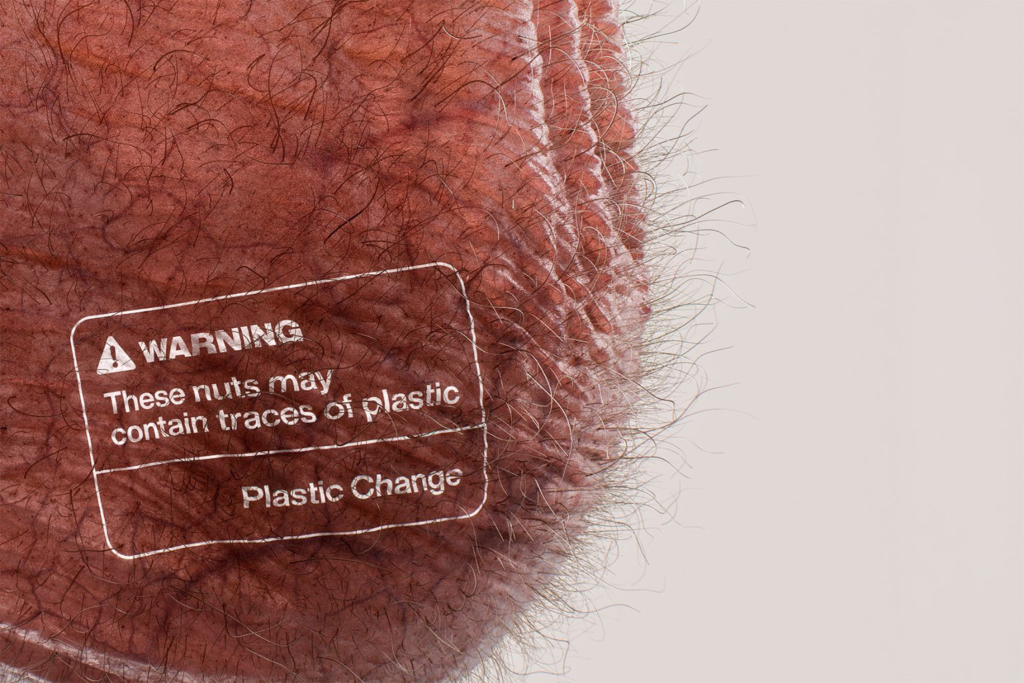
“May contain traces of nuts” is one of the most universally recognised disclaimers in food packaging. For people with severe allergies, it is a vital warning about hidden toxic ingredients. For everyone else, it is text that disappears into the back of a chocolate bar without registering.
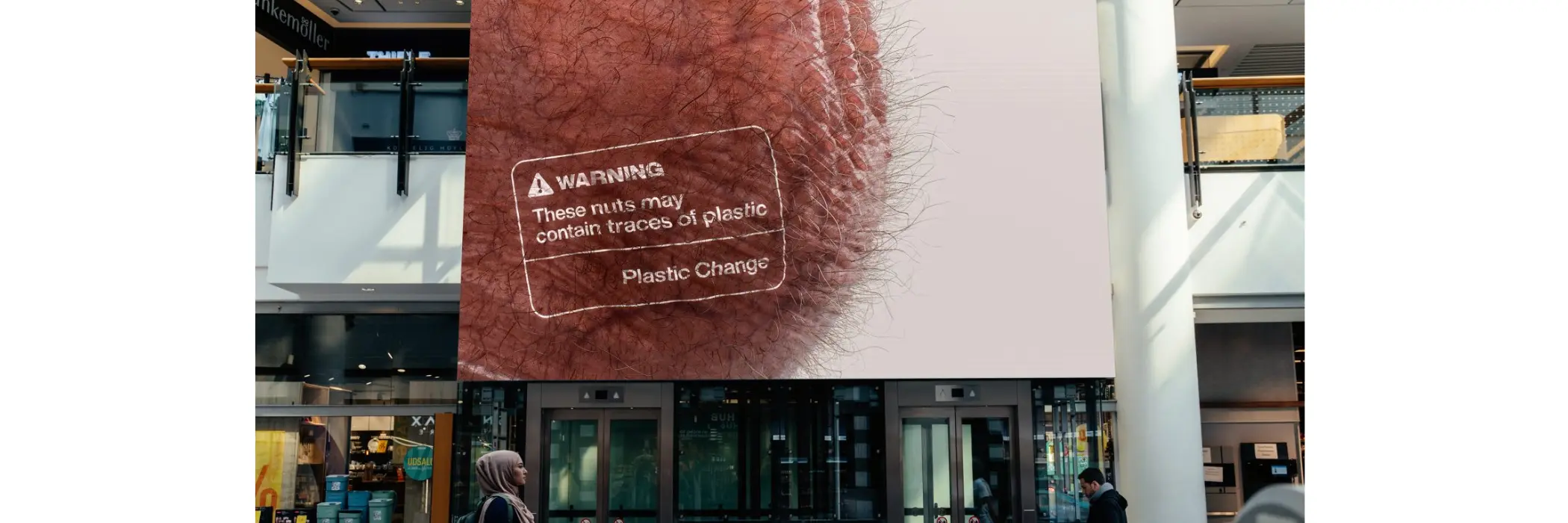
Worth Your While took that exact phrase and redirected it. “These Nuts May Contain Traces of Plastic” launched on World Environment Day, June 5, 2026, simultaneously the day Denmark observes Father’s Day, with OOH executions across Denmark, social, PR, and earned media. The campaign is built on a double meaning that requires no explanation: nuts, the food product, and nuts, the anatomical fact that microplastics are now detectable in male testicles.
The Science Behind It
The campaign is not a rhetorical move. It is backed by a growing body of peer-reviewed research that the advertising industry has been slow to address. A 2024 study published in Toxicological Sciences found microplastics in all 23 human testicles studied, with researchers suggesting the findings may be linked to the decades-long global decline in sperm counts. A separate study published in Science of the Total Environment found microplastics in all 40 semen samples collected from healthy men in China, identifying eight distinct plastic types, with polystyrene the most prevalent. A 2024 study in the International Journal of Impotence Research became the first to detect microplastics in human penile tissue, finding them in 80% of samples taken from men undergoing surgery for erectile dysfunction.
Preliminary findings from a review of 15 studies covering 1,200 men, presented at the ESHRE 2025 conference, found that men with microplastics in their testicular tissue had sperm counts of roughly half those of men without. The science that underlies the campaign’s claim is not contested. The campaign’s job is to make sure people have actually heard it.
The Creative Execution
The OOH executions were produced with digital imagery studio We Are Eli. Hyper-real, close-up images of testicle skin are styled and framed as product packaging, complete with nutrition-style labels listing microplastics as an ingredient, with potential side effects listed: infertility, hormone disruption, reduced sperm count. The format is entirely borrowed from food labelling. The content is entirely not.
The campaign follows Bottle Bulge, Plastic Change and Worth Your While’s previous collaboration in August 2025, in which microplastics in penile tissue were similarly communicated through deliberately confrontational imagery. The two campaigns together constitute a deliberate strategy of reaching men through the specific anatomical consequences they are most likely to pay attention to.
Why the Approach Is Strategically Sound
Tim Pashen, creative director and partner at Worth Your While, described the behavioural problem the campaign was designed to solve: “Environmental campaigns often struggle because the consequences feel distant, abstract or someone else’s problem. We wanted to find a way to make the issue impossible to ignore by connecting it to something deeply personal. If microplastics are showing up in places as intimate as testicular tissue, then plastic pollution is no longer just an environmental issue; it’s a human issue.”
Henrik Beha Pedersen, founder of Plastic Change, framed the urgency: “We know that tiny plastic particles are invading our bodies. Otherwise, we walk on towards an unknown future.”
The campaign also arrives in the wake of The Plastic Detox, a Netflix documentary released in March 2026 that drew significant public attention to the reproductive health implications of microplastics. Worth Your While and Plastic Change are converting that documentary-generated awareness into an outdoor campaign that takes the conversation out of streaming and into the street.
The Timing
World Environment Day and Danish Father’s Day falling on the same date in 2026 is not incidental to the campaign’s framing. The fertility implications of microplastics connect directly to fatherhood, to the question of whether current plastic consumption patterns are compatible with future reproduction at a population level. Plastic Change made that connection explicit in its campaign framing, describing the dual occasion as a reminder that the health of the environment and the health of future generations are deeply connected.
Campaign Name: “These Nuts May Contain Traces of Plastic”
Agency Name: Worth Your While / Digital imagery: We Are Eli
Brand Name: Plastic Change
Location: Denmark (OOH, social, PR and earned media); global digital distribution