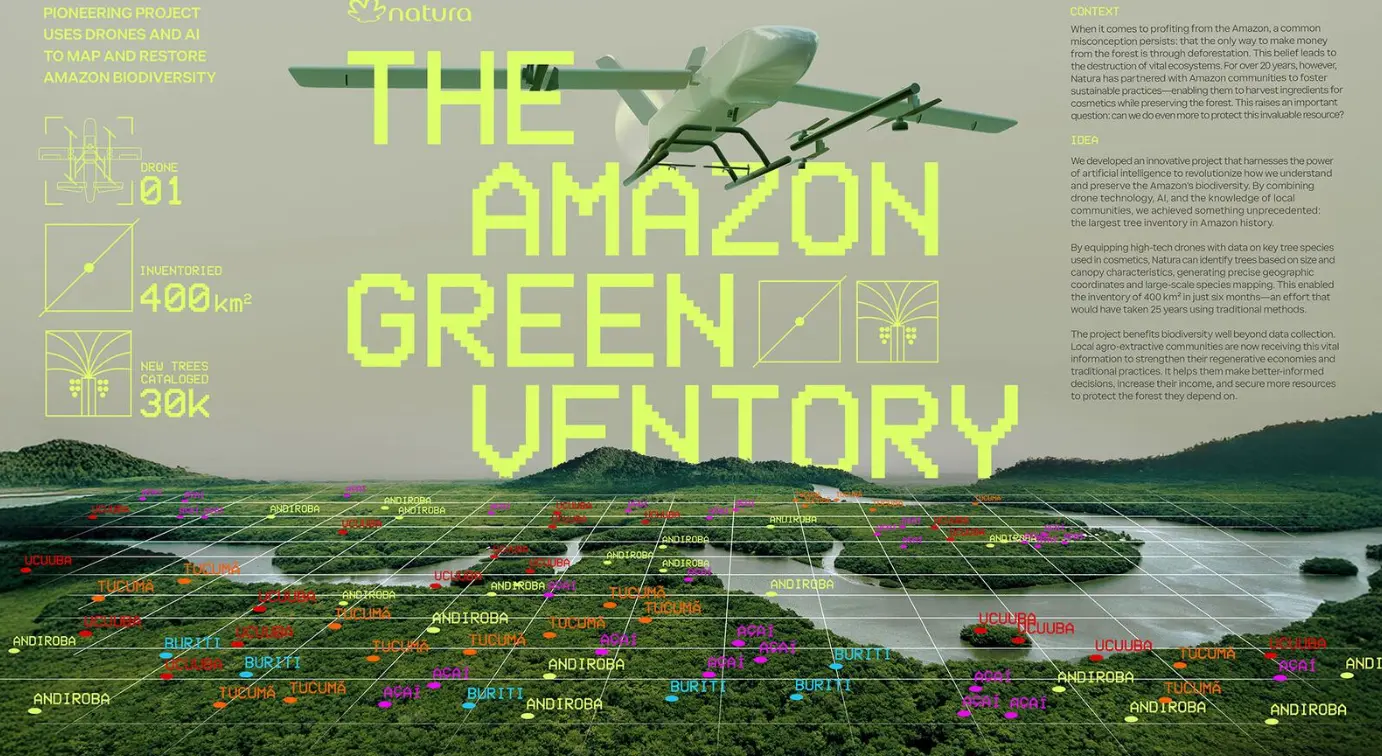
A Brazilian cosmetics company used drones and artificial intelligence to conduct the largest tree inventory in Amazon history, identifying 30,000 trees with cosmetic potential across 400 square kilometres in six months. A task that would have taken conventional methods 25 years to complete. The technology, the communities it served, and the environmental impact behind it are not in dispute. What happened next, and who deserves credit for it, is.
The Project
Natura, Brazil’s largest cosmetics company, began working with Bioverse, a company specialising in AI-powered forest mapping technology, in 2019. The mapping technology combined drone flights with AI prompts capable of identifying individual tree canopies by species across vast areas. Applied to Amazon, it allowed researchers to map zones in months that would previously have taken decades, and to build a granular, species-level inventory of what was actually in the forest rather than relying on aggregated estimates.
The commercial logic is direct. Natura’s product lines depend on Amazonian ingredients: natural oils, plant extracts, botanical compounds sourced from the forest. The cosmetics industry has historically relied on deforestation-adjacent supply chains, either directly or indirectly, because the economic pressure on local communities favoured clearing land over sustainable extraction. The inventory offered a different argument: if local communities knew precisely where the highest-value trees were located, and had a committed buyer for 100% of what they harvested from those trees, the forest was worth more standing than cleared.
Natura is committed to purchasing 100% of the production from the identified trees at guaranteed prices, providing a stable income stream to 10,000 families across 44 communities in the region. The combination of mapping technology, community knowledge, and commercial commitment created what Natura described as a new model for sustainable harvesting in which the forest’s economic value was made explicit, visible, and accessible to the people who lived alongside it.
The Campaign Name and the Cannes Entry
Africa Creative DDB, Natura’s São Paulo-based creative agency, came to the project years after the underlying technology and the community partnerships had been established. The agency coined the name “The Amazon Greenventory” for the Cannes Lions entry, framing the mapping project as a brand campaign and positioning it as a creative initiative rather than the years-long conservation programme it had originally been.
The case study film, directed by Daniel Klajmic and produced by Pródigo Filmes, presented the Greenventory as a unified, campaign-led initiative. At Cannes Lions 2025, it won the Sustainable Development Goals Grand Prix, competing against 481 entries in the category. Josy Paul, Chairperson and CCO of BBDO India and SDG Jury President, described the work in the citation: “Good work informs. Great work transforms. That’s exactly what the SDG Jury saw in Natura’s Amazon Greenventory. It wasn’t just impressive, it was transformational.”
Africa Creative DDB also won Agency of the Year and Good Track Agency of the Year at Cannes 2025. DDB Worldwide was named Network of the Year. The Greenventory was among the most-cited campaigns in those results.
The Controversy
In June 2026, DeSmog, a publication specialising in climate and sustainability journalism, published an investigation into credibility gaps in Cannes Lions submissions, using The Amazon Greenventory as a primary case study. According to a source described as having direct knowledge of the project, Africa Creative DDB came to the initiative very late and invented the Greenventory concept and name specifically for the Cannes submission. The drone and AI mapping technology had been developed by Bioverse starting in 2019, and Natura’s community partnership programme had also been running for years before any agency involvement.
“It was never conceived as an advertising campaign,” the source told DeSmog. “Africa Creative was not part of the project at all.”
In response, a Natura spokesperson confirmed that the mapping project began in 2021 as part of the company’s long-term sustainability strategy, and that the Cannes submission was made “with the knowledge and consent of the partners involved, all of whom were credited and recognised in the video and related materials.” The spokesperson confirmed that Africa Creative coined the “Amazon Greenventory” name. Africa Creative DDB did not respond to DeSmog’s request for comment.
The DeSmog investigation placed the Greenventory within a broader pattern it identified across the Cannes Lions festival: campaigns where agencies claimed creative credit for real-world initiatives they had little or no involvement in designing, using the creative agency’s framing of that work to enter an advertising award show. DeSmog specifically noted that the underlying project and its outcomes were independently verifiable, but that much of the external documentation of the project did not include the “Amazon Greenventory” name and predated Africa Creative’s involvement.
What the Work Actually Achieved
Setting aside the authorship question, the project’s environmental and economic outcomes are documented and significant. Four hundred square kilometres of the Amazon were mapped using technology that compressed a 25-year job into six months. Thirty thousand trees with cosmetic potential were identified. Ten thousand families across 44 communities gained access to data about where to harvest, a committed buyer for 100% of their output at guaranteed prices, and an income model that made preservation economically superior to deforestation. Natura’s stated goal is to preserve three million hectares of Amazon forest by 2030, and the mapping programme is a structural component of the evidence base for achieving that.
Whether an advertising agency invented the name for those outcomes or not, the outcomes themselves represent a genuine contribution to conservation in one of the world’s most ecologically critical regions.
The Larger Industry Question
The Greenventory controversy is not isolated. DeSmog’s investigation identified a pattern at Cannes Lions where the pressure to win awards creates incentives for agencies to retrospectively claim creative credit for impact that was generated by other actors, including scientists, NGOs, governments, and long-running corporate sustainability programmes. The SDG Lions category, designed to recognise advertising that contributes to the UN’s Sustainable Development Goals, is the category where that gap between creative claim and actual contribution is most consequential.
The industry’s response to the controversy has been mixed. Cannes Lions has previously withdrawn wins from entries where eligibility questions were raised, most notably regarding the Lucky Yatra campaign’s duration. Whether the Greenventory question leads to a formal review has not been confirmed.
Campaign Name: The Amazon Greenventory
Agency Name: Africa Creative DDB, São Paulo / Production: Pródigo Filmes, Halley Sound, Zaine Filmes / Director: Daniel Klajmic / Technology Partner: Bioverse
Brand Name: Natura (Natura &Co)
Location: Amazon Rainforest, Brazil