Every major nation and private company is currently competing to reach the Moon in search of future energy resources. SKF, a Swedish industrial bearings manufacturer founded in 1907 and operating across 130 countries and 40 industries, looked at that race and pointed the other direction. The moon’s energy, it argued, is already here. It has been here for billions of years. It is called tidal energy, and the only people currently harnessing it seriously are living in a small group of islands in the North Atlantic Ocean with a total population of 54,000 people.
The Problem SKF Was Trying to Solve
SKF makes the bearings that sit inside virtually every rotating machine on Earth, from wind turbines to electric vehicles to industrial machinery. Twenty percent of all energy produced globally is consumed overcoming friction. SKF’s entire commercial purpose, reducing friction and making better use of existing resources, connects directly to the global conversation about energy efficiency and renewable power, but the brand was struggling to communicate that connection in a way that reached beyond its engineering audience.
NORD DDB Stockholm was tasked with increasing SKF’s brand perception as an innovation leader without relying on paid media. The brief required connecting industrial engineering to the urgent, high-interest conversation about sustainability in a way that would earn attention rather than buy it.
The Idea
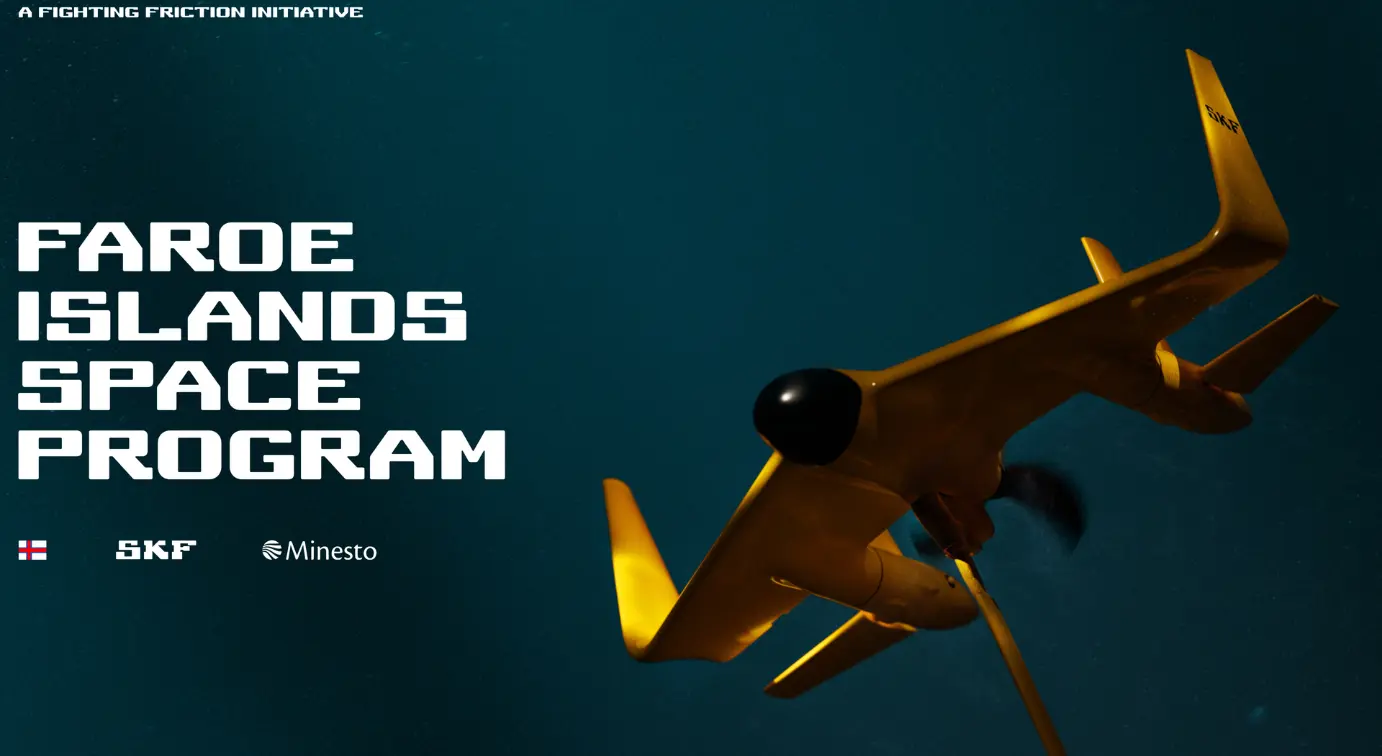
The creative team at NORD DDB noticed two things running simultaneously in global culture. The moon was dominating the energy conversation, with NASA, SpaceX, China’s space programme, and multiple private entities all framing lunar resource extraction as the next energy frontier. And in the North Atlantic, around the Faroe Islands, a technology company called Minesto had developed underwater tidal kites, devices that fly through ocean currents in figure-eight patterns, powered entirely by the gravitational pull of the moon on Earth’s tides. Minesto’s kites were already producing real electricity. Nobody outside the engineering community had ever heard of them.
The creative solution was to reframe those underwater kites as spacecraft and reframe the entire tidal energy project as a space programme, one that happened to be taking place at the bottom of the ocean rather than above the atmosphere. The Faroe Islands Space Programme: a space programme that never leaves Earth.
Art Director Carl Laurén described the strategic pivot: “We tapped into that cultural conversation and gave another perspective on moon energy. A space programme that doesn’t leave Earth but instead harnesses moon power we already have, using spacecrafts that go in the opposite direction: underwater.”
What Was Built
SKF partnered with NORD DDB, Minesto, and Faroese utility company SEV to bring the concept to life. The tidal kites were already installed in the North Atlantic Ocean around the Faroe Islands. The campaign’s job was to communicate their existence through a global platform built from documentary-style films, engineering content, earned media outreach, and a dedicated digital experience.
Minesto integrated film production into live offshore operations, meaning the campaign footage was shot during actual energy generation, not simulation. Technical drawings were provided for visualisation. The resulting content showed real kites flying through real currents, generating real electricity from the gravitational pull of the actual Moon, presented within the visual language of NASA mission briefings and space programme documentation.
Each tidal kite has the capacity to generate enough electricity for 200 villas for a year. The kites operate continuously, driven by tidal currents that are predictable to the minute for centuries in advance, unlike solar or wind energy which depend on weather conditions.
Cecilia Sernhage, Chief Communications Officer at Minesto, described the production challenge: “Combining real offshore operations with storytelling at this level is extremely demanding. The way our team executed this together with SKF and partners clearly contributes to the world-class recognition.”
Junior copywriter Ida Nordeng articulated the ambition that drove the creative approach: “SKF is much more than a bearing maker. It’s a clean tech company really. We didn’t want to create another campaign, but real action that stands out to showcase SKF’s mindset and move the world forward.”
The Results
The campaign generated 800 million impressions and over 1,400 pieces of earned media coverage across 140 markets, with features appearing in the BBC, CNBC, The Economist, BILD, and Interesting Engineering. More than 500,000 visits were driven to the dedicated campaign website. The technical documentary content accumulated 25 million views. Social engagement outperformed internal targets by 101%. The campaign reached audiences that SKF’s conventional marketing had never accessed, including engineers at competing companies making their first appearance on social media to post about a space programme their employer had somewhat unexpectedly launched.
Internal data confirmed a measurable uptick in the “Leader in Innovation” brand perception metric, validating the shift from technical product specifications to high-concept storytelling as a B2B communications strategy.
Martin Edlund, CEO of Minesto, captured the broader commercial purpose: “Building a completely new industry requires building awareness and recognition. This project achieves both.”
The Cannes Recognition
At Cannes Lions 2026, The Faroe Islands Space Programme won the Creative B2B Grand Prix, awarded as the world’s most outstanding B2B creative campaign of the year, alongside a Gold Lion in Creative Strategy. The Creative B2B Lions received 355 entries. Eleven Lions were awarded in total. The Grand Prix went to Stockholm and the Faroe Islands.
The B2B Lions jury’s reasoning captures what the campaign achieved structurally. A rival can copy a spec sheet within a week. A rival cannot copy an idea that buyers already remember. SKF sells bearings. It ran a space programme. The combination is what earned the campaign its place in the buyer’s memory, which is the only place B2B marketing ultimately needs to go.
Campaign Name: The Faroe Islands Space Programme
Agency Name: NORD DDB, Stockholm / Production: House / Post-Production & VFX: Current Occupation / Music: Ponytail, composer Høgni Reistrup
Brand Name: SKF / Partners: Minesto (tidal energy developer) / SEV (Faroese utility company)
Location: Faroe Islands, North Atlantic Ocean (global campaign distribution)