
The 9-to-5 workday is gone. What replaced it is something more complicated, and for advertisers across Southeast Asia, far more consequential.
The Infinite Workday Is Now the Default
According to Microsoft’s 2025 Work Trend Index, the average worker today faces 275 interruptions a day. Meetings scheduled after 8pm are up 16% year-on-year. By 10pm, 29% of active workers are back in their inboxes. Nearly 20% are checking email before noon on weekends. Work and personal life no longer run in sequence. They run simultaneously, on the same device, often on the same screen.
The pressure is most acute in Southeast Asia. Eighty four per cent of APAC workers say they lack enough time to complete their work, four percentage points above the global average. In Indonesia and Thailand, that figure rises to 88%. At the same time, 61% of APAC business leaders say productivity must increase, eight points above the global benchmark. The result is a workforce that is permanently on, permanently context-switching, and permanently fragmented.
Ryan Miles, international marketing director at Microsoft Advertising, put it plainly: consumers in Asia do not experience their day in neat blocks anymore. The working day no longer has a hard edge.
The PC Is Still the Primary Screen
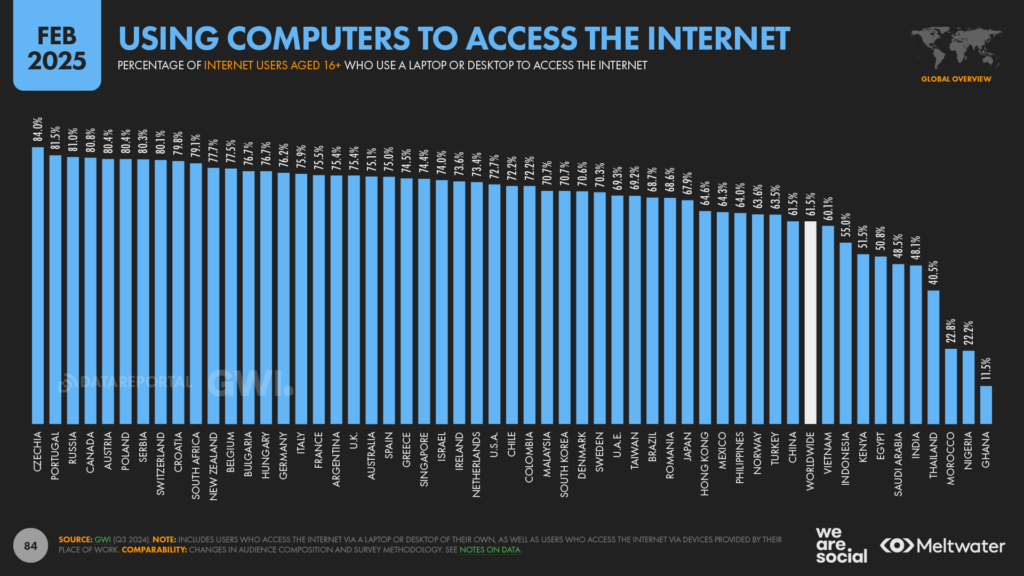
As work bleeds into more hours and more spaces, the laptop and PC have become the central devices of daily life across Southeast Asia. Windows holds an 84% desktop operating system share in Indonesia, 77% in Thailand, 74% in Malaysia, and 71% in the Philippines. In Singapore, the figure is 53%. These are not marginal numbers. For advertisers focused on mobile-first strategies, the PC dominance across the region represents a significant gap in how audiences are actually being reached.
Time spent online compounds the opportunity. Consumers in Southeast Asia spend between 3.5 and 4.3 hours online daily, with the Philippines and Malaysia leading the region. Microsoft audiences across these markets are 12% to 18% more likely to spend six to ten hours online per day compared to the average internet user.
Nick Seckold, regional vice president at Microsoft Advertising APAC, traced the behaviour back to COVID-19. Work-from-home accelerated online usage dramatically, and that acceleration did not reverse when offices reopened. People are now regularly on a Teams call with video off while shopping on another tab. Two screens, two tasks, one moment.
Intent No Longer Has a Schedule
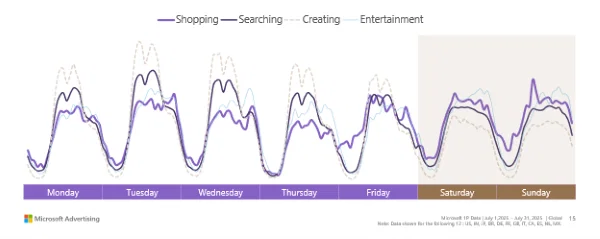
The practical consequence for advertisers is that intent, the moment when a consumer is ready to discover, research, or decide, is no longer concentrated in predictable time windows. Shopping activity typically peaks on weekends, but Microsoft’s platform data shows planning and discovery happening continuously across the working week. The separation between work mode and consumer mode has collapsed.
This changes what effective advertising looks like at a structural level. Formats that demand attention perform worse in a high-interruption environment. Snackable, utility-driven creative that fits into a task flow performs better. Context matters more than reach. Being present in a moment of genuine need outperforms occupying volume.
Miles described the shift as a change in what audiences expect from brands. They are no longer passive recipients waiting to be reached at an appointed hour. They expect relevance at the moment of contact, and they have a lower tolerance for messaging that arrives without it.
Where Microsoft Advertising Fits In
Microsoft’s owned surfaces, Windows Edge with Bing as the default browser, the MSN content feed, and Copilot, sit inside these task flows by design. When a user opens a browser, the MSN feed surfaces news and content they have already engaged with. Advertising runs natively within that environment. Seckold described the approach as deliberately restrained, noting that the platform is careful not to overload the experience and that brands are embedded into content rather than placed over it.
Copilot adds a forward-facing dimension. The tool already handles email summarisation, task drafting, and priority surfacing for millions of users across the region. As automation takes over the organisational layer of the workday, the space that opens up shifts toward higher-order decisions, which is precisely where brand consideration and purchase intent tend to operate.
Microsoft is also expanding available ad formats across these surfaces in response to growing advertiser demand.
What Advertisers Need to Change
The blended workday dismantles two assumptions that have underpinned digital advertising strategy for years: that audiences can be segmented cleanly by device, and that consumer intent clusters around predictable daily peaks. Neither is accurate anymore in Southeast Asia, and the gap between the old playbook and current audience behaviour is widening.
The operational shift Microsoft Advertising is recommending is not about spending more. It is about synchronising messaging across PC, mobile, and connected TV using dayparting and AI-led optimisation, and building creatives that are designed to fit into micro-moments rather than interrupt them. Signals from search behaviour, shopping patterns, and conversational AI tools like Copilot now provide a clearer picture of what someone is trying to do in a given moment than demographic data alone.
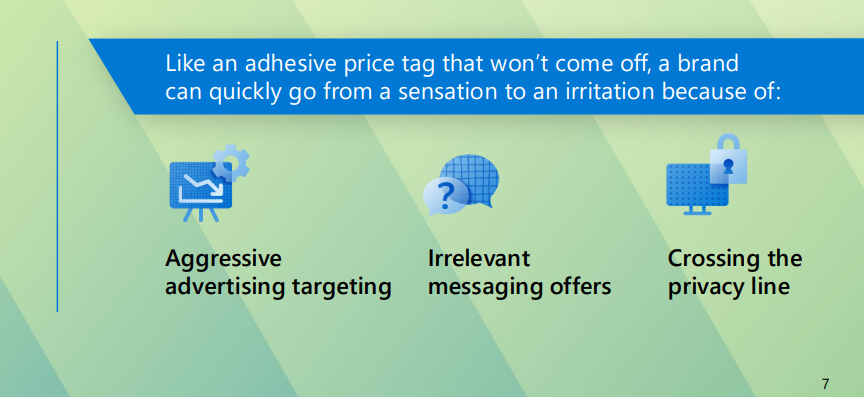
Miles framed the risk for brands that ignore this directly: advertising that shows up at the wrong time, or without relevance, does not just underperform. In a high-interruption environment, it actively erodes trust.
The brands that will perform best in this environment, according to Microsoft’s positioning, are the ones that stop trying to dominate attention and focus instead on supporting progress at the moment it is happening.