In February 2016, McDonald’s France built a road sign outside Brioude, a town of 6,700 people in the Haute-Loire region, chosen with surgical precision for one reason: the nearest Burger King was 258 kilometres away. Nearly a five-hour drive.
The Sign
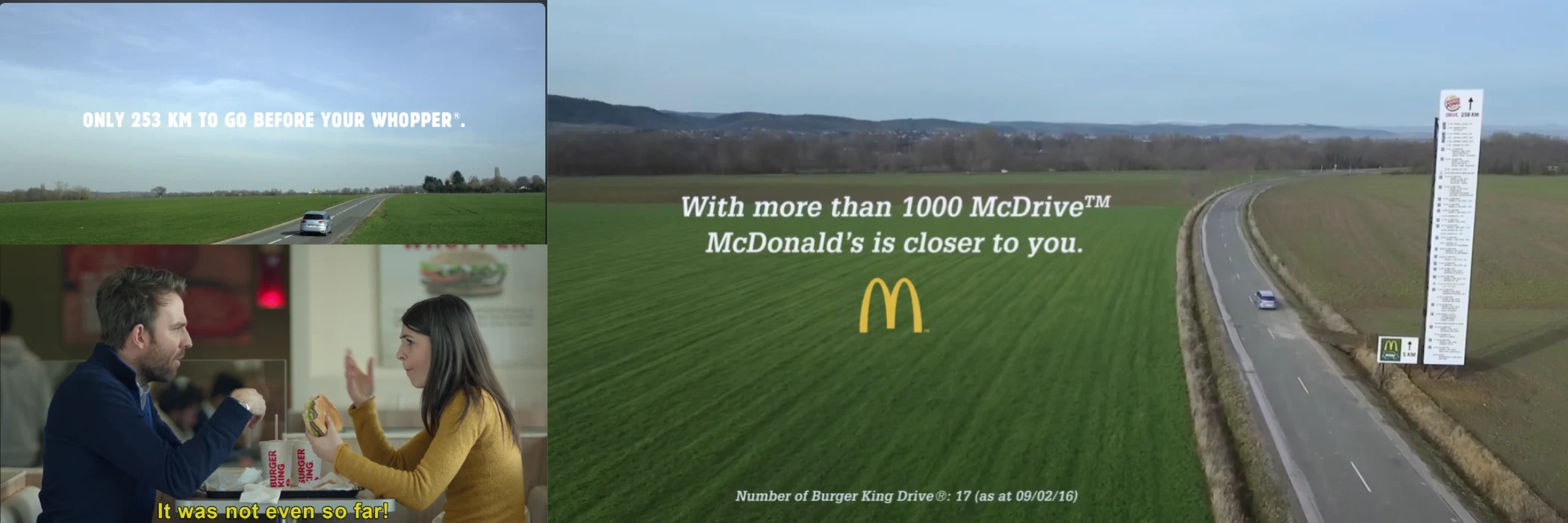
TBWA Paris erected two temporary billboards side by side outside the town. The larger one gave full road directions to the nearest Burger King drive-thru, complete with route instructions across 258 kilometres. The smaller sign beside it pointed left. McDonald’s: 5 km.
The math behind it was the message. McDonald’s had over 1,300 locations across France. Burger King had 45. The sign was not subtle about what it was doing. Proximity was McDonald’s stated competitive advantage, and the billboard turned that advantage into a physical taunt, planted in a town where Burger King was effectively unreachable.
The sign came down within days. It had already done its job. Coverage ran across advertising and mainstream press globally. The campaign hashtag was #McDriveKing. For a few news cycles, McDonald’s France owned the French fast food conversation entirely. Then Buzzman responded, and the conversation moved.
The Response That Rewrote the Story
Buzzman, working for Burger King France, did not dispute a single number in the McDonald’s sign. They accepted the premise completely and wrote an ending for it.
A short film opens with a young French couple driving past the Brioude billboard. They pull into the nearby McDonald’s. They order one large coffee. They get back on the road. The film tracks them driving across France, 253 kilometres remaining, then fewer. They arrive at Burger King. They unwrap their Whoppers. The man says it didn’t feel that far at all.
The line on screen reads: “Only 253 kilometres to go before your Whopper. Thank you, McDonald’s, for being everywhere.”
The sign McDonald’s built to mock Burger King’s scarcity had just been reframed as a fuelling station on the way to a better burger. McDonald’s 1,300 locations, its single greatest structural advantage in France, became the infrastructure that made the Burger King journey possible. The competitor’s strength was rewritten as a service to the underdog.
What Made the Buzzman Response Work
Most competitive advertising works by attacking a rival’s weakness. Buzzman did the opposite. The film acknowledges that McDonald’s is everywhere. It accepts the 258 kilometres. It does not argue that the distance is not real or that Burger King is more accessible than it is. It simply recontextualises what that distance means when a Whopper is waiting at the other end.
The strategic shift is precise. McDonald’s billboard was a dominant play. The Buzzman film converted dominance into utility. Every McDonald’s in France suddenly existed, in the audience’s mind, as a place you stop for coffee on the way to Burger King. The brand with 45 locations had just colonised the narrative of the brand with 1,300.
The film hit 1.3 million views in its first weekend with no paid media support. Coverage ran in The Local France and international advertising press. The story was no longer about McDonald’s proximity advantage. It was about Burger King’s audacity.
The Broader Context
The campaign sits inside a pivotal moment for Burger King in France. The brand had just received regulatory approval to acquire the Quick fast food chain, which would add approximately 400 restaurants to its existing 45. The gap that McDonald’s had mocked with its billboard was about to close significantly. The Buzzman film, made at its peak underdog status, carried an implicit confidence about where Burger King was heading, even if it could not say so directly.
McDonald’s France pulled the sign. Burger King France got the last word, with fewer locations, no outdoor budget, and a coffee stop.
Campaign Name: #McDriveKing (McDonald’s) / Not mentioned (Burger King response)
Agency Name: TBWA Paris (McDonald’s) / Buzzman (Burger King)
Brand Name: McDonald’s France / Burger King France Location: Brioude, Haute-Loire, France