Most cities have tactile paving on their pavements. The raised lines and dots guide visually impaired pedestrians forward and tell them when to stop. What they cannot tell a blind person is what is in front of them, whether the building beside them is a bank, a pharmacy, a restaurant, or a bus stop. In Peru, where visual impairment is the most prevalent physical disability, that gap left more than 500,000 people dependent on asking strangers for directions to reach basic services. Cemento Sol, the country’s leading cement brand, and Circus Grey Peru spent nearly two years building a solution out of the same material the problem sat on: the pavement itself.
The Problem With the Existing System
The universal tactile paving system, present in cities across the world, uses textured ground surfaces in two forms. Lines guide pedestrians forward. Dots tell them to stop. The system addresses navigation. It does not address the destination. A visually impaired person standing at a line of tactile paving knows they are on a path and knows where the kerb is. They do not know what businesses line the street they are walking down or which side of the road a specific service is on.
In Lima’s Miraflores district, the most visited and commercially dense area in the country, that limitation was a daily barrier for thousands of residents. A blind person needing a pharmacy, a bank, or a convenience store could not find it independently. They had to ask someone nearby, which meant every basic errand depended on a stranger.
What Sightwalks Does
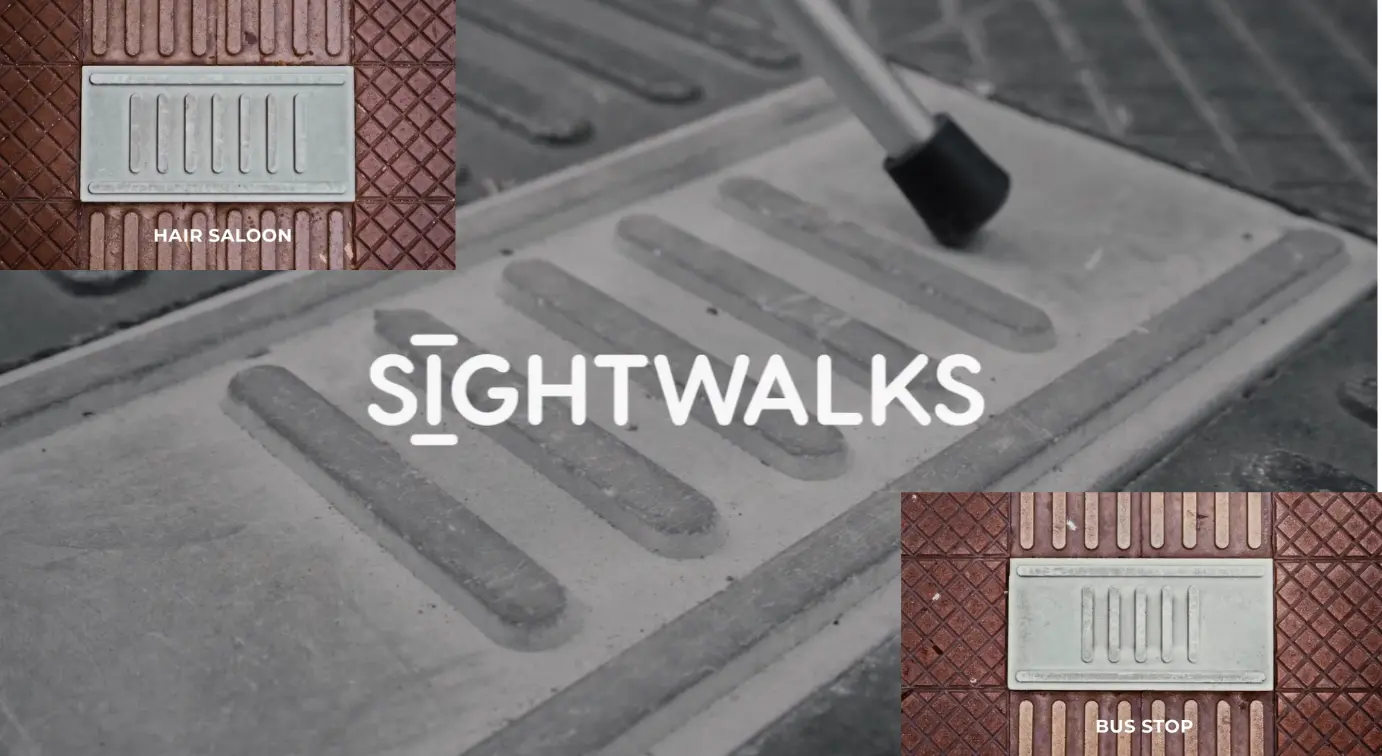
Circus Grey Peru designed a new layer of tactile information to sit on top of the existing universal system. The Sightwalks tiles carry a coded vocabulary of horizontal and vertical lines. Horizontal lines on the tile surface indicate the category of the adjacent business. One line means a restaurant. Two lines indicate a bank. Three lines signal a grocery store. Four lines signify a pharmacy. Additional categories extend the system for hospitals, bus stops, hotels, and other services. Vertical markers above and below those horizontal lines indicate which side of the street the venue is on.
A visually impaired person using a guide cane counts the lines by touching the tile’s surface. The information arrives instantly, without speaking, without waiting, without relying on anyone else. The entire system was co-created with Peru’s leading visually impaired organisations across the full two-year development process, with multiple rounds of prototype testing to validate the tactile vocabulary and confirm that it was intuitive under real urban conditions before a single tile was laid permanently.
Piero Oliveri, CCO of Circus Grey, described the development philosophy: “Each stage was crucial to ensure the system’s effectiveness, from the initial prototypes to the final tests. The collaborative, multidisciplinary, co-creation work with the country’s leading associations for the visually impaired, industrial designers, and engineers is noteworthy.”
The Implementation
The first rollout was in Miraflores, selected for its commercial density and high foot traffic, meaning the system immediately addressed the venues and services that blind residents needed to navigate most frequently. Over 75,000 square metres of Sightwalks tiles are now installed across the district’s streets, covering the full pedestrian network of Lima’s most visited neighbourhood.
Training sessions ran in 2023 through the major visually impaired organisations in Peru, using braille brochures and instructional audio to introduce the new tile vocabulary to the people who would use it. The barrier to adoption was deliberately kept low. The tile language is simple enough to learn in a single session.
Rubén Goicochea, president of the National Union of the Blind in Peru, described what the installation meant personally: “I feel proud and happy to have more accessible streets. For us, these tiles are not just any lines. They have a significance that allows us to replace sight with touch.”
Carlos Canales, the Mayor of Miraflores, confirmed the municipality’s commitment: “With this initiative, we continue the work started 20 years ago to make Miraflores more inclusive.”
Open Source by Design
Cemento Sol made a deliberate decision not to patent the system for commercial exclusivity. The tile designs and their implementation methodology are open source and available for free download at cementosol.com.pe. Any city, municipal authority, or organisation anywhere in the world can adopt and replicate the Sightwalks system at no cost. The goal is explicit: the system was built to be universal, not proprietary.
Conversations are already underway with organisations in the United States, Europe, and Japan about local implementation. If the system scales to even a fraction of those markets, the 500,000 people currently benefiting in Lima become a number many times larger.
The Awards
Sightwalks won the Design Grand Prix at Cannes Lions 2024, alongside four Gold, two Silver, and one Bronze Lion. It also won the Grand Prix at the London International Awards 2024 and multiple Grands Prix at Clio Health 2025, One Show 2025, where it won the Grand Prix and nine Golds, and El Sol and ANDY Awards. Fast Company named it a 2025 World Changing Ideas Award honouree for its impact, sustainability, scalability, and design.
The body of recognition reflects something the campaign itself makes clear. Sightwalks is not primarily a marketing campaign for a cement brand. It is an urban infrastructure project that permanently improves mobility for half a million people, happened to be conceived by an advertising agency, and uses the client’s core product as its delivery mechanism. Cemento Sol did not make an ad about making cities more inclusive. It made the city more inclusive and built the tiles from its own cement.
UNACEM’s Gabriel Barrio summarised the project’s intent with precision: “We believe that building goes beyond concrete. It’s about leaving a positive mark on people and the world around us. An ordinary sidewalk becomes a tool for inclusion and hope.”
Campaign Name: Sightwalks
Agency Name: Circus Grey Peru (Grey / WPP) / Experience Agency: DINAMO / Production: REBECA
Brand Name: Cemento Sol / UNACEM
Location: Miraflores District, Lima, Peru (open-source design available globally)