
60% of American men mistakenly believe prostate cancer screening begins with an invasive rectal exam. That single misconception is responsible for millions of eligible men avoiding a test that, when it catches the disease early, carries a greater than 99% five-year survival rate. Novartis and Fallon decided the largest television audience in the world was the right room to correct it.
The Misconception That Drove the Brief
Prostate cancer is the most commonly diagnosed cancer among men in the United States and the second leading cause of cancer-related death. Despite those numbers, an estimated 40.3 million age-eligible American men have never had a PSA blood test. The barrier is not access. For most men, it is a persistent and inaccurate assumption about what screening involves.
The PSA test, the standard first step in prostate cancer screening, is a routine blood draw. A small vial of blood is taken. The PSA protein level is measured. If the result is concerning, further investigation follows. There is no invasive physical exam involved in that first step. The digital rectal exam that men fear is a different procedure, sometimes used as a secondary tool in specific circumstances, not the standard starting point. Six in ten men did not know this.
The campaign’s creative task was therefore not to raise awareness of prostate cancer itself. It was to correct a specific, documentable, and entirely unnecessary piece of misinformation that was preventing men from showing up for a potentially lifesaving test.
The Double Entendre
Fallon’s solution found its entry point in football terminology. A tight end is a standard offensive position in American football. The tight end is also, anatomically, the part of the male body that men associate with the invasive exam they fear. “Relax Your Tight End” is a line that works entirely on both registers simultaneously.
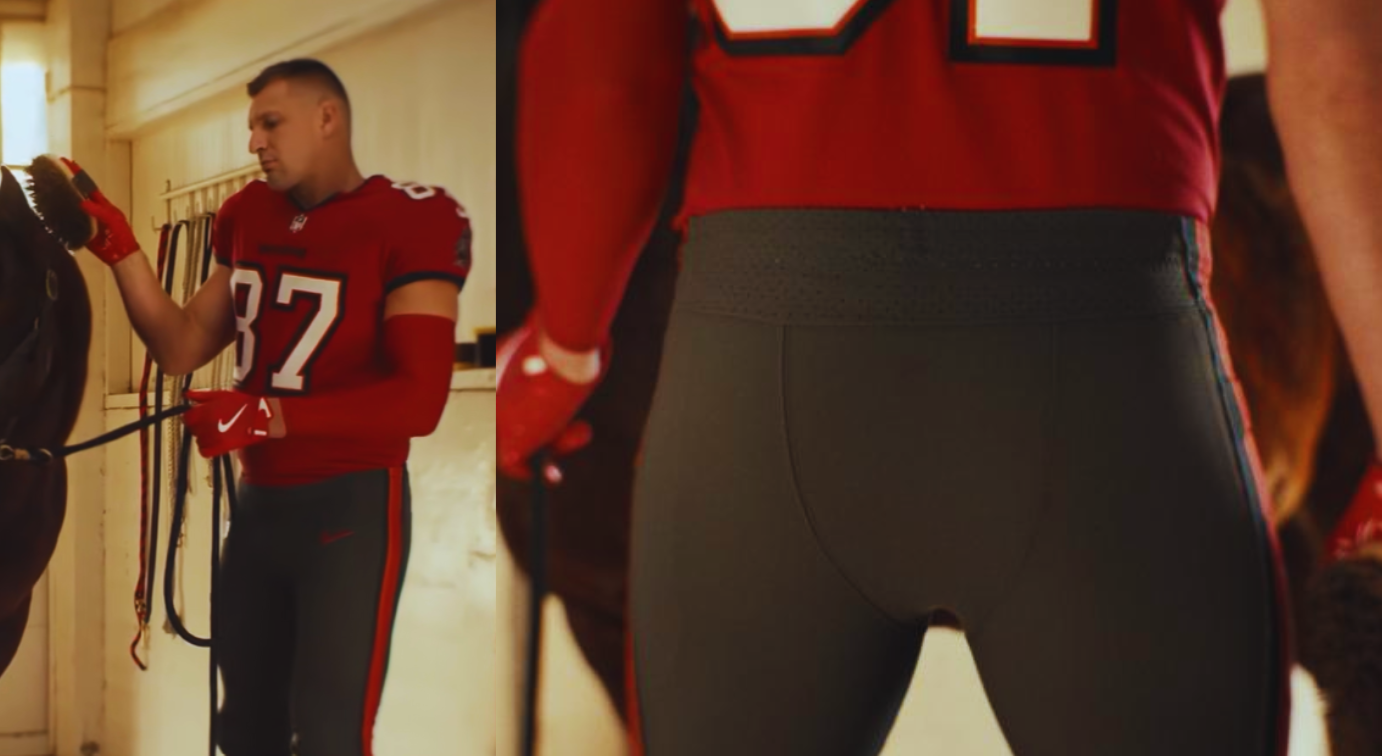
The creative mechanic is executed by director Eric Wareheim through PRETTYBIRD with a cast of seven NFL tight ends, current and legendary, shown visibly, almost absurdly, relaxed. Rob Gronkowski brushes a horse. George Kittle floats in a pool. Tony Gonzalez birdwatches. Greg Olsen practises yoga. Colby Parkinson paints a portrait of Super Bowl-winning coach Bruce Arians. Vernon Davis has his hair brushed. Delanie Walker completes the ensemble.
Enya’s “Only Time” plays throughout, a piece of music specifically selected to add an additional layer of deliberate absurdity to the sight of some of the most physically imposing athletes in American professional sport in states of complete, almost meditative calm. Arians, a prostate cancer survivor himself, narrates with the understated delivery of a coach who has seen everything: “Have you ever in your life seen tight ends this relaxed? You know what these tight ends are so relaxed about? Prostate cancer screenings. They’ve learned there’s a simple, finger-free blood test.”
Each of the eight men in the campaign, including Arians, has a personal connection to prostate cancer. The number eight is also the jersey number prefix for most tight ends, and, as Novartis noted in its materials, one in eight men will be diagnosed with prostate cancer in their lifetime. The symmetry between the cast size, the jersey numbers, and the statistics was deliberate.
The Super Bowl Stage
The one-minute film debuted during Super Bowl LX on February 8, 2026, in front of more than 100 million viewers, making it the largest single audience for a prostate cancer awareness message in American broadcast history. Novartis is the official pharmaceutical partner of the NFL, a partnership that gave the campaign structural legitimacy beyond its celebrity roster. The network relationships facilitated on-site PSA testing activations at NFL team facilities and at the Super Bowl Experience, turning the campaign from a media moment into a physical access point for the men who needed the test most.
Victor Bultó, President, US, Novartis, described the brief’s underlying goal: “Early detection of prostate cancer can make a meaningful difference in outcomes, but the fear of a potentially uncomfortable exam causes many of us to avoid making an appointment. By teaming up with the NFL and these celebrated players, we’re empowering men nationwide to take the first step: a simple blood test.”
The Advocacy Infrastructure
The broadcast campaign sat inside a significantly larger activation. Novartis partnered with the American Cancer Society, Prostate Cancer Foundation, ZERO Prostate Cancer, Malecare, the National Alliance of State Prostate Cancer Coalitions, and the Prostate Health Education Network to build an educational infrastructure around the media moment. The campaign website carries risk assessment tools, localised information on how to access PSA testing, and community outreach materials developed with the advocacy partners.
Shane Jacobson, CEO of the American Cancer Society, framed the systemic gap the campaign addresses: “Expanding access to cancer screening, especially in communities where limited resources and persistent misconceptions have hindered life-saving education and care, is essential to changing outcomes. By working with partners like Novartis to break down barriers to screening, we can help men detect prostate cancer earlier, expand equitable access to care, and fundamentally change what a diagnosis means for patients and their families.”
The campaign specifically addresses the disparity that makes screening avoidance most dangerous. Black men face a higher risk of prostate cancer diagnosis and are among the populations least likely to have accessed early screening. The campaign materials and community outreach activations directed particular attention toward reducing that specific gap.
Bruce Arians, whose own 2007 diagnosis was caught through early detection, delivered the campaign’s most personal line: “I hear men all the time say they’re hesitant to get screened because of what they think it involves. There is no need to avoid it if you talk to a doctor and learn your risk. You can relax. It’s a blood test.”
The Healthcare Advertising Lesson
The campaign belongs to a specific and valuable category of health advertising that identifies one precise behavioural barrier, builds a creative platform entirely designed to remove it, and deploys that platform in the environment where the target audience is most likely to receive it. Novartis did not attempt to make men care about prostate cancer in the abstract. It identified the single wrong fact that was stopping men from getting screened and used the most-watched television broadcast in American culture to correct it with a football pun.
CNN medical correspondent Dr Jamin Brahmbhatt, in his post-Super Bowl assessment of the campaign, described what it achieved in clinical terms: “Amid the other ads, it did something we struggle to do in medicine: Get men to pay attention to prostate cancer screening.”
Campaign Name: “Relax, It’s a Blood Test” / “Relax Your Tight End”
Agency Name: Fallon Minneapolis / Production: PRETTYBIRD (Director: Eric Wareheim) / Media: Publicis N2 / Activation: Bespoke MKT / Agency Partners: Digitas Health, Publicis Groupe
Brand Name: Novartis
Location: United States (Super Bowl LX broadcast, national rollout; on-site activations at NFL facilities and Super Bowl Experience)