Most advocacy campaigns argue from the position of the people being harmed. Smartphone Free Childhood argued from the position of the people profiting. The result is a two-minute satirical film that has done more to communicate the structural problem with children on social media than most serious documentaries on the subject.
The Film and the Character
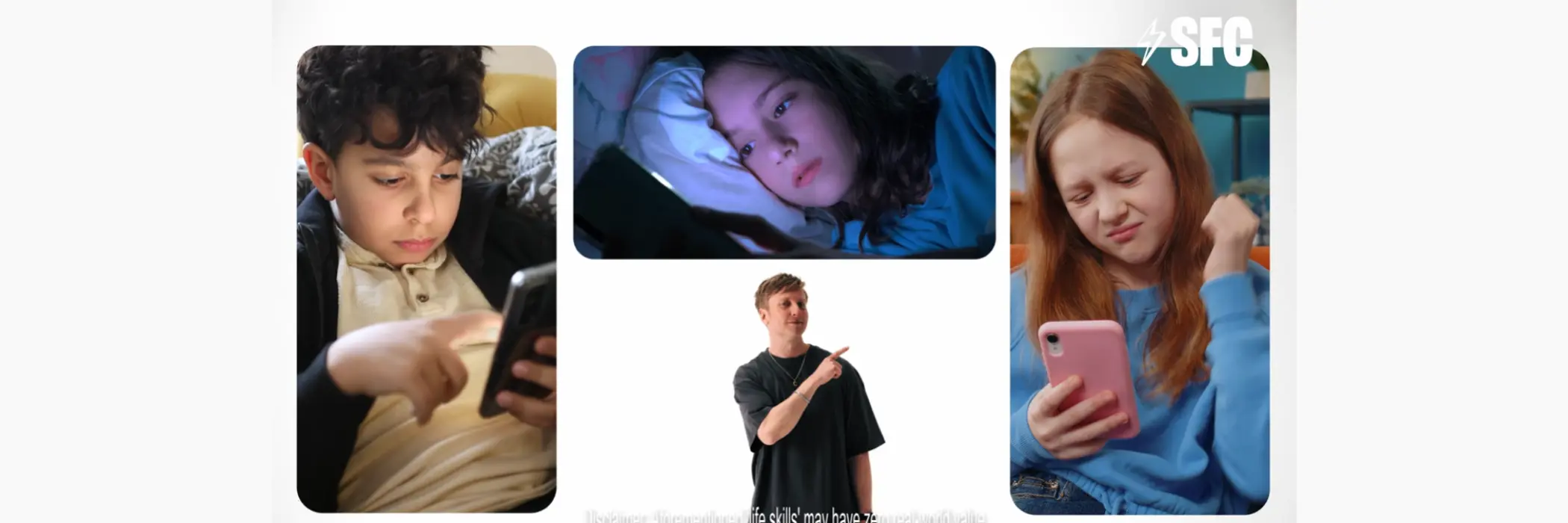
“Zack Zingerberg” is a fictional tech billionaire, a transparent composite of real Silicon Valley figures, fronting a heartfelt charity appeal. The appeal asks parents and the UK Government to please, please let him keep accessing children’s attention. His business model depends on it. His MMA career benefits from it. It would mean a great deal to him personally if meaningful age restrictions were not introduced.
The film is built and paced exactly like a genuine charity appeal. The emotional register, the sincerity, the direct address to the camera, all of it is borrowed from the format of a plea for help. Only the beneficiary is inverted. This is not a campaign on behalf of children. It is a campaign on behalf of the people, extracting value from them.
The film was produced by a group of UK creatives working entirely pro-bono, in partnership with Smartphone Free Childhood. Creative work was led by Sam Ojari and Dulcie Cowling. Production was handled by NUSA Studios. The total production cost to the charity was zero.
The Context It Was Built For
The film was timed deliberately to coincide with the UK Government’s formal review of technology and young people, which followed a sustained public campaign from Smartphone Free Childhood and considerable political pressure from multiple directions.
The organisation was founded in February 2024 by two parents in Suffolk who started a WhatsApp group. Within weeks, local chapters had formed across every county in the UK. The organisation now has over 350,000 members and affiliations with similar movements in more than 40 countries. Over 100,000 people have signed its petition calling on the government to raise the minimum age for social media access to 16. More than 100,000 people separately contacted their local MP to call for an Australia-style ban for under-16s after the campaign launched.
Prime Minister Keir Starmer stated publicly in response to SFC’s earlier campaign that “all options are on the table” regarding social media restrictions for children, adding that he was particularly concerned about under-fives and screen time. A government consultation launched in March 2026 specifically to guide new legislation.
Why Satire Works Here and Elsewhere Would Not
Joe Ryrie, co-founder of Smartphone Free Childhood, described the creative decision directly: “Some of the richest and most powerful companies in human history are making billions from capturing as much of our children’s attention as possible, whatever the consequences. We wanted to use satire to shine a light on the absurdity of that business model in a way that people would actually watch, remember and share. Because while Zack is very much a joke, the reality facing children and families is not.”
Dulcie Cowling, one of the film’s creators, described the underlying mechanics: “It’s quite dark when you stop and think about what’s going on. But humour is the best tool we have. It’s a handy little Trojan horse.”
The Trojan horse function is the campaign’s primary strategic asset. A serious film about children and social media harm is watched by people who already agree with it. A satirical film fronted by a fictional tech billionaire begging to keep his business model intact gets shared by people who find it funny, reaches audiences who were not already engaged with the issue, and lands its argument precisely because the laughter arrives before the defence mechanisms do. By the time the viewer has finished laughing at Zack Zingerberg’s sincere appeal, they have already internalised what his appeal was actually describing.
The Broader Numbers
Ofcom data published in 2024 found that a quarter of three and four-year-olds in the UK now have a smartphone. Half of children under twelve are on social media. Thirty-eight percent of five to seven-year-olds use social media, up from 30% the previous year. These are the conditions in which the Zack Zingerberg film was released. The satire does not exaggerate the business model it is mocking. It describes it.
Campaign Name: “Urgent Charity Appeal from Social Media Billionaires”
Agency Name: Sam Ojari and Dulcie Cowling (pro-bono) / Production: NUSA Studios
Brand Name: Smartphone Free Childhood
Location: United Kingdom