Up to 80% of New Zealanders contract oral or genital herpes at some point in their lives. Despite that statistic placing the virus firmly in the category of the ordinary and the common, research found that New Zealand had one of the highest rates of herpes stigma in the world. Thirty percent of those diagnosed with herpes in New Zealand experience depressive or suicidal thoughts, a consequence not of the virus itself but of the shame attached to it. The New Zealand Herpes Foundation had been trying to crack a destigmatisation campaign for over 20 years without success. Motion Sickness found the brief’s answer in national pride.
The Strategy
New Zealand’s sense of national identity runs on competitive achievement. The All Blacks. The world’s best pandemic response. A sheep-to-human ratio that was once a source of genuine cultural pride. By 2024, according to the campaign’s own framing, several of those sources of pride had diminished. The sheep-to-human ratio had dropped. Pies were pushing seven dollars. The country needed something new to be proud of.
Motion Sickness positioned herpes destigmatisation not as a public health obligation but as a new national competitive target. The campaign’s brief to the country was simple: make New Zealand the best place in the world to have herpes. To quantify what “best” meant, Motion Sickness commissioned independent insights agency TRA to conduct a Herpes Stigma Index across ten OECD countries, producing a baseline ranking of which countries carried the most and least stigma. New Zealand started low. The campaign gave the public a leaderboard and a way to climb it.
The Course
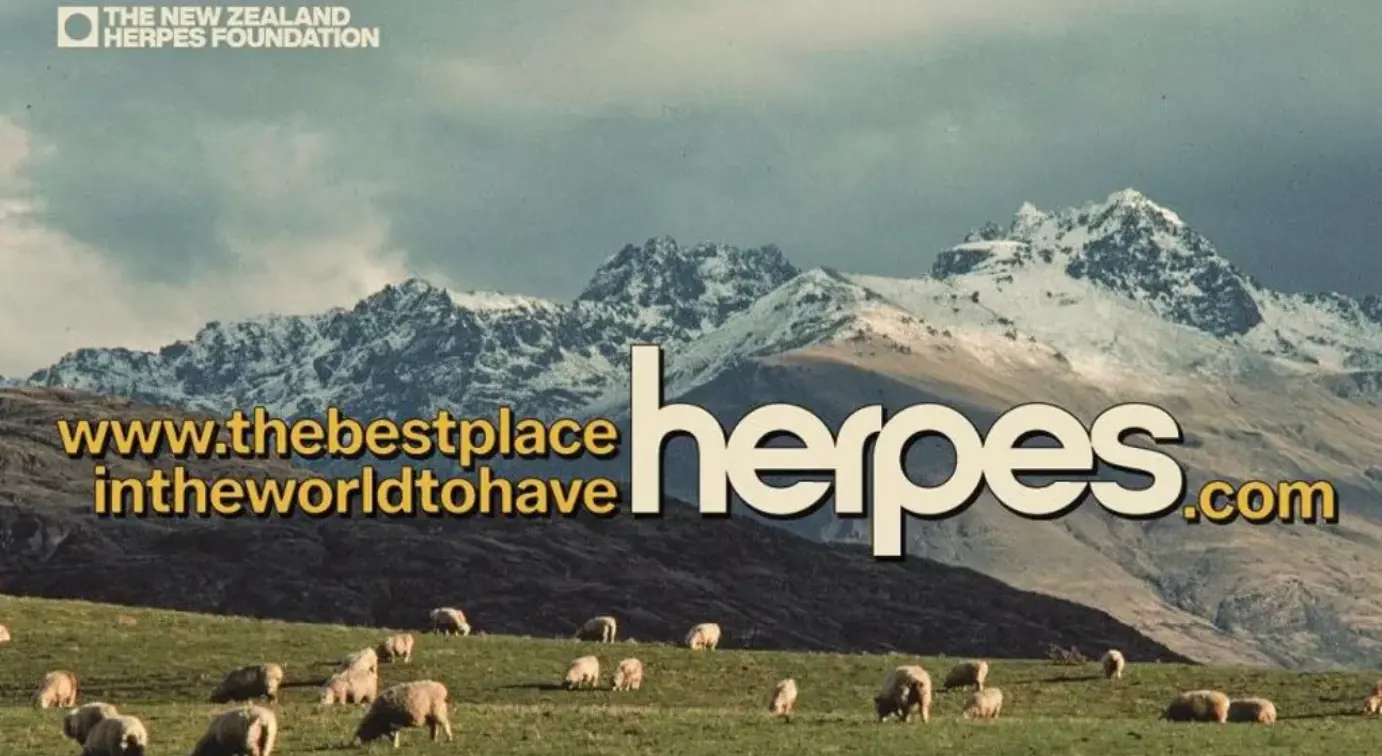
The Herpes Destigmatisation Course is the campaign’s creative centrepiece, developed with production company Finch. It looks and feels like a New Zealand tourism advertisement from another era, warm, slightly daggy, self-aware, and completely deadpan about its subject. Sir Graham Henry, former All Blacks head coach, opens the campaign by lamenting New Zealand’s declining national pride and scrawling the word “HERPES” in all capitals on a chalk board as his proposed solution. What follows is a multi-video educational series.
Sir Ashley Bloomfield, who led New Zealand’s public health response during the COVID-19 pandemic and was knighted for it, appears as a course presenter and explains the psychological impact of stigma directly: “Thirty percent of all Kiwis diagnosed with the herpes virus experience depressive or suicidal thoughts. This is a problem we can solve, which is pretty rare these days.” Sir Buck Shelford, rugby icon. Angella Dravid, comedian. Mea Motu, professional boxer. Each presenter brings a different corner of New Zealand’s cultural identity into a conversation the country had spent decades avoiding.
The educational content is evidence-based and dermatologist-informed. The packaging is not. Claire Hurst, founding trustee of NZHF, described what the campaign achieved after two decades of failed attempts: “In many cases the social stigma is much more damaging than the virus.”
The Mechanic
Completing the course earns points for New Zealand on the Herpes Stigma Index leaderboard, which updates in real time on the campaign website, thebestplaceintheworldtohaveherpes.com. The mechanic turned a private act of education into a public act of national contribution. A person could complete the course without telling anyone, but their completion improved New Zealand’s global ranking. Watching the videos was simultaneously personal and collective, which is precisely the framing that made the most stigmatised health topic in New Zealand feel less isolating to engage with.
Over eight weeks, New Zealand climbed the global leaderboard and officially became, by the measure of the TRA post-campaign survey, the best place in the world to have herpes.
The Numbers
The campaign was produced on a media spend of $28,000 USD. It generated 12 million impressions. Within the first four days, over 5,000 lesson views were recorded, with 1.2 million social media views and 152,897 engagements. Across all channels, the campaign reached 565,728 unique New Zealanders in the first week alone. Over eight weeks, 10,776 hours of destigmatisation content were viewed, the equivalent of more than a year of herpes education watched by the population of a small country.
Post-campaign survey results confirmed behavioural shift rather than simply awareness. Eighty-seven percent of viewers said they understood herpes better. Eighty-two percent said they would be more supportive of someone who had it. Supportive attitudes rose from 44% to 67%, the highest figure measured in any OECD country at the time of measurement.
The Awards
At Cannes Lions 2025, Make New Zealand the Best Place in the World to Have Herpes won both the Grand Prix for Good, the festival’s top award for non-profit and charitable work, and the Lions Health Grand Prix for Good. Jury President Judy John, Global CCO at Edelman, delivered the citation with the kind of directness the campaign itself had brought to its subject: “The bravery of this idea, the creativity is off the charts. The execution was flawless. We were able to admit to one another that we may all have herpes, and we’re okay with it. That is effectiveness. That is de-stigmatising. That’s the brilliance of this campaign.”
She added that the case study did not do it justice until you watched the actual content, which is educating and entertaining simultaneously: “You actually want to watch the whole thing and you’re learning, and it does destigmatise herpes. It’s so effective.”
Campaign Name: Make New Zealand the Best Place in the World to Have Herpes
Agency Name: Motion Sickness, Aotearoa / Production: Finch / Research: TRA / Web: ED Creative
Brand Name: New Zealand Herpes Foundation (NZHF)
Location: New Zealand (national campaign; global digital distribution)