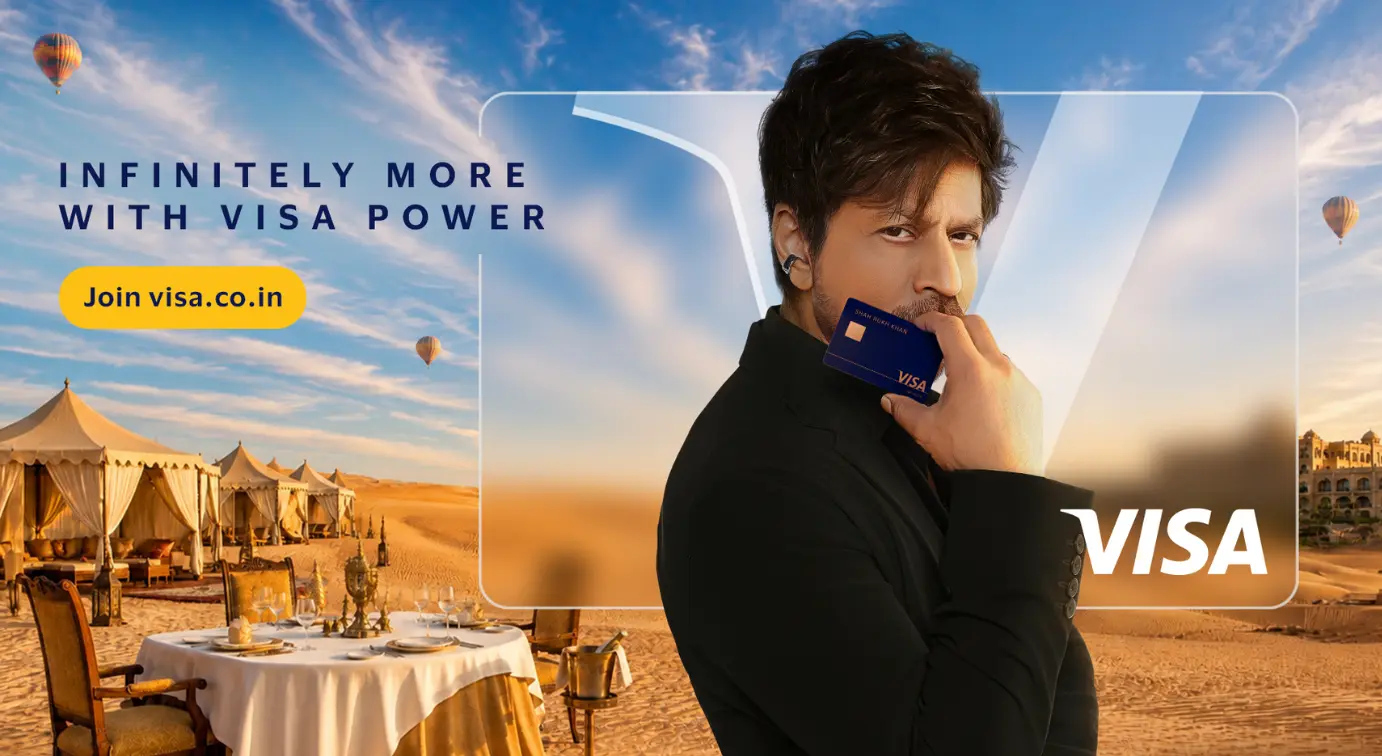
Most brand films with a superstar ambassador are built around the face in the frame. Visa’s “Infinitely More,” launched in India in June 2026 with Shah Rukh Khan as the brand’s new ambassador, is built around something more layered. Leo India and Publicis Groupe South Asia packed the film with visual callbacks to Visa’s own advertising history, hidden in plain sight for anyone who has been paying attention across the brand’s decades of global campaigns.
The Campaign on the Surface
“Infinitely More” positions Visa as the enabler of India’s growing experience economy, targeting affluent consumers who are increasingly choosing experiences over ownership. The film is fast-paced, cinematic, and deliberately maximalist, placing SRK across a cascade of travel, dining, wellness, and lifestyle moments that unfold with the energy of a heist sequence rather than a luxury catalogue.
Shah Rukh Khan described the partnership in terms that echo Visa’s most famous tagline: “In every journey that has mattered, Visa has been everywhere I want to be.” The phrase is a direct callback to “Visa. It’s everywhere you want to be,” the tagline the brand ran globally from 1985 to 2005, one of the longest-running and most recognised taglines in financial services advertising history.
The Tuk-Tuk Driver
The first easter egg requires no archaeology. A tuk-tuk driver appears in the film, and it is not a generic casting decision. The same tuk-tuk driver featured in previous Visa international campaigns has been brought back for this film. The reappearance is confirmed by Gaurav Ramdev, Head of Marketing at Visa India and South Asia, who described the callbacks as references drawn from “some of our most memorable campaigns.” A figure from the brand’s own advertising past reappears decades later in a new film, unchanged in role if not in years. For a viewer who remembers the original appearance, it registers immediately. For a viewer who does not, it reads as a charming supporting character. Both experiences are valid. Only one of them is the intended one.
The Orangutan
The second callback is the one that has generated the most discussion among advertising professionals watching the film. An orangutan appears in the film, and its presence is not accidental. Visa’s earlier international campaigns had featured an orangutan in a global spot that is well-documented in advertising archives. The animal’s reappearance in “Infinitely More,” confirmed by the brand’s own spokesperson, is the most deliberate of the film’s nostalgia anchors. Orangutans do not typically appear in payment advertising. When one appears in a Visa film for the second time across decades of work, it is not a creative coincidence.
The Soundtrack: “Paisa Hai Paisa”
The third layer is sonic rather than visual. The film uses a revival of “Paisa Hai Paisa,” a retro Hindi track whose title translates as “Money Is Money.” The choice is playful, ironic, and self-aware. A payment brand using a song about money carries its own meta-commentary, but the specific choice of a vintage track reframes the brand’s modern positioning through the lens of nostalgia, connecting the experience-led present to a cultural past. Rajdeepak Das, CCO of Publicis Groupe South Asia and Chairman of Leo South Asia, confirmed the intentionality: “The soundtrack takes on a playful new meaning here.”
Why the Easter Eggs Matter
Most celebrity campaign films operate in a single register: impress the viewer with the star, communicate the brand proposition, drive awareness. Visa’s film operates in two registers simultaneously. The surface layer is Shah Rukh Khan moving through aspirational experiences with a Visa card in hand. The second layer is a conversation with anyone who has been watching Visa’s advertising long enough to recognise what is being referenced.
The tuk-tuk driver and the orangutan are not just nostalgic flourishes. They are signals of creative continuity, evidence that the brand’s advertising history is being treated as an asset rather than archived. For the casual viewer, the film works as a premium campaign with a global superstar. For the eagle-eyed one, it is a Visa retrospective disguised as a new film.
Das described the creative intention in the most direct terms available: “We have created a fast-paced, high-energy, cinematic narrative and packed it with many references like metaphorical easter eggs, including the tuk-tuk, the orangutan as a throwback, all coming together in this larger-than-life piece. Every frame is designed to reveal something unexpected.”
Campaign Name: Infinitely More
Agency Name: Leo India / Publicis Groupe South Asia
Brand Name: Visa India
Location: India