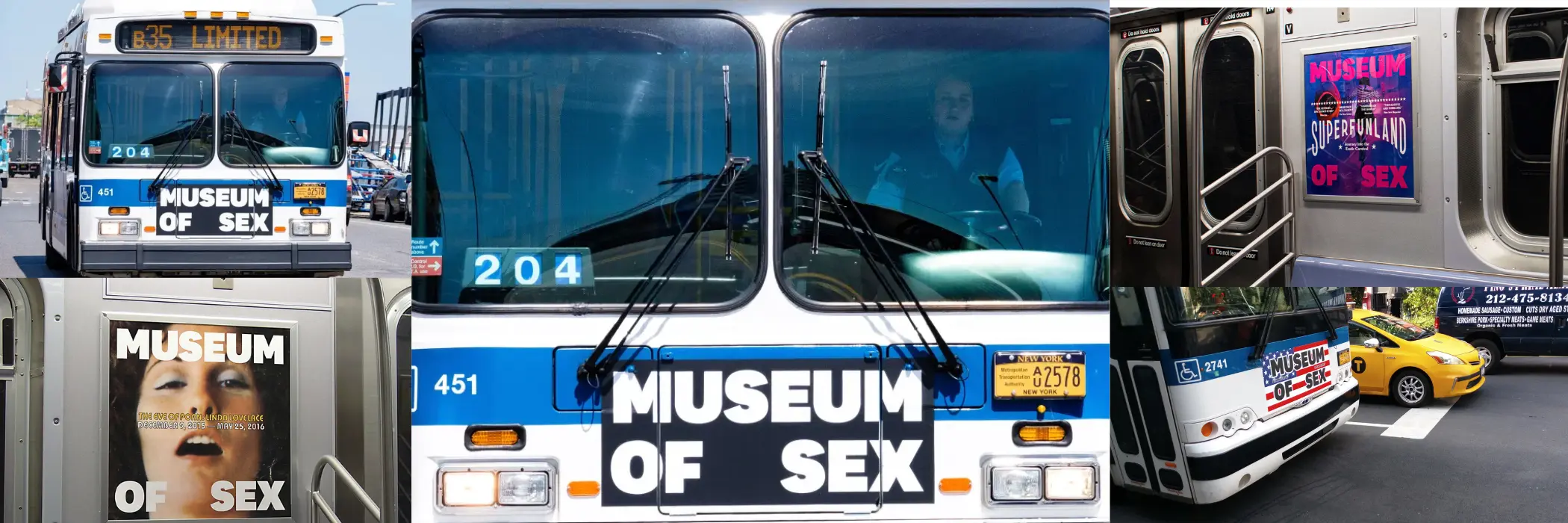
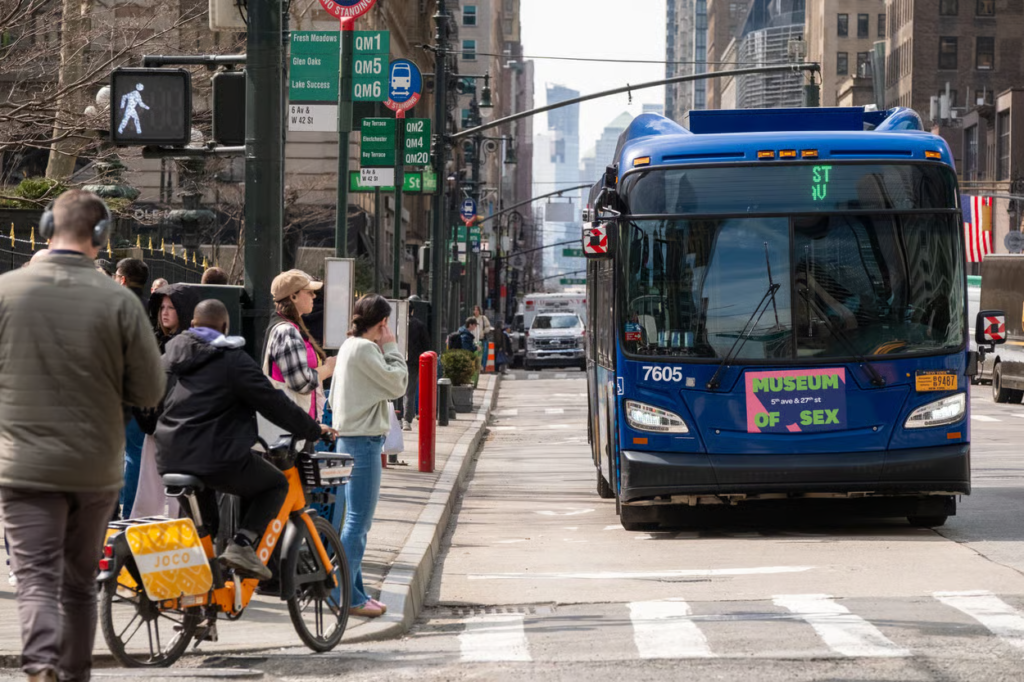
Three thousand buses. One logo. No imagery. No campaign line. Just the words “Museum of Sex” on the front of every MTA bus rolling through New York City, in rotating colour combinations, from December 2025 through the end of 2026. The campaign does not explain what the museum does. It does not need to.
The Setup
The Museum of Sex opened on Fifth Avenue in Manhattan in 2002. It took the institution years to convince the MTA to allow it to advertise on public transit at all. Its first attempt in 2018 placed the logo on city buses through Outfront Media. The campaign was pulled within weeks after bus drivers complained that the signage was attracting unwanted attention and harassment directed at them. Daniel Gluck, founder and executive director of the museum, said the negative feedback from drivers was surprising given what he described as an overwhelmingly positive response from the general public.
The current campaign launched in December 2025 and runs through December 2026. This time, it has not faced calls for removal.
Why Just the Logo
Gluck’s reasoning is precise. Bus advertising operates in a flash. A pedestrian sees a bus for two or three seconds. A driver passing in the opposite direction has even less. There is no dwell time, no opportunity for a viewer to absorb an image or read copy. On the subway, where passengers sit or stand in a fixed space for minutes at a time, the Museum of Sex has used detailed campaign imagery: sideways mouths, golden robots, people floating through psychedelic landscapes, each visual tied to a specific exhibition. The bus is a different medium with a different behavioural contract.
The logo alone does the work precisely because of what it says. “Museum of Sex” printed on the front of a city bus creates an instant context shift. The bus is one of the most mundane, civic, and utilitarian objects in New York City. Placing those three words on its face turns every sighting into a small jolt. Gluck described the mechanism directly: “You can put our logo on a very innocuous image, and suddenly it takes another context.”
Three or four buses running different colour combinations down the same avenue amplifies the effect. Each one lands as a fresh sighting, and none of them requires the viewer to do any interpretive work.
The Turkey Incident
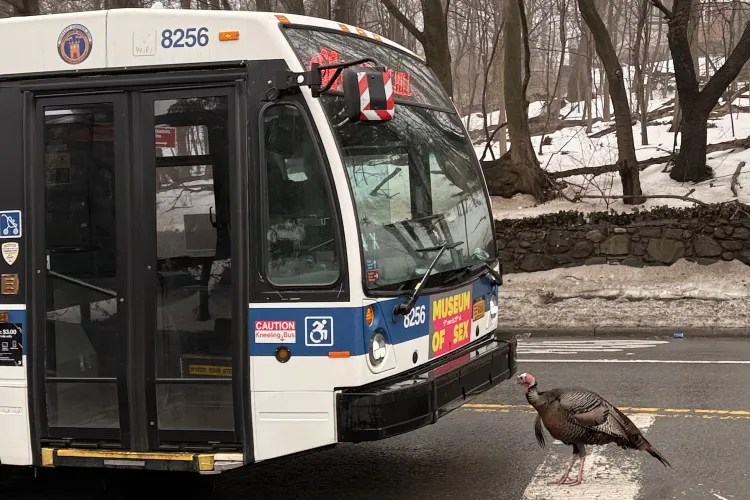
In February 2026, a wild turkey in New York City stopped a bus in its tracks. The bird squared off with the vehicle at close range, and someone photographed the standoff. In the photograph, clearly visible on the front of the bus above the turkey, was the Museum of Sex logo. The image circulated across social media and news outlets, generating earned media coverage worth multiples of any paid placement. The museum did nothing to produce the moment. The campaign’s ubiquity produced it.
Gluck described the broader results simply: “It’s been going very well. A lot of people are really getting a kick out of it.” The museum has seen a measurable bump in foot traffic and earned media since the campaign launched.
The Broader Context
The Museum of Sex is not the only institution that has navigated the MTA’s advertising boundaries. Sex toy company Dame sued the MTA in 2019 after its ads were rejected on the basis that it constituted a “sexually oriented business,” despite the MTA simultaneously running ads for erectile dysfunction medication and, ironically, the Museum of Sex itself. OkCupid had campaign materials rejected after prior approval. The MTA’s position on what constitutes acceptable sexual advertising has been inconsistent enough to generate multiple legal challenges and a running industry conversation about whose content qualifies as cultural and whose qualifies as commercial.
The Museum of Sex occupies an unusual position in that landscape. It is an accredited institution. Its advertising is treated as cultural programming rather than product promotion, which is what gives it access to a medium that has been closed to commercially oriented sexual wellness brands. The bus campaign exploits that positioning to its fullest. The logo carries the institutional weight of a museum and the immediate recognition value of three of the most attention-grabbing words in any language, placed on the most ordinary moving object in New York.
Gluck said the plan going forward includes experimenting with gold vinyl, textured finishes like fur, and eventually expanding onto the sides of vehicles. For now, the front of the bus is enough. As Gluck put it: “Hopefully it becomes another iconic New York thing.”
Campaign Name: Not mentioned
Agency Name: Not mentioned (Outfront Media as media partner)
Brand Name: Museum of Sex
Location: New York City, USA