Every May, Indian advertising performs the same ritual. Slow-motion footage of a woman stirring dal. A child’s hand reaching up. A voice-over about sacrifice. Soft piano. Fade to logo. In 2026, several brands broke from that format entirely and found sharper, more honest ground to stand on.
Philips: “When Did the Home Become One Person’s Responsibility?”
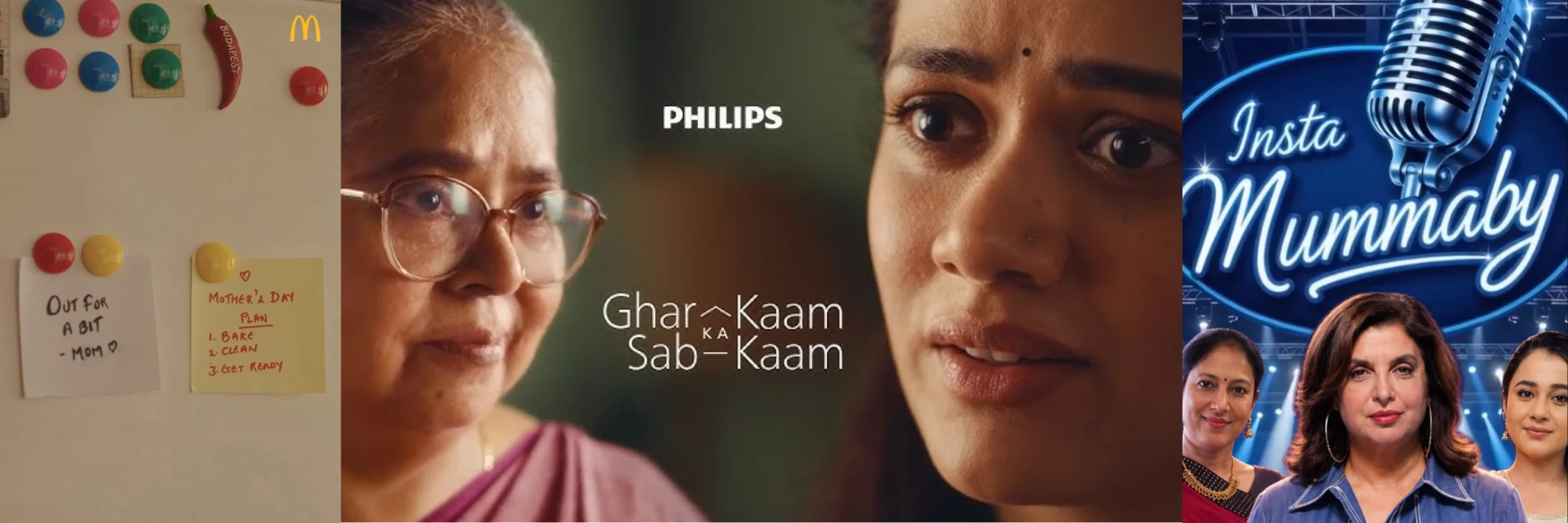
Philips Domestic Appliances, operating in India under Versuni, took the sharpest structural position of any brand in the Mother’s Day 2026 wave. The campaign did not celebrate mothers. It questioned why household work is still quietly assigned to them in the first place.
The film reframes the word “helping” as the problem. When a family member says they are “helping” with the dishes or “helping” with cooking, the language implies that ownership of those tasks belongs elsewhere, to the mother. The campaign, developed by agency magiccircle, builds its argument around this precise linguistic observation: the word “help” signals that domestic responsibility has a default holder, and that holder is almost always the mother.
Angira Lahiri, head of strategy at magiccircle, stated the brief plainly: “The idea that one person is accountable for the home, while everyone else opts in and out, is fundamentally flawed. We don’t realise how much language shapes behaviour.” Pooja Baid, CMO at Versuni India, extended it further: “Real change in homes doesn’t begin with grand gestures. It begins with small shifts in how we think, speak, and behave.”
For a brand whose products live inside kitchens and domestic spaces every day, the campaign carries commercial logic alongside the social position. Philips did not run a Mother’s Day sale or a gift guide. It raised a question that the category has avoided for decades. In a week when most brands were thanking mothers, Philips was asking the household to redistribute the load.
McDonald’s India: “Every Mother Deserves a Break”
McDonald’s India, North and East, built its Mother’s Day film around a single, unadorned truth: mothers do not take enough breaks, and the people around them rarely notice until she is gone.
The film shows a family attempting to manage the household in their mother’s absence. They struggle immediately. The film makes no attempt to exaggerate the chaos for comic effect. It simply shows the visible gap her presence fills every day without acknowledgement. Meanwhile, the mother is at a McDonald’s, sipping a Strawberry Matcha and eating a croissant, alone and at peace. She eventually invites her family to join her.
The title of the film, “Every mother deserves a break,” is both the campaign line and the product placement. The restaurant is where the break happens. The limited-time Mom’s Buddy Meal, priced at ₹399, and a Mother’s Day offer running from May 8 to 10 across North and East India, made the campaign retail-functional, alongside being emotionally resonant.
Where Instamart used satire, McDonald’s used restraint. Both arrived at the same insight from opposite directions: the problem with Mother’s Day is not that brands celebrate too little. It is that the celebration rarely translates into something that actually reduces the load.
Swiggy Instamart: “Mummaby”
Instamart opened a talent show. The premise is deliberately absurd: if mothers have spent their entire lives singing lullabies to their children, it is time someone sang them to sleep for a change. Contestants perform their best “Mummaby” for a panel of judges that includes filmmaker and choreographer Farah Khan alongside two visibly exhausted actual mothers.
What follows is a parade of escalating chaos. Death metal growls. Bhangra bangers. Rap riffs. DJ mashups. Each act tries harder and fails more completely than the last. Farah Khan’s reactions anchor the humour. The judges are not moved to rest. They are moved to exasperation.
The pivot arrives at the end. The film lands on a single, grounded observation: mothers do not need a performance. They need someone to actually do something useful, take over a chore, order what is needed, and handle what is pending. Instamart, a 10-minute delivery service, positions itself as that practical intervention. The campaign was created to cut through what Swiggy’s head of brand, Mayur Hola, described as the performative framing of Mother’s Day, in favour of something more grounded and more useful.
Farah Khan’s involvement is not decorative. She has directed and choreographed some of Indian cinema’s biggest production numbers. Putting her in a room full of people performing increasingly terrible acts of affection, and watching her face fall with each one, is the entire joke. It lands because the target is not mothers. It is the category of brands that treat grand gestures as a substitute for actual help.
The Wider Pattern
Across the Indian advertising landscape on Mother’s Day 2026, the campaigns that generated the most coverage shared a single structural characteristic: they acknowledged the labour of motherhood rather than aestheticising it.
Google India and Slurrp Farm ran a 140-second film told entirely through a mother’s search queries, ending with her child noticing her cold cup of chai and quietly reheating it. Himalaya BabyCare built its film around a mother watching her daughter’s first day of school, told as a sequence of physical memories rather than emotional summaries. GIVA took a direct jab at lookalike brands, positioning its silver jewellery as the gift that produces genuine joy rather than a polite smile. FNP built its campaign around the phrase every Indian child has heard: “kuch nahi,” the reflexive answer mothers give when asked what they want.
The common thread is specificity. Each campaign identified one precise, recognisable moment in a mother’s life and stayed there, rather than reaching for a universal statement about maternal sacrifice. In a category that has relied on that universal statement for decades, specificity is what made 2026’s wave of Mother’s Day campaigns land differently.