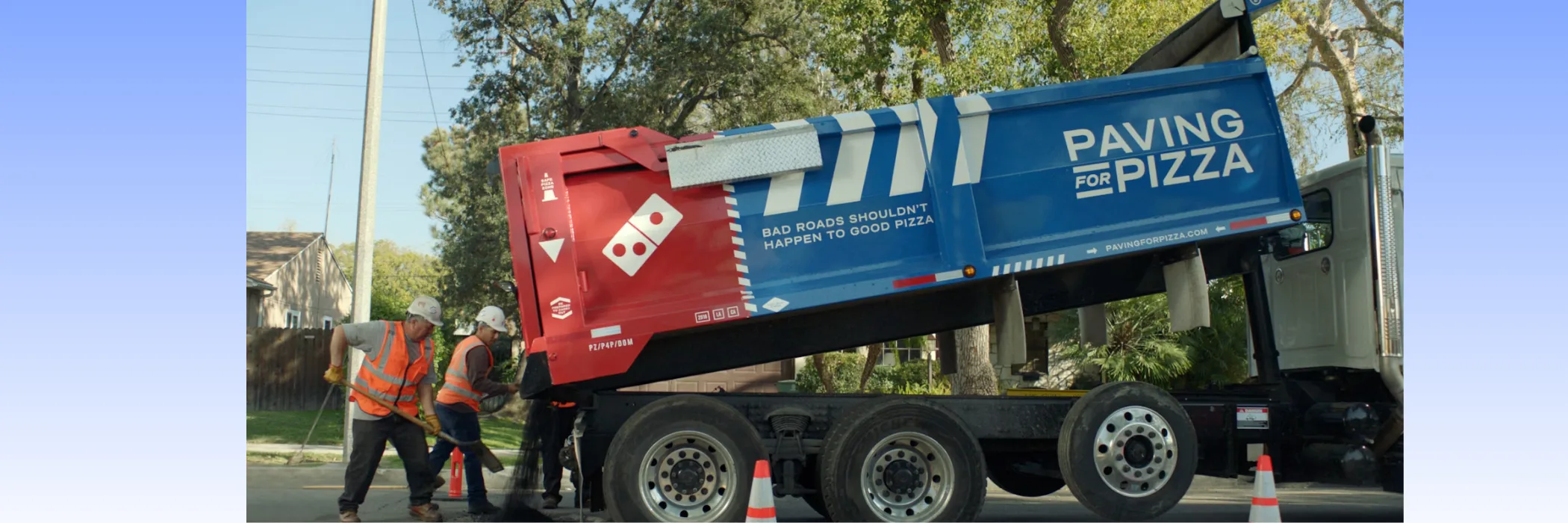
In June 2018, Domino’s Pizza announced it was hiring road repair crews to fix potholes across the United States. Not because the government asked it to. Not as a generic act of corporate goodwill. Because bumpy roads were ruining the cheese-to-topping ratio on pizzas en route to customers, and Domino’s had decided that was its problem to solve.
Where the Idea Came From
The campaign originated with Crispin Porter and Bogusky, Domino’s agency of record at the time. Planning began in early 2018, built from a straightforward customer insight: people picking up or receiving a Domino’s pizza had a documented anxiety about the condition of roads between the store and their front door. Kate Trumbull, Domino’s VP of Advertising, described her reaction to the pitch directly: “The first time I heard the idea, it was obvious to me that it really was a breakthrough, unique idea that would resonate and demonstrate our obsession and passion with pizza.”
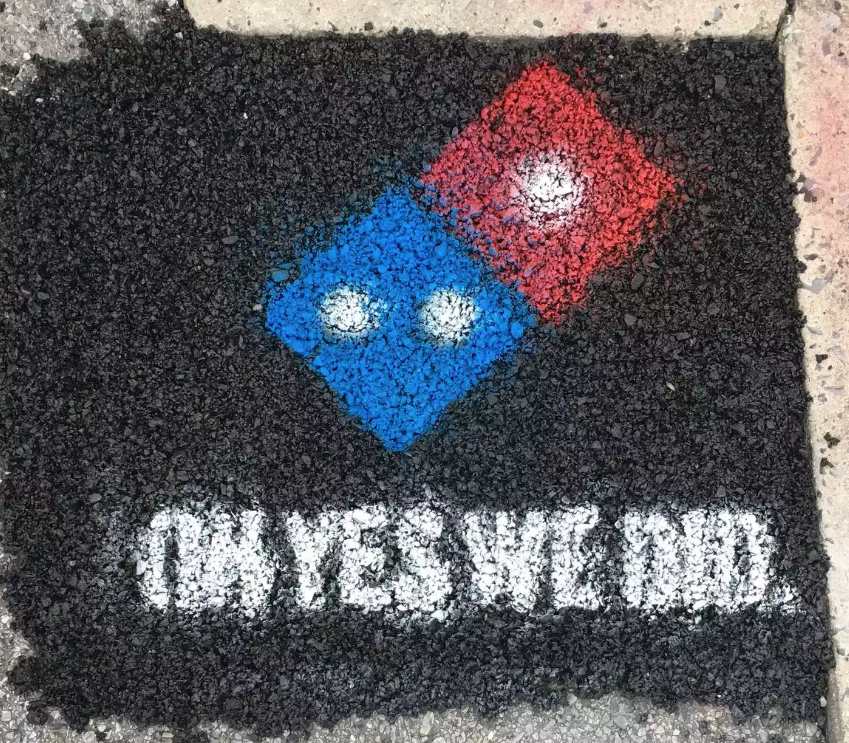
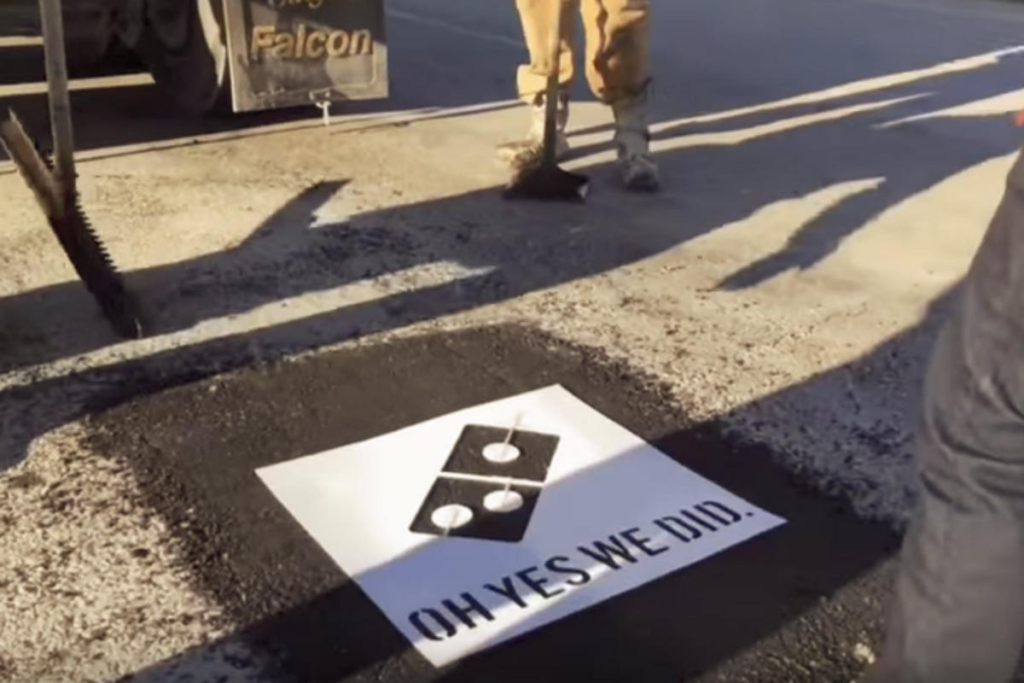
The campaign brief was simple. Domino’s would offer $5,000 grants to municipalities across the United States to fund local road repair projects. In exchange, every repaired section of road would be stenciled with the Domino’s logo and the tagline “Oh yes we did.” The road crew’s equipment would carry Domino’s branding. Videos of the repairs would go live on a dedicated microsite. The infrastructure itself became the advertisement.
The Pilot Phase
Before the public launch in June, Crispin Porter and Bogusky cold-approached four cities with grant offers. On December 12, 2017, Bartonville, Texas became the first municipality to accept, with crews filling eight potholes across three roads. Milford, Delaware followed in March 2018, repairing 40 potholes across 10 roads in 10 hours, work that represented a significant portion of the city’s entire annual road repair budget of $30,000. Athens, Georgia repaved 150 square yards of failing roadway in April. Burbank, California had five potholes repaired by the production crew filming the Paving for Pizza television commercial.
Milford’s city manager Eric Norenberg acknowledged the impact in a Washington Post op-ed, noting that the $5,000 grant had made a genuine difference to a municipality with severely constrained road repair resources. His crew held a staff pizza party with the $200 in Domino’s gift cards that accompanied the grant.
The Public Launch and the Microsite
On June 11, 2018, Domino’s launched the campaign publicly alongside the microsite pavingforpizza.com. Visitors could select their road condition on a “Pothole Impact Meter” rated mild, moderate, critical, or catastrophic, and watch a video showing what happens to a pizza driven over each surface. To demonstrate the problem with physical evidence, Domino’s had placed a GoPro camera inside a pizza warmer and driven it over roads of varying quality, capturing the results as a “Pizza Damage Report.”
Crucially, the site let customers nominate their own town for a grant. The nominations came in fast. By the time the campaign wound down, the site had received more than 137,000 nominations covering more than 15,000 zip codes across the country.
The Scale It Reached
The campaign was originally planned to cover 20 municipalities. The response forced a rethink. By August, Domino’s announced a second phase targeting at least one municipality in all 50 states. Franchisees began matching Domino’s grant donations from their own pockets. Trumbull received photographs of people dressed as Domino’s road crews for Halloween. A town administrator in Texas reached out to his counterpart in Delaware to compare notes on their experience, describing the project as rare and fun.
By November 2018, grants had been given to 11 towns with 20 more local governments reviewing agreements. Confirmed repairs included: Athens, Georgia repaved 150 square yards; Milford, Delaware patched 40 potholes; Bartonville, Texas filled 8 potholes and repaired 3 roads; and a growing list of additional cities across Wilkes-Barre, Fitchburg, Kinston, Des Moines, Milwaukee, New Orleans, Jackson, and others.
Why It Generated Coverage
Domino’s campaign succeeded for a specific structural reason that most corporate community initiatives miss: the execution was commercially honest. Domino’s did not claim altruism. It said directly that the roads were damaging its product, and it was fixing them. Every repaired pothole was branded. Every piece of equipment carried the logo. The “Oh yes we did” tagline made the self-interest explicit and turned it into a virtue. Transparency about the commercial motivation is what made the campaign credible rather than cynical.
The campaign also gave its audience something to do. The nomination mechanic converted passive observers into active participants, with 137,000 nominations generated entirely by people who wanted their own road fixed. Each nomination was also a piece of earned media, as nominators shared their entries with local communities and social networks, generating coverage that no media spend could replicate at that scale.
Jenny Fouracre-Petko, Director of PR at Domino’s, described the surprise that followed the launch: “We started in July and it really took off. People loved it. People are very passionate about potholes.”
According to the national transportation research group TRIP, 37% of American roads were in a state of disrepair in 2018. Domino’s did not fix all of them. It fixed enough to fill a press cycle, stamp its logo on public infrastructure in 50 states, and generate a case study that is still referenced in marketing curricula nearly a decade later.
Campaign Name: Paving for Pizza
Agency Name: Crispin Porter and Bogusky (CP+B)
Brand Name: Domino’s Pizza
Location: United States (national rollout targeting all 50 states; pilot cities in Bartonville TX, Milford DE, Athens GA, Burbank CA)