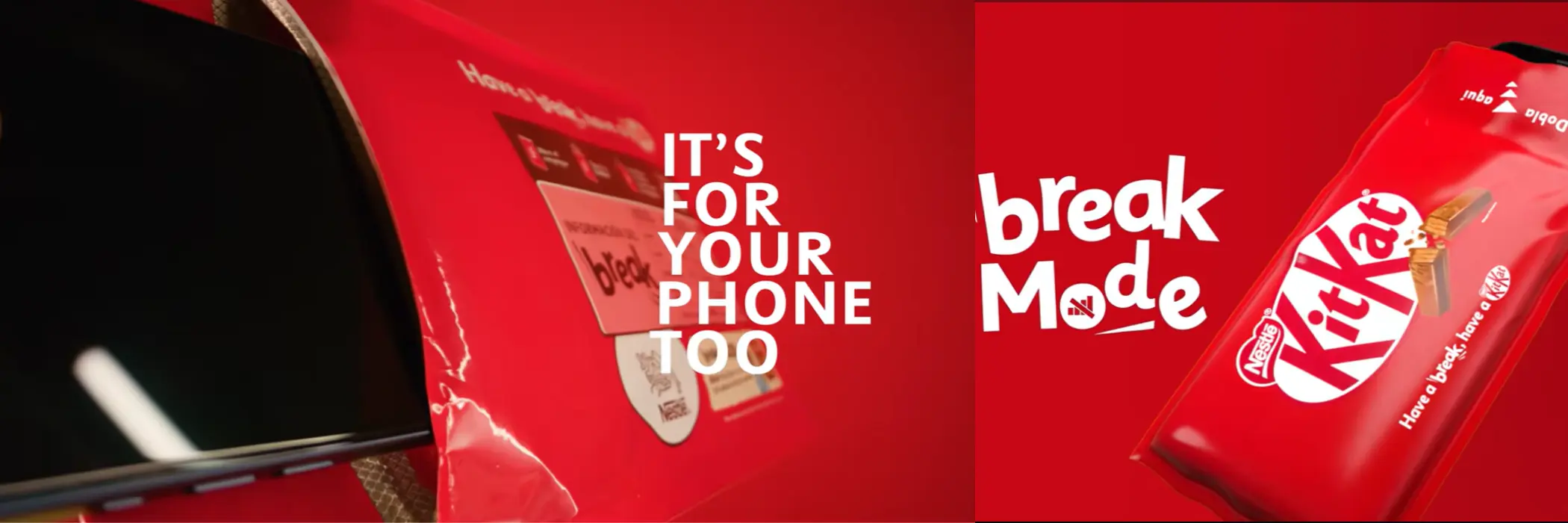
KitKat has been telling people to “Have a Break” since 1957. For nearly seventy years, that promise lived in the chocolate. In April 2026, KitKat Panama and Ogilvy Colombia turned the packaging itself into the break.
What Break Mode Actually Is
Break Mode looks like an oversized KitKat wrapper. It is not. Beneath the familiar red and white exterior is a fully functional Faraday cage, a conductive enclosure engineered to block electromagnetic fields. Place your phone inside, seal it, and every signal disappears. Calls, 4G and 5G mobile data, Wi-Fi, Bluetooth, and GPS: all blocked. The phone does not go into aeroplane mode. It goes dark entirely.
The engineering behind it is not cosmetic. The packaging uses a multilayer construction combining copper and polyester to form a continuous conductive surface that redistributes and neutralises incoming electromagnetic signals. An outer polypropylene layer protects the structure and allows it to be reused for approximately a year. Ogilvy’s Impact Lab in Colombia ran the technical development through stringent validation tests, including RF signal attenuation, cellular signal strength measurements, and electromagnetic isolation testing, confirming 100% effectiveness across all signal types.
Gastón Potasz, Chief Creative Officer of Ogilvy Andina, described the starting point as an opportunity found inside the wrapper itself: “Break Mode is a prime example of the impact we can achieve by recognising an extraordinary opportunity within the very fabric of the KitKat wrapper, pushing the brand’s promise to unprecedented levels.”
The Ritual Built Into the Packaging
The campaign’s creative director, Kim Waigel, Nestlé’s Marketing Director for Central America, laid out how the intended experience works. You open the KitKat. You eat the chocolate. You place your phone inside the empty wrapper. You seal it. Your digital world goes quiet. Your break actually begins.
That sequence is the entire idea. The act of unwrapping a KitKat, which has been the brand’s visual shorthand for taking a break for seven decades, now triggers a second step that physically enforces the pause. The wrapper is no longer a byproduct of the chocolate. It is an instrument of the brand promise.
Waigel described it plainly: “Break Mode goes beyond simply saying ‘Have a Break.’ It empowers individuals with the physical tool to genuinely achieve it. We make the true break a reality.”
Where It Was Tested
Break Mode was not launched through a media campaign or a retail rollout. Ogilvy Colombia took it directly to three environments where phone dependency is most acute and most noticed. First, Expo Tech, Panama’s premier technology conference, where attendees were surrounded by devices and product demonstrations. Second, a major concert event. Third, a university campus. At each location, demo kits were distributed and filming captured real time reactions to phones going offline inside what appeared to be a chocolate wrapper.
The videos shot at each activation became the campaign’s promotional content, distributed through Ogilvy’s Instagram and KitKat Panama’s social channels. Ogilvy’s campaign post asked the central question directly: “In a world that never disconnects, how can a brand’s promise of a ‘break’ become a reality? You reinvent the packaging.”
The Cultural Context
Break Mode did not arrive in a vacuum. The appstinence movement, a growing cultural counter to smartphone dependency, has produced a wave of individual made tools for digital detox. Logan Ivey built a six-pound phone case designed to make picking up a phone genuinely uncomfortable. Hank Green launched a productivity app structured around a virtual companion. Rhys Kentish built an app that requires users to physically touch grass before accessing social media.
These were individual responses to a felt need. Brands have been slower to move into the space, but the shift is arriving. IKEA launched a flat packed phone bed in October 2025, designed to encourage people to leave devices outside the bedroom before sleep. Break Mode is a similar intervention, more technically sophisticated, and embedded inside a product ritual that already carries seventy years of cultural association with pausing.
Innova Market Insights named digitally enhanced packaging as one of its top packaging trends for 2026. Break Mode sits at the intersection of that forecast and a category of consumer anxiety that has been building for years.
What It Is, and What It Isn’t
Break Mode is not yet a commercial product. Potasz confirmed that its commercial viability is still under evaluation. There is no shelf date. No retail rollout has been announced. What exists is a campaign concept, tested at three live events, validated technically, and released into the media environment as a demonstration of what KitKat’s packaging could do.
That distinction matters. Break Mode is currently a marketing activation dressed in engineering credibility. Whether it becomes a product people can actually buy is a separate question. What it has already done is reframe the KitKat wrapper as something with utility beyond protection and branding, and in doing so, turned a piece of packaging into the most talked about product concept the brand has produced in years.
Campaign Name: Break Mode
Agency Name: Ogilvy Colombia
Brand Name: KitKat Panama / Nestlé
Location: Panama City, Panama