In 2025 and 2026, a quiet but unmistakable shift took hold in advertising. Brands started showing their work. Not as a creative experiment, but as a commercial strategy. As AI-generated imagery flooded feeds and consumers grew increasingly attuned to what was real and what was rendered, a growing number of brands made a calculated decision: prove it happened.
Apple TV: Actual Glass, Actual Light
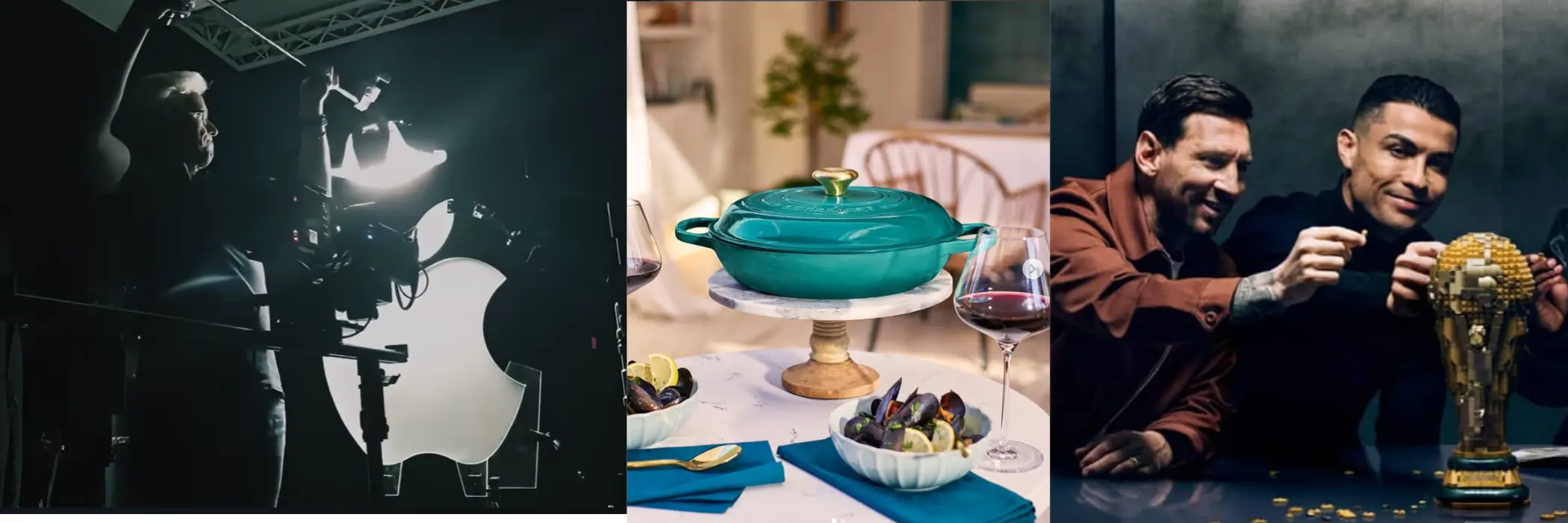
In November 2025, Apple TV unveiled its new animated logo, a rainbow hued ident that plays before every show and film on the platform. To anyone watching, it looked like a polished CGI sequence. It was not. The Apple logo and “tv” lettering were physically sculpted from solid glass by London based creative studio Optical Arts, in partnership with TBWA Media Arts Lab. The glass was mounted on a set. A crew member moved the lights by hand. The camera moved around a stationary object. Every shimmer was captured in-camera, with no CGI involved anywhere in the final sequence.
TBWA Media Arts Lab described it plainly: “Built from real glass and captured entirely in camera, the new identity explores reflection, colour, and light to express the cinematic spirit at the heart of Apple TV. Every shimmer was made for real. No CG shortcuts.” The production ran for weeks in a London studio. Apple’s VP of marketing communications, Tor Myhren, has been publicly consistent on this point since Cannes 2024: the brand values human artistry. The Apple TV logo is the most literal demonstration of that position.
Apple MacBook Neo: Stop-Motion, Confetti Cannons, and LED Strips
Five months later, Apple did it again. The “Hello, MacBook Neo” launch film debuted in March 2026 for Apple’s $599 entry level laptop. The film was widely praised for its warmth and playfulness. In April, Apple released a behind-the-scenes YouTube Short titled “A Peek at Some Handmade Magic,” revealing how it was made.
The production team built a physical simulated trackpad. A stop motion fireworks sequence was shot frame by frame. LED strip lights created colour effects on set. Mini confetti cannons were fired in camera. The final film combined all of that practical work with 3D modelling and post-production compositing. For a short launch video that could have been generated entirely on a computer, the volume of physical production work was significant. The BTS video was released deliberately. Apple is not just using craft. It is publicising it.
LEGO: Four Football Icons, One Table, Zero Shared Shoots
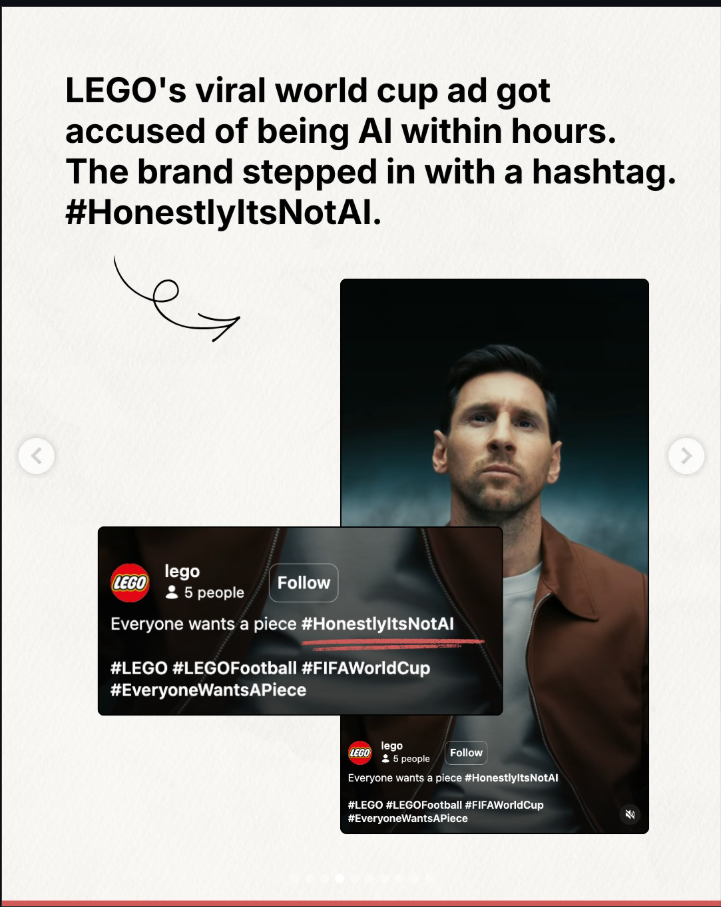
LEGO’s “Everyone Wants a Piece” campaign for the 2026 FIFA World Cup placed Lionel Messi, Cristiano Ronaldo, Kylian Mbappé, and Vinicius Junior around the same table, competing to place personalised LEGO minifigures atop a replica World Cup trophy. Rather than waiting for anyone to question how four of the world’s most scheduled impossible athletes ended up in the same frame, LEGO got ahead of it. The brand added the hashtag #HonestlyNotAI directly in the campaign’s social captions, a two word declaration that the ad was produced through real production work, not generated. No lengthy disclaimer. No press release. Just a hashtag that told the audience what to think before they had the chance to wonder. In a moment when AI-generated celebrity appearances have become a legitimate concern for audiences, that small piece of copy did significant trust-building work.
Le Creuset: Factory First, Always

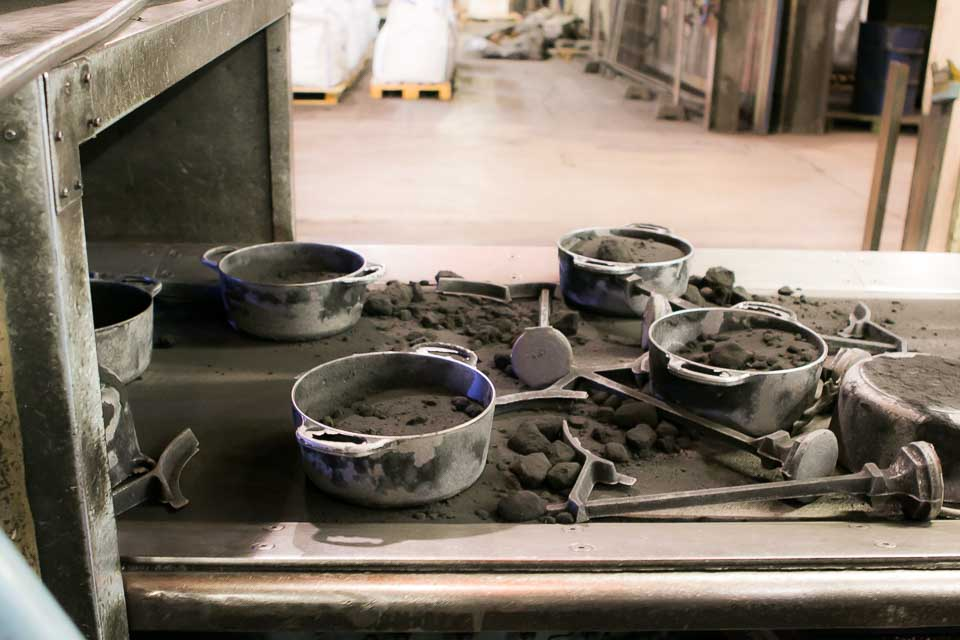

Le Creuset has been running a version of this playbook since before transparency was a trend. The brand has long opened its foundry in Fresnoy-le-Grand, France, to cameras, press tours, and media visits, showing how a single Dutch oven takes seven days to produce. The process involves casting iron in sand, applying porcelain enamel by hand, and firing for heat resistance. For its 100th anniversary in 2025, the brand brought TODAY’s Dylan Dreyer to the factory for a full behind-the-scenes feature, letting the production process speak for the product’s price point without a single line of copy.
Le Creuset president Paul Van Zuydam described it directly: “You’re actually taking a piece of cast iron and then putting glass on it and fusing the two, which is the most complicated process in housewares.” The factory tour is the campaign. Craft visibility has been the brand’s primary justification for why a pot costs what it costs for a century.
Aerie: “You Can’t Prompt Realness”
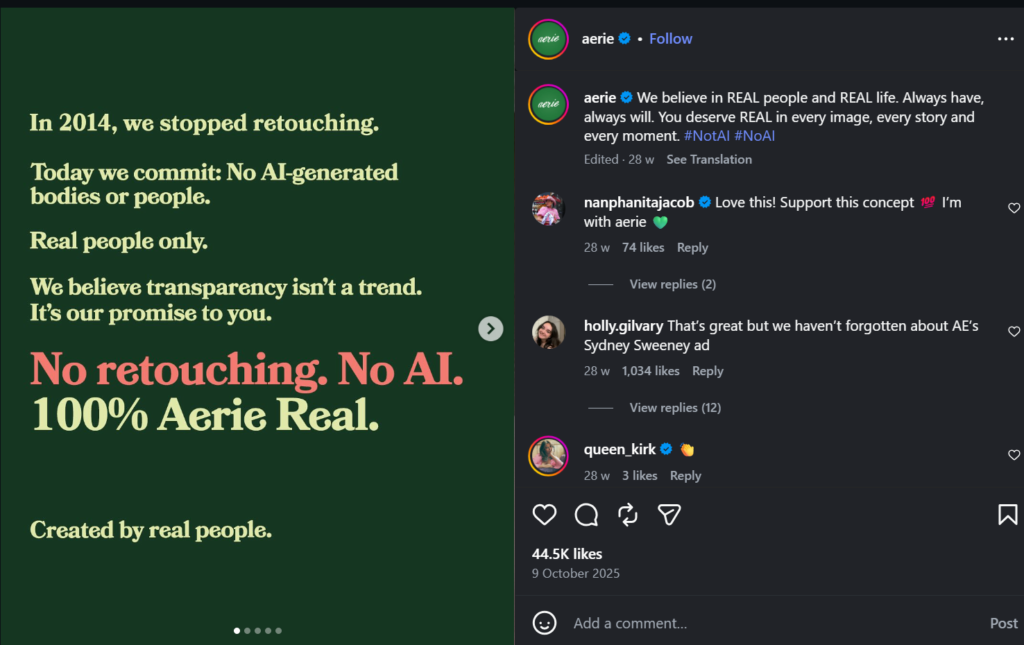
Aerie’s version of this strategy started in 2014, when it became one of the first major lingerie brands to publicly commit to using unretouched images of models in all advertising. The pledge held for over a decade. In October 2025, the brand extended it: no AI-generated images of people or bodies, ever, and the same requirement applied to all partners and creators working with the brand.
In March 2026, Aerie launched a campaign with Pamela Anderson that made the commitment impossible to miss. The spot contrasted a cold, AI-generated environment with a real photo shoot, with Anderson’s voice prompting an AI system to produce authenticity, and the system failing. The tagline was blunt: “You can’t prompt realness.”
The commercial results have followed the pledge. Aerie saw a double-digit increase in brand awareness in Q4 2025. Sales were up 23% over Q4 2024. CMO Stacey McCormick said it clearly: “In this industry where everything can be generated, real becomes rare and unique. And that becomes powerful and different.”
Polaroid: “AI Can’t Generate Sand Between Your Toes”
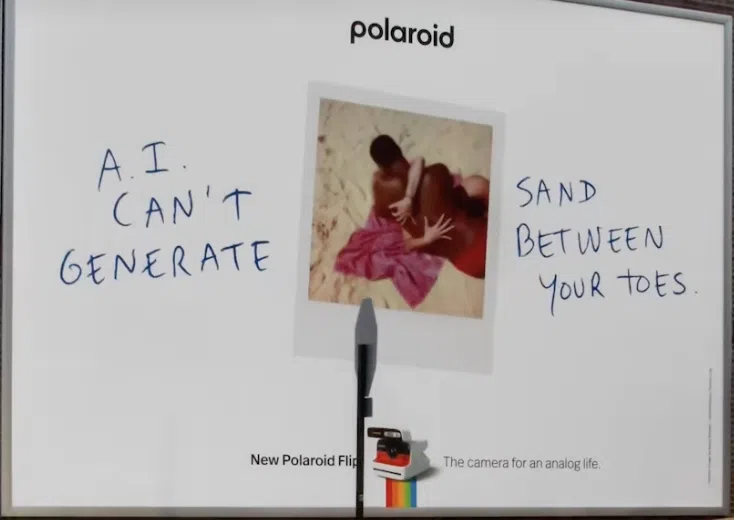
Polaroid launched “The Camera for an Analogue Life” in July 2025, timed to the release of its new Flip camera. The campaign ran on billboards and bus shelters in New York and London, flyposting Polaroid prints across city walls and placing them in deliberate proximity to Apple Stores and Google offices. The contrast was the message: analogue imagery, physical prints, handwritten copy, placed directly outside the temples of the digital world.
The OOH copy landed with precision. “No one on their deathbed ever said: I wish I’d spent more time on my phone.” “Real stories. Not stories and reels.” And most shareable: “AI can’t generate sand between your toes.” Brand and Creative Director Patricia Varella put the logic plainly: “The more we lose ourselves in digital algorithms, the more we drift away from empathy and real connection. There is something magical in a Polaroid picture. It captures the humanness in all of us, wrinkles and all.”
The Wider Pattern
What connects all of these campaigns is not nostalgia. It is a commercial strategy. As AI-generated imagery normalises, as generative tools become cheaper and faster, the cost of faking anything drops to near zero. That shift changes the value of proof. A brand that can show how something was made and show that humans made it owns a differentiator that cannot be algorithmically replicated. Aerie, Polaroid, Apple, Le Creuset, and even LEGO, in its own complicated way, are all responding to the same market condition. The brands that understand it earliest are treating transparency not as a risk but as a competitive position.