Consumer spending on Mother’s Day in 2026 is projected to hit a record $38 billion in the United States, with shoppers spending an average of $284 each. With that much money in motion, the category has every incentive to produce safe, polished, predictable work. Four brands did the opposite.
Panera: “Meet Your Mother”
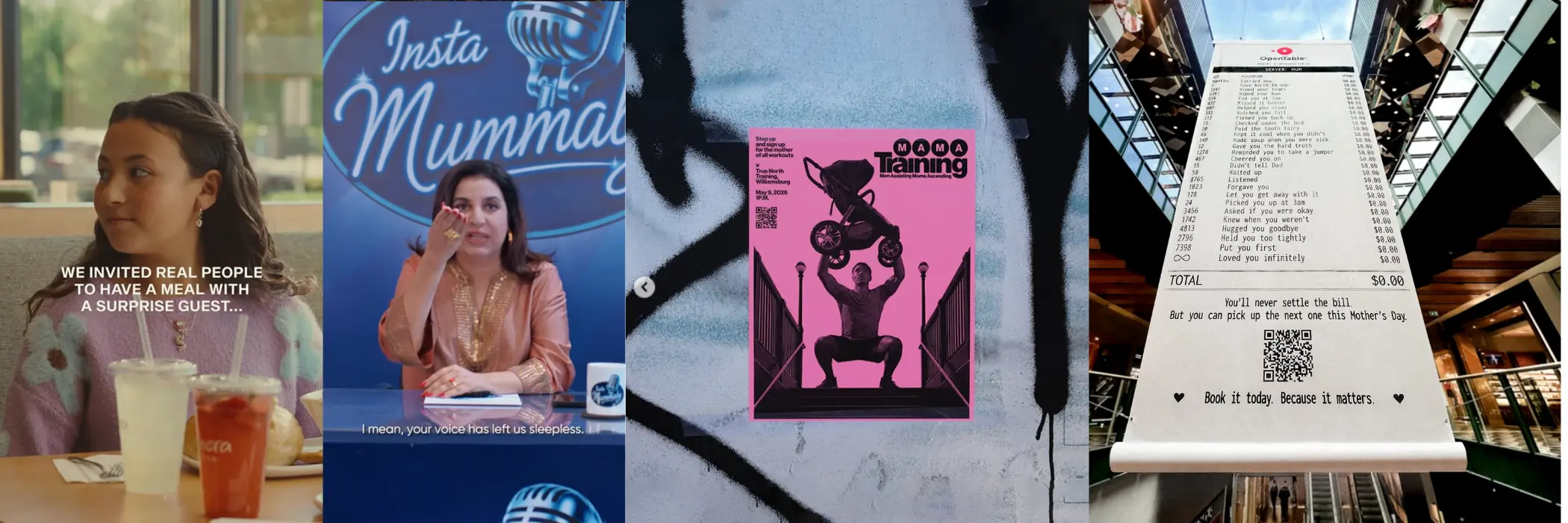
Panera and agency 72andSunny New York built their campaign around the smallest version of a Mother’s Day moment: lunch. Not a grand dinner reservation. Not a surprise trip. Just two people, a mother and her child, sharing a meal at a Panera and actually talking.
The campaign featured real influencer parent-child duos filmed in genuine conversation over a Panera meal, with no script designed to produce a tearful climax. The conversations are mundane in the best sense. They cover the things mothers and adult children talk about when there is no occasion, forcing a grand statement. The limited edition Mother’s Day meal offerings launched alongside the campaign gave the emotional positioning a retail anchor, connecting the intimacy of the table to a product people could actually book.
The creative bet is a quiet one. In a category full of sweeping emotional declarations, Panera claimed the ordinary lunch and treated it as the most undervalued gift available.
Mother New York: “MAMA Training”
An advertising agency named Mother built a pop-up gym in Williamsburg and invited men to train for motherhood. The event, called MAMA Training, an acronym for Men Assisting Moms Ascending, staged everyday parenting tasks as athletic events.
Baby carriers were lifted like dumbbells. Strollers were pushed across a marked course. The difficulty was documented straight, with no winking at the camera. The physical comedy arrives naturally from the contrast between the athletic framing and the domestic reality of what is being performed.
The structural argument underneath the humour is the same one Philips India made in its “Ghar Ka Kaam Sabka Kaam” campaign: the invisible physical and emotional labour of parenting is real, measurable, and disproportionately carried by mothers. MAMA Training externalised that labour into a fitness routine and made it visible by making men attempt it. The agency named Mother running a campaign about maternal labour is not incidental. It is the whole joke, and the whole point.
OpenTable: The Billboard
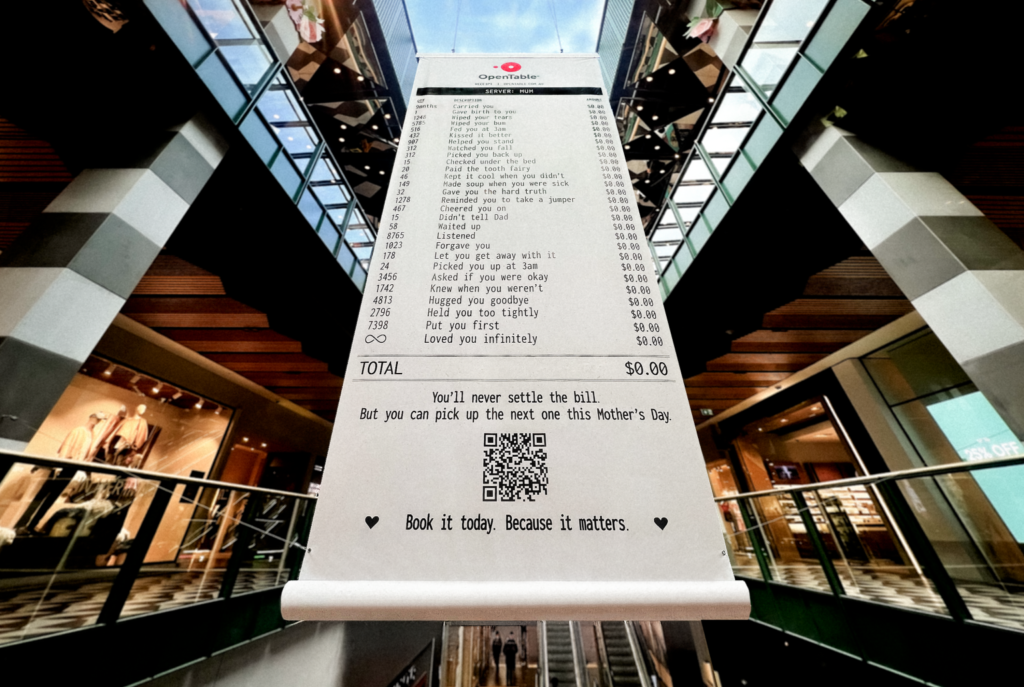
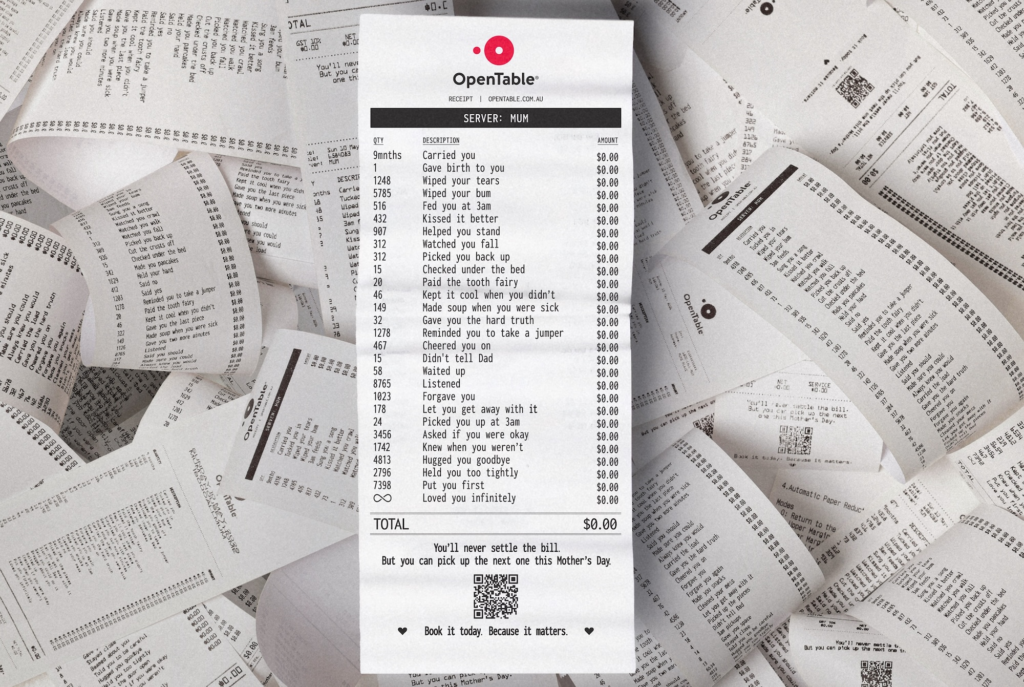
OpenTable placed a towering restaurant receipt inside Melbourne Central during Mother’s Day week, listing every act of unpaid maternal care from “carried you” to “loved you infinitely,” with the total arriving at $0.00. The campaign line did the rest: “You’ll never settle the bill. But you can pick up the next one this Mother’s Day.”
The format works because it borrows the most transactional document in everyday life and applies it to a category of work that has never been accounted for. A booking platform with no product to photograph and no kitchen to showcase found its role in the occasion by acknowledging why the table matters in the first place. The Billboard does not pretend that a restaurant reservation closes the debt. It says so explicitly, which is what gives it permission to suggest the gesture anyway.
Philips: “When Did the Home Become One Person’s Responsibility?”
Philips Domestic Appliances, operating in India under Versuni, took the sharpest structural position of any brand in the Mother’s Day 2026 wave. The campaign did not celebrate mothers. It questioned why household work is still quietly assigned to them in the first place.
The film reframes the word “helping” as the problem. When a family member says they are “helping” with the dishes or “helping” with cooking, the language implies that ownership of those tasks belongs elsewhere, to the mother. The campaign, developed by agency magiccircle, builds its argument around this precise linguistic observation: the word “help” signals that domestic responsibility has a default holder, and that holder is almost always the mother.
Angira Lahiri, head of strategy at magiccircle, stated the brief plainly: “The idea that one person is accountable for the home, while everyone else opts in and out, is fundamentally flawed. We don’t realise how much language shapes behaviour.” Pooja Baid, CMO at Versuni India, extended it further: “Real change in homes doesn’t begin with grand gestures. It begins with small shifts in how we think, speak, and behave.”
For a brand whose products live inside kitchens and domestic spaces every day, the campaign carries commercial logic alongside the social position. Philips did not run a Mother’s Day sale or a gift guide. It raised a question that the category has avoided for decades. In a week when most brands were thanking mothers, Philips was asking the household to redistribute the load.
Swiggy Instamart: “Mummaby”
Instamart opened a talent show. The premise is deliberately absurd: if mothers have spent their entire lives singing lullabies to their children, it is time someone sang them to sleep for a change. Contestants perform their best “Mummaby” for a panel of judges that includes filmmaker and choreographer Farah Khan alongside two visibly exhausted actual mothers.
What follows is a parade of escalating chaos. Death metal growls. Bhangra bangers. Rap riffs. DJ mashups. Each act tries harder and fails more completely than the last. Farah Khan’s reactions anchor the humour. The judges are not moved to rest. They are moved to exasperation.
The pivot arrives at the end. The film lands on a single, grounded observation: mothers do not need a performance. They need someone to actually do something useful, take over a chore, order what is needed, and handle what is pending. Instamart, a 10-minute delivery service, positions itself as that practical intervention. The campaign was created to cut through what Swiggy’s head of brand, Mayur Hola, described as the performative framing of Mother’s Day, in favour of something more grounded and more useful.
Farah Khan’s involvement is not decorative. She has directed and choreographed some of Indian cinema’s biggest production numbers. Putting her in a room full of people performing increasingly terrible acts of affection, and watching her face fall with each one, is the entire joke. It lands because the target is not mothers. It is the category of brands that treat grand gestures as a substitute for actual help.