Sponsorship visibility inside football stadiums has a structural problem. A logo on a perimeter board, a name on a stand, even naming rights on the building itself, all of it sits in the background while fans watch the actual game. Attention goes to the players. The brand becomes wallpaper. GUT São Paulo and Mercado Livre decided to make the pitch itself the advertisement, and the most literal commerce tool on the field.
The Idea
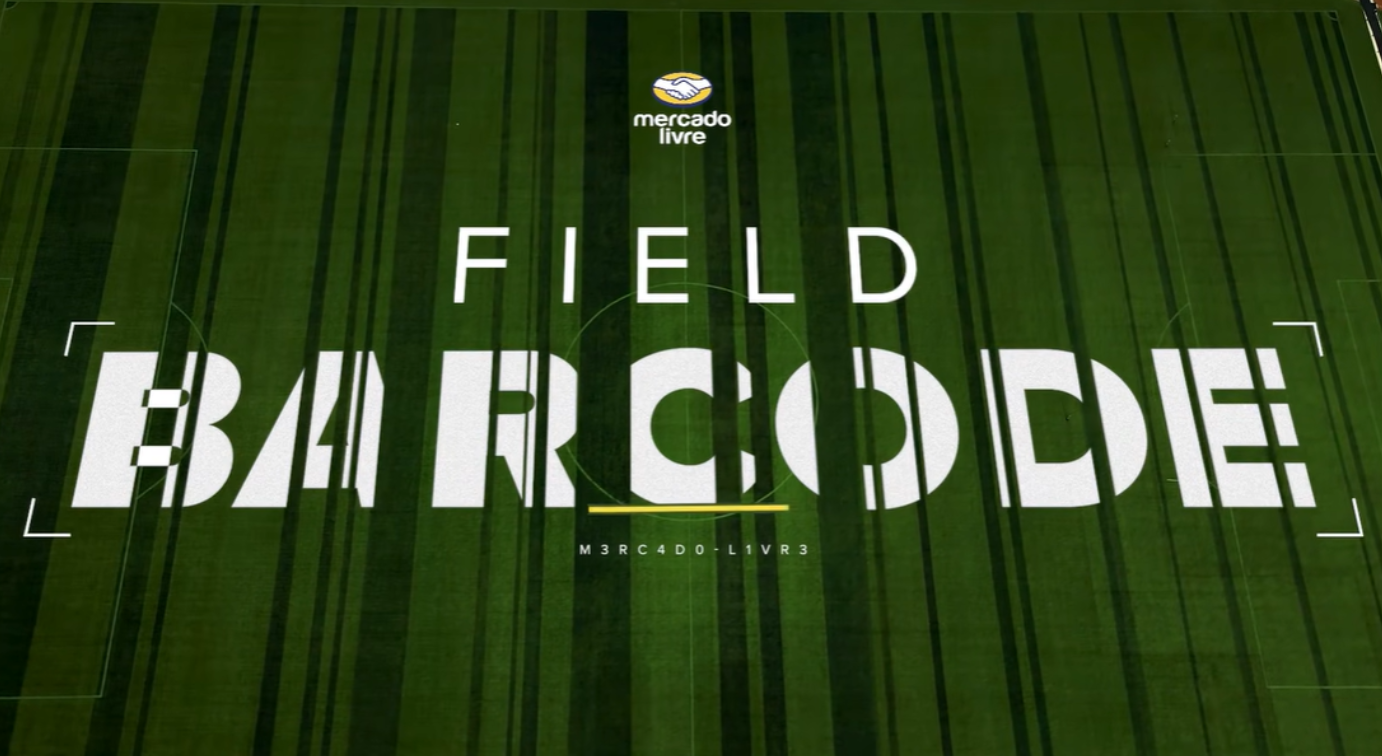
Mercado Livre holds naming rights to Pacaembu Stadium in São Paulo, one of Brazil’s most storied football venues. Rather than settling for a stand name and a perimeter board, the brand and GUT mowed a fully functional, scannable barcode directly into the grass of the pitch, using variations in mowing pattern and grass cutting direction to create a 104-metre code readable by any standard smartphone camera.
The execution required genuine technical precision. Working with groundskeepers and technology specialists, the team engineered a barcode pattern that would remain scannable from multiple broadcast camera angles, hold up against the visual distortion live sports television introduces, and still function correctly even when only part of the code was visible in a given shot. The barcode needed to survive ninety minutes of players running across it.
How Fans Used It
As matches aired across Brazil, viewers could scan the pitch barcode directly off their television screens, their phones, or shared social content, and the scan connected them instantly to Mercado Livre’s platform, unlocking discounts and converting passive viewership into immediate shopping activity. The mechanic did not interrupt the match in any way. No broadcast overlay, no commercial break, no pop-up. The commerce layer existed entirely inside the broadcast feed itself, embedded into the one part of the screen every viewer was already looking at.
The Results
Match coverage of the activation spread across 37 publications, turning standard sports journalism into an additional discovery channel for the discount mechanic. The Mercado Livre platform recorded traffic from 813 cities across 25 Brazilian states during the campaign period, and the brand reported a 7% increase in overall platform sessions while the activation was live. Thousands of successful scans were logged directly from televised matches, confirming that the barcode worked exactly as engineered under real broadcast conditions, not just in controlled testing.
Why It Works
Most stadium sponsorship assets are passive by design. A name on a building or a logo on a board asks nothing of the viewer beyond recognition. Field Barcode asks for an action, and rewards it immediately. The insight that made the mechanic possible is straightforward: football already commands sustained, undivided visual attention from millions of people at the same time, every weekend, across every screen format imaginable. Most sponsors have been treating that attention as exposure. GUT and Mercado Livre treated it as a conversion funnel and built the pitch itself into the first step of checkout.
Campaign Name: Field Barcode
Agency Name: GUT São Paulo (Creative) / ZETABE São Paulo (Media) / NWB and SPARK São Paulo (Production)
Brand Name: Mercado Livre / Mercado Libre
Location: Pacaembu Stadium, São Paulo, Brazil