Apple’s “Shot on iPhone” campaign has been running since 2015. It is one of the most copied visual formats in outdoor advertising history. Clean layout. Bold caption. Arresting image. DAVID São Paulo looked at that format, identified the one assumption built into it, and used Faber-Castell pencils to pull it apart.
The Problem the Campaign Was Solving
Faber-Castell is a 263-year-old German brand and one of the world’s largest manufacturers of writing and art supplies. Its Supersoft line of artist-grade coloured pencils carries exceptional pigmentation and colour fidelity. The problem is that most consumers do not know this. Despite the range’s technical superiority, Faber-Castell is broadly perceived as a school supplies brand, the box of pencils that goes into a child’s bag on the first day of term. The brief was direct: communicate the impressively high quality of the premium line to consumers who have no idea the pencils are capable of producing anything beyond a homework assignment.
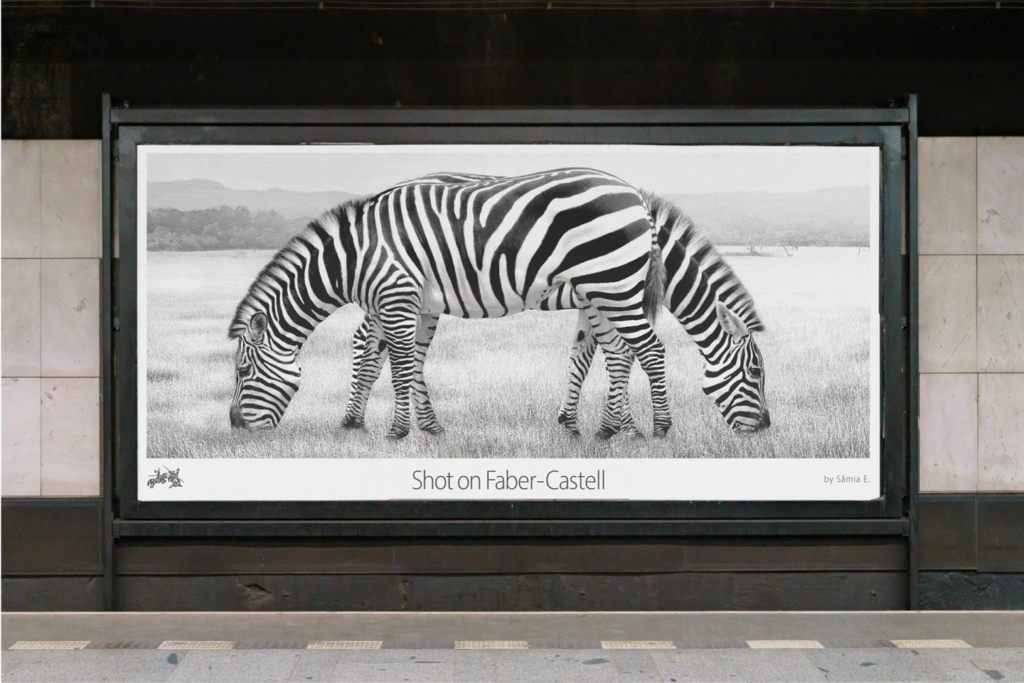
The campaign’s strategic insight was equally direct. The best proof of a pencil’s quality is not a claim, a specification, or a celebrity testimonial. It is an image so precise that no one can tell it was drawn by hand.
The Execution
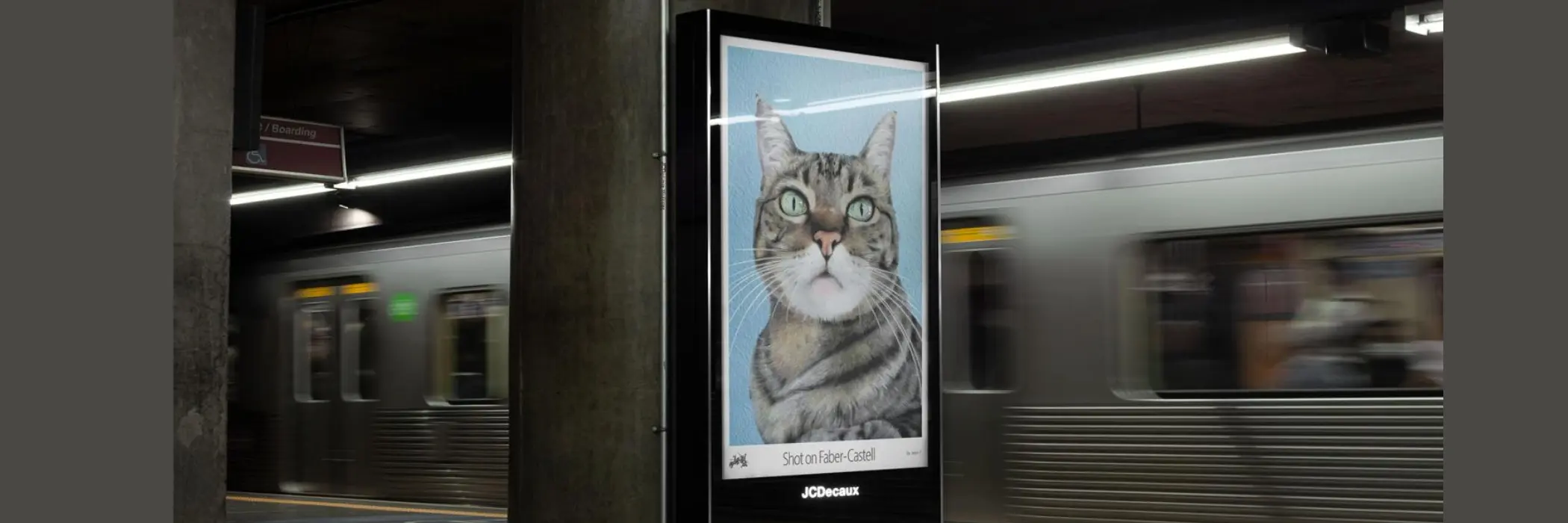
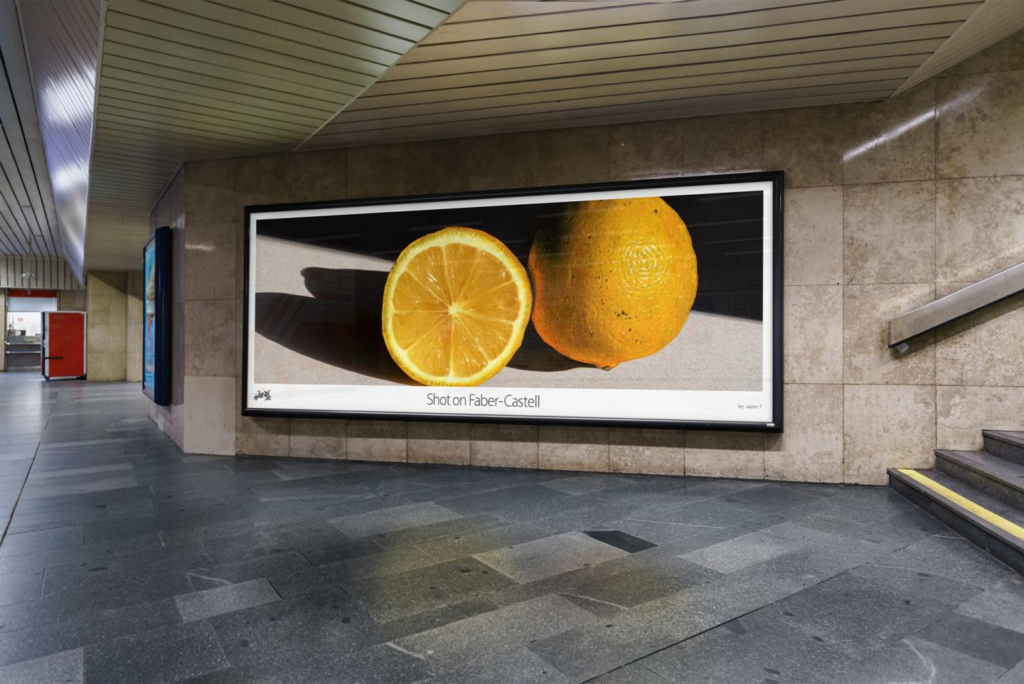
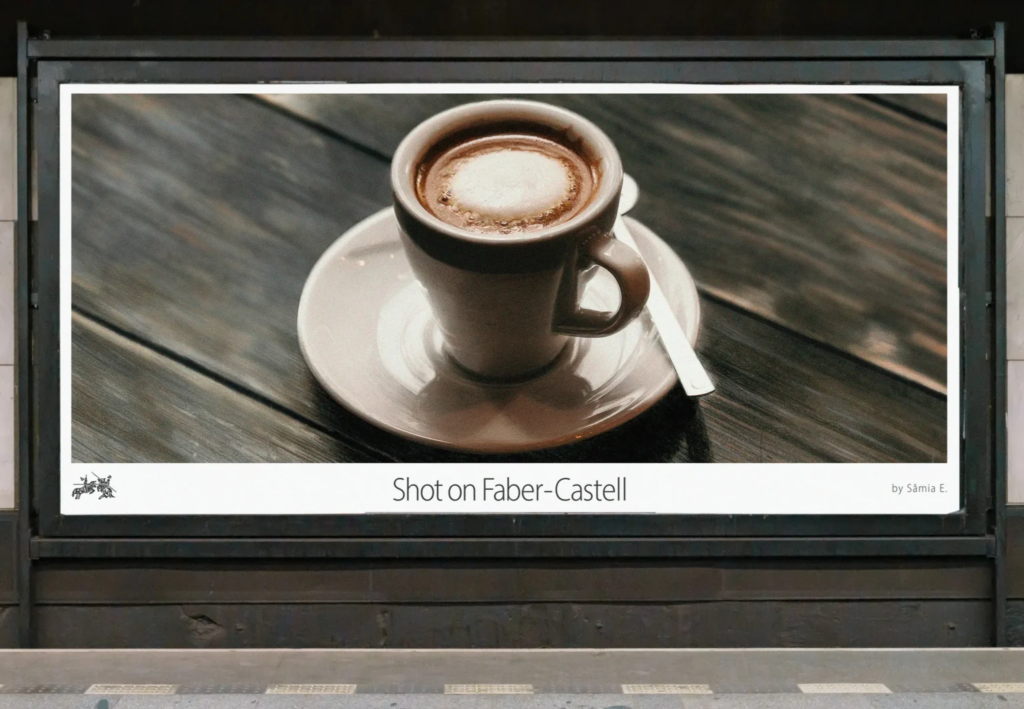
DAVID São Paulo launched “Shot on Faber-Castell” across billboards and Metro stations in São Paulo, timed shortly after Apple’s own “Shot on iPhone” campaign ran across the same outdoor locations in Brazil. The format was reproduced in exact detail: identical layout proportions, identical caption position, identical typographic treatment. The single line at the bottom read “Shot on Faber-Castell” where Apple’s version would read “Shot on iPhone.”
The images on the boards were a cat, an eye, a slice of toast, a cup of coffee, a lemon. Hyperrealistic illustrations produced by artists Sâmia Escórcio, Jader Ferrari, and Gustavo Assarian using Faber-Castell’s Supersoft line pencils. Photographed and reproduced at billboard scale, they were indistinguishable from photographs at the distance and viewing conditions of a typical outdoor placement.
The deliberate choice to retain the word “Shot” rather than substituting “Drawn” or “Illustrated” was the campaign’s central structural decision. The word “Shot” implies a camera. A commuter encountering the board had no reason to question that implication. The deception was built into the caption. The discovery moment, the realisation that every image was hand-drawn, only arrived on closer inspection or when the campaign was shared with context. The campaign reached 6,521,610 people across the São Paulo Metro network.
The Double Reveal
The campaign operates in two stages, and the second stage is the product demonstration. When a viewer first sees the board, they see what appears to be a photograph with a brand caption. Clean, familiar, credible. When they learn or notice that the image is a pencil drawing, the entire visual reclassifies. What looked like photographic precision becomes evidence of human craftsmanship. The billboard has not changed. The viewer’s understanding of what it represents has.
That reframing is not an advertising trick appended to the campaign. It is the product claim. Faber-Castell Supersoft pencils can produce images of photographic quality. The billboard proves it at scale without a single line of supporting copy. The board is the demonstration. The reveal is the argument.
What the Campaign Won
Shot on Faber-Castell picked up a Cannes Lions Silver in Outdoor 2024, a Gold at the Brazilian Creative Club in Outdoor, Gold and Silver at the London International Awards in the Billboard and Poster categories, a Clio Awards Silver for Print and Out of Home Craft, a D&AD Pencil in 2025, and a One Show shortlist. The campaign has since been entered in retrospective award cycles and continues to appear on outdoor advertising curriculum lists globally.
The One Club entry, which contains the campaign’s full brief, described its outcome: the brand managed to increase public perception that Faber-Castell pencils have a high quality standard through impressively hyperrealistic hand-made illustrations. The campaign did not require a media budget beyond the placements themselves. The image was the proof.
Why It Holds Up
The campaign borrows Apple’s visual equity without mocking it. It does not position Faber-Castell as an opponent of technology or a nostalgic alternative to smartphones. It enters the same cultural conversation about image quality that Apple has owned for a decade and makes a parallel argument: the quality of an image is a function of the tool used to create it, and a Faber-Castell pencil in skilled hands produces images that compete with a camera lens. That argument is not made in copy. It is demonstrated in the drawing, at city scale, on a billboard that reads exactly like an iPhone ad until you look closely enough to see the pencil marks.
Campaign Name: Shot on Faber-Castell
Agency Name: DAVID São Paulo
Brand Name: Faber-Castell
Location: São Paulo, Brazil (Metro stations and OOH billboards)